
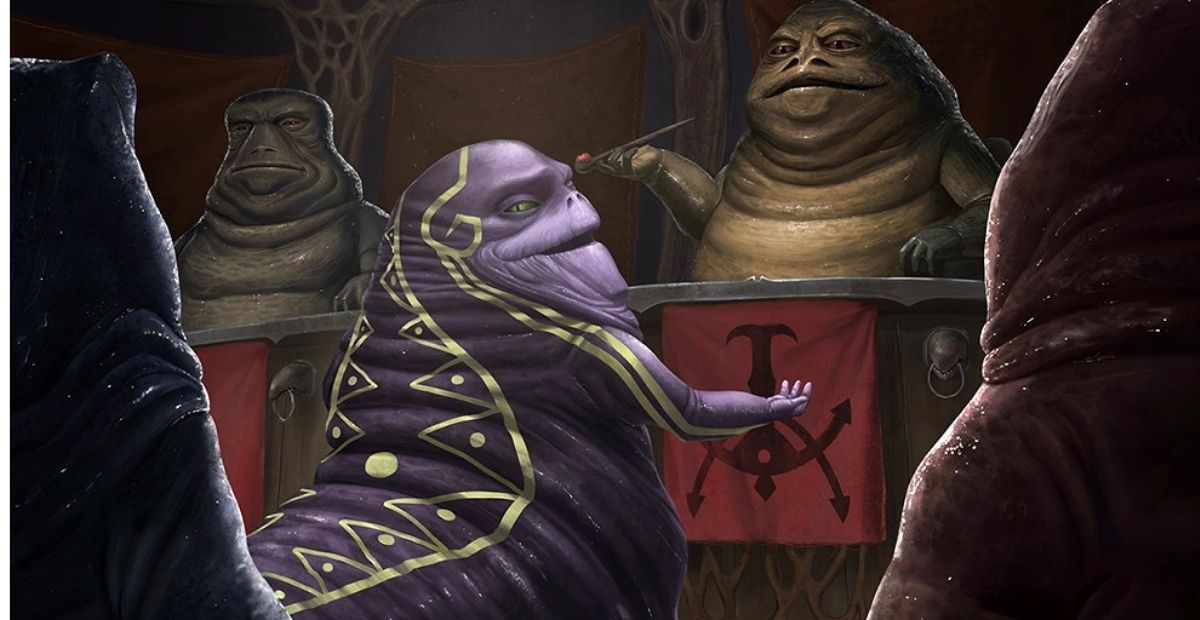
I’ve always treated the Hutts as background crime bosses—big slugs on thrones, feeding people to rancors and making threats. But when you start looking at what their clans and cartels actually do every day, it’s a lot worse than one slimy gangster on Tatooine. Slavery, spice, piracy, gunrunning, death sports, extortion—most of the really ugly stuff in the Outer Rim turns out to have a Hutt sigil stamped on it somewhere.
So what are the jobs the Hutts quietly handle every day that the rest of the galaxy just learns to live with?
Table of Contents
1. Slave Trading – The Hutts’ Oldest Business
If you strip everything else away, the Hutts are slavers first and crime lords second. Star Wars Insider #224 describes Jabba as a leader of the Hutt Clan, “a powerful criminal syndicate that used slavery and piracy to seize wealth and control.” It even singles out that trafficking Twi’leks as slaves “brought Jabba great wealth” and more power. Put together, it makes slavery look like the foundation of his kajidic, not a side crime, but the core of the business.
By the time of the Empire, that slave network is so deeply wired into the Outer Rim that it’s basically untouchable. Whole communities depend on the credits flowing out of Jabba’s operation, and everyone else is either on his payroll or afraid of ending up in chains, so nobody is really in a position to shut it down even if they want to.
2. Spice as a Daily Pipeline
If slavery is the foundation, spice is the fuel line that keeps Hutt power burning. Star Wars Insider #224 doesn’t just talk about Jabba’s slaves; it spells out how he and the Hutt Clan “used their influence to control hyperspace lanes so any smuggling of goods, illegal or otherwise, was under their control.” It then notes that “the spice trade… brought Jabba great wealth and even more power.” That’s basically a canon way of saying the Hutts run their own galactic drug cartel out of the Outer Rim.

Day to day, that means the Hutts control production, shipping, and distribution. Miners, freighter captains, smugglers, and street dealers all end up answering to some kajidic higher up the chain. Lawful governments only ever see pieces of it, a freighter seized here, a busted shipment there—but the routes themselves are mapped, taxed, and protected by the Hutts. And because so many worlds in the Rim rely on the credits and jobs that flow from those spice runs, almost nobody is willing to pull the plug completely, even when they know exactly who’s getting rich off other people’s addiction.
3. Owning the Smuggling Lanes
Once you add spice and slaves together, the next step is obvious: you need shipping. The Hutts don’t just hire the occasional smuggler—they build whole smuggling corridors and then act like they own every lane that crosses their territory. Star Wars Insider #224 spells out that Jabba and the Hutt Clan used their influence to control key hyperspace lanes so that any smuggling of goods, illegal or otherwise, passed through their hands. That turns them from local gangsters into gatekeepers for entire trade routes.
We actually see the fallout from that in the movies. In A New Hope, Han admits he had to dump a spice shipment when the Empire boarded his ship, and the whole reason he’s running from Jabba is because that lost cargo belonged to a Hutt-controlled operation. His life is basically what it looks like when you cross their shipping business—every bounty hunter in the Outer Rim suddenly knows your name.

Day to day, that means the Hutts control who moves what, where, and for how much. Freighter captains, pirates, and small-time smugglers all end up answering to some kajidic higher up the chain. If a job goes wrong, the captain gets a price on their head. If it goes right, the Hutts take the biggest cut and quietly tighten their grip on another route. And because a lot of Outer Rim worlds depend on the credits and cargo that come through those lanes, most governments decide it’s easier to tolerate Hutt control than try to blow the whole system up.
4. The Hutts Turn Whole Worlds into Safe Havens for Criminals
One of the nastiest things the Hutts do on a daily basis isn’t just running individual crimes, it’s running the places where crime can breathe. In Heir to the Jedi, when Luke and Nakari plan their route to Omereth, they have two options: fly north through more Imperial worlds, or cut south and “traverse Hutt Space and avoid the Empire while risking who knew what in the seedy side of the galaxy.” Luke immediately notes that “one thing was more likely near Hutt Space: bounty hunters.” That’s the reputation Hutt territory has in canon: it’s where you go to slip out from under Imperial control, and where the galaxy’s criminals, hunters, and smugglers can operate with a lot more freedom than they’d ever get under direct Imperial rule.
And that’s the real problem: you can’t shut this down without going straight through the Hutts themselves. Cleaning up Hutt Space would mean sending fleets into worlds that aren’t officially Imperial territory, tearing up economies that depend on Hutt money, and trying to replace an entire criminal infrastructure overnight. No one wants to pay that price, so those worlds stay exactly what they are—safe harbors for criminals, as long as the Hutts keep getting their cut.
5. Killing for the Crowd
If you only know one thing about Jabba, it’s probably the trapdoor.
In Return of the Jedi, the whole palace is set up so a bad joke or a bored gesture can drop someone straight into the rancor pit. We watch it happen twice: first with Oola, who’s fed to the beast for daring to pull away from Jabba, and then with Luke, who’s thrown in as a show for the whole court. Both are played the same way—music stops, everyone gathers at the rail, and a living person becomes part of the floor show.

When that fails to kill Luke, Jabba just escalates to a bigger venue: the Great Pit of Carkoon and the Sarlacc, with a full barge of guests watching the execution from the deck like it’s a sporting event.
And because this is happening on Hutt turf, nobody steps in. There’s no local law that outranks Jabba, and the Empire is happy to let him run Tatooine his way as long as the credits and raw materials keep moving. So the rancor pit and the Sarlacc barge stay in business, and everyone nearby just learns the rule: if a Hutt gets bored, somebody dies for the crowd.
6. Death Sports Built to Profit
With the Hutts, almost nothing is just “for fun,” and that includes podracing. On Tatooine, Jabba isn’t only there to watch the Mos Espa Grand Arena. He’s the one backing the races and running the gambling and concessions around them, so every podrace is really a Hutt business operation with engines and explosions on top.
In Legends material and the RPG book Lords of Nal Hutta, Jabba doesn’t stop when podracing is outlawed. The book talks about him shifting that same energy into underground combat events and destructive “vehicle games,” where souped-up speeders and walkers tear each other apart in front of a paying crowd. The format changes, but the structure doesn’t: high danger on the track, betting all around it, and a Hutt taking a cut from every pot.
Lords of Nal Hutta also leans into what Hutt worlds look like around those events: districts packed with casinos, betting parlors, and fight pits, all built to keep visitors gambling, drinking, and spending until they’re broke or in debt to a kajidic. It’s less “night out” and more a machine designed to strip credits.
7. They Run the Galaxy’s Biggest Black Markets
If there’s something you’re not supposed to buy, chances are someone in Hutt space is selling it. Nar Shaddaa is the clearest example. The “Smuggler’s Moon” is a vertical sprawl of docks, alleys, and towers ruled by Hutt crime lords, with whole districts given over to stalls and back rooms trading in stolen cargo, unregistered weapons, sliced droids, spice, and trafficked beings—all as long as a kajidic gets its cut.
One Hutt source on their economics describes the black market as basically perfect for them: they get to make their own rules, and then use the very laws they’re breaking as an excuse to charge more. The riskier the trade looks and the tighter the local government tries to clamp down, the higher the prices the Hutts can demand. It’s a business model built on scarcity, fear, and desperation.

Even newer material like Star Wars Outlaws leans into that idea. The Hutt Cartel has its own district and its own droid black market, and the whole area is presented as a place where you can pick up gear and tech you’d never find in a legal shop—as long as you’re willing to owe the Cartel afterward.
8. Weapons for Anyone Who Can Pay
Arms dealing sits right alongside slavery and spice in Jabba’s business model. His profile lays it out clearly: over time his criminal empire grew to include slavery, arms dealing, spice smuggling, and gambling as its main sources of income.
Books like Lords of Nal Hutta fill in the gaps. Hutt ports and safe worlds are where crates of “misplaced” military blasters, heavy rifles, and ship weapons are moved off the record—bought cheap from corrupt officers, stripped from captured freighters, or diverted from official shipments, then sold on through smugglers and black-market stalls. If a gang, militia, or local warlord needs guns with no questions asked, they go through Hutt channels.