
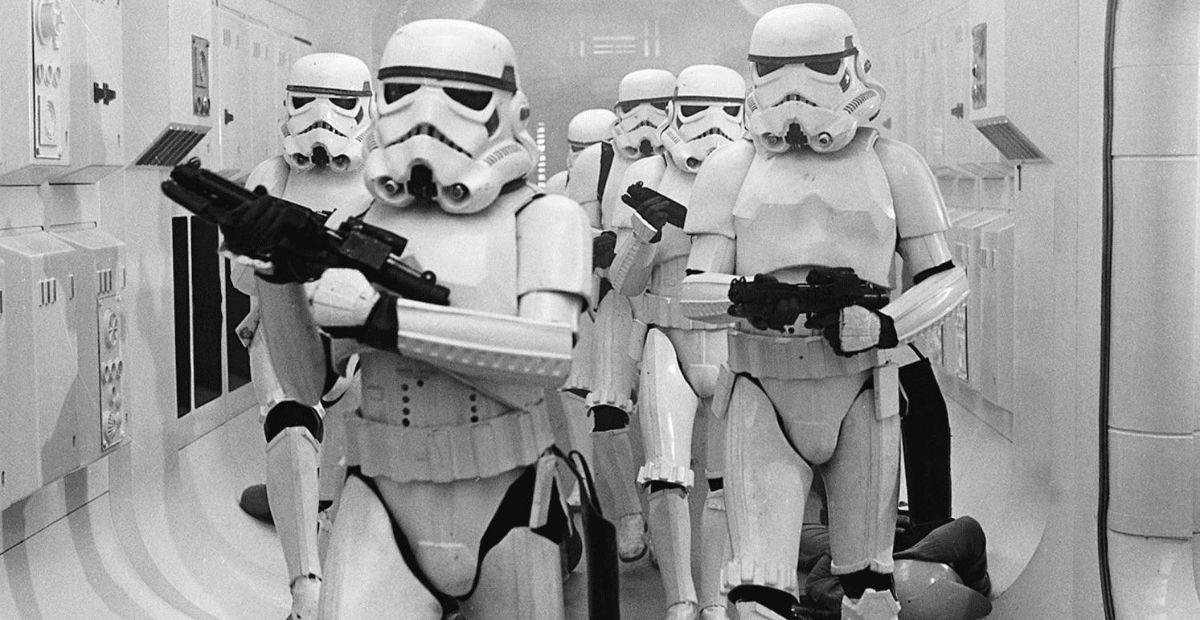
In the Star Wars films, we usually see stormtroopers portrayed as ineffective. Their marksmanship looks poor, their tactics are sloppy, and they’re often defeated by Rebels and even the Ewoks. On screen, they rarely come across as elite soldiers.
But elsewhere in Star Wars lore, we’re told something very different. Stormtroopers are described as some of the Empire’s best troops. In Star Wars: A New Hope, Obi-Wan Kenobi immediately recognizes the precision of an attack and tells Luke it could only have been done by stormtroopers. That moment treats them as professionals, not incompetents.
So which version is the real one? Are stormtroopers meant to be dangerous, well-trained soldiers—or are they really as ineffective as their on-screen reputation suggests?
Stormtroopers Are Meant to Be Effective Soldiers
One of the clearest portrayals of stormtroopers as competent soldiers comes from Allegiance by Timothy Zahn. In the novel, we follow a small group of stormtroopers operating independently, making tactical decisions under pressure rather than blindly following orders.
During a confrontation involving an AT-ST walker, the Imperials face a situation where a direct assault would get civilians killed. The solution isn’t brute force or hesitation—it’s precision. The squad sets up a sniper position with the understanding that the trooper will get one shot. If it fails, the walker will simply turn and obliterate the building and everyone inside it.
That shot succeeds.
The sniper places his fire exactly where it needs to go, disabling the walker without endangering civilians nearby. The scene isn’t framed as luck or desperation. It’s treated as the expected result of training, coordination, and discipline. The stormtroopers communicate clearly, move with purpose, and execute the plan without panic.
The novel also gives us direct insight into why they’re capable of this. Zahn repeatedly emphasizes the level of training stormtroopers undergo. At one point, the narration makes it explicit: LaRone is described as an Imperial stormtrooper “ruthlessly trained in the arts of combat and survival,” with reflexes so deeply ingrained that they act before conscious thought. When threatened, his body responds instantly, disarming an opponent without hesitation.

So Why Do Stormtroopers Seem So Ineffective in the Movies?
What we see from stormtroopers on screen often contradicts how they’re described elsewhere in Star Wars lore. In the films, they frequently miss obvious shots and fail to stop small groups of Rebels, especially when main characters are involved.
A clear example comes from Star Wars: A New Hope. During the escape from the Death Star, stormtroopers repeatedly fire at Luke, Han, and Leia at close range without landing a decisive hit. On the surface, it looks like incompetence. But the story itself gives us an explanation: the Empire wants the heroes to escape so they can track them back to the Rebel base. The stormtroopers aren’t failing—they’re being allowed to miss.
That pattern shows up repeatedly. When stormtroopers are directly opposing named heroes, their effectiveness drops because the story requires those characters to survive. If stormtroopers performed at full efficiency in those moments, the film would end very quickly.
When the focus shifts away from plot-protected characters, the portrayal changes. In Andor, stormtroopers are far more threatening, especially in the final arc, where their presence feels oppressive and dangerous rather than disposable.

The difference isn’t training or ability—it’s context. Stormtroopers look ineffective when the story centers on heroes who can’t be killed yet. When that protection is removed, they behave much closer to how the lore describes them: disciplined, organized, and dangerous.