

We all know Order 66, the day the clones turned on their Jedi generals and everything fell apart. But what if I told you there were other orders? Ones that never made it into the movies.
Hidden in the same list was Order 37, a command the Republic hoped it would never have to use. Most fans haven’t even heard of it, and for good reason.
Because once you learn what it allowed the clones to do, you’ll see that Order 66 wasn’t the worst thing in their programming.
What Order 37 Actually Was
Order 37 was one of the Republic’s secret contingency orders that survived into the early Empire, a command that gave military leaders the right to lock down entire cities, arrest civilians in mass numbers, and execute hostages if a fugitive refused to surrender. It was a system of collective punishment, meant to make fear do the work that troops couldn’t.
In The Last of the Jedi: The Desperate Mission, the Empire enforces Order 37 on Bellassa to capture Ferus Olin, a former Jedi who was helping the local resistance. The order wasn’t designed for open warfare, it was designed to make examples out of populations, to break their will.
When Obi-Wan Kenobi sliced into Imperial records, he found the horrifying details:
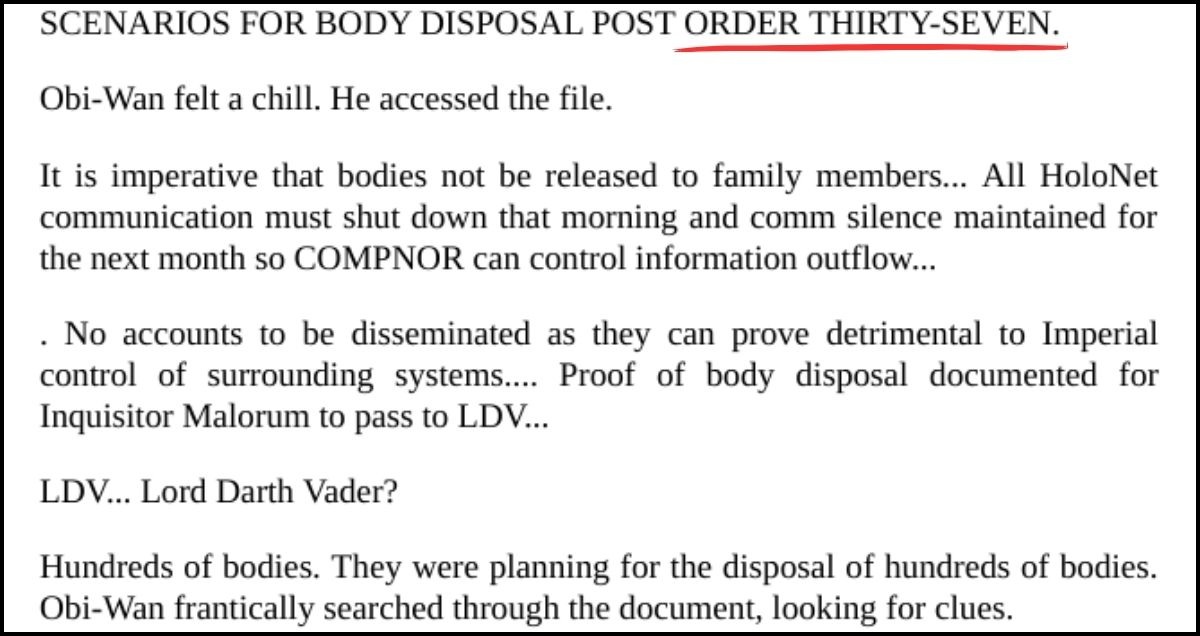
“It is imperative that bodies not be released to family members… All HoloNet communication must shut down that morning and comm silence maintained for the next month so COMPNOR can control information outflow… No accounts to be disseminated as they can prove detrimental to Imperial control of surrounding systems… Proof of body disposal documented for Inquisitor Malorum to pass to LDV.”
In short, Order 37 punished everyone for the crimes of one person.
Why Order 37 Was Even Worse Than Order 66
Order 66 was horrifying, but at least it had a clear target, the Jedi. The clones were programmed to believe the Jedi had betrayed the Republic, and their orders were to eliminate them, not civilians. Order 37, however, was something far darker. It didn’t just target traitors or enemies of the Empire; it targeted everyone.
Where Order 66 was about destroying an institution, Order 37 was about controlling a population through fear. It gave Imperial commanders permission to turn entire cities into prisons, using innocent people as leverage. If a fugitive refused to surrender, their friends, family, and even strangers could be rounded up, executed, and quietly disposed of, their bodies hidden, their stories erased.
From a military standpoint, it was brutally efficient. The Empire didn’t need to chase every dissident; fear did that for them. The moment someone heard about a mass arrest or a silent neighborhood disappearing overnight, they learned to stay quiet, to comply, to never question Imperial authority. Order 37 didn’t just kill people, it killed trust, community, and hope.
That’s why it’s remembered as one of the cruelest policies in Imperial history. It showed that after Order 66, Palpatine no longer needed clone troopers to wipe out his enemies. All he needed was a system that made ordinary citizens too terrified to resist.