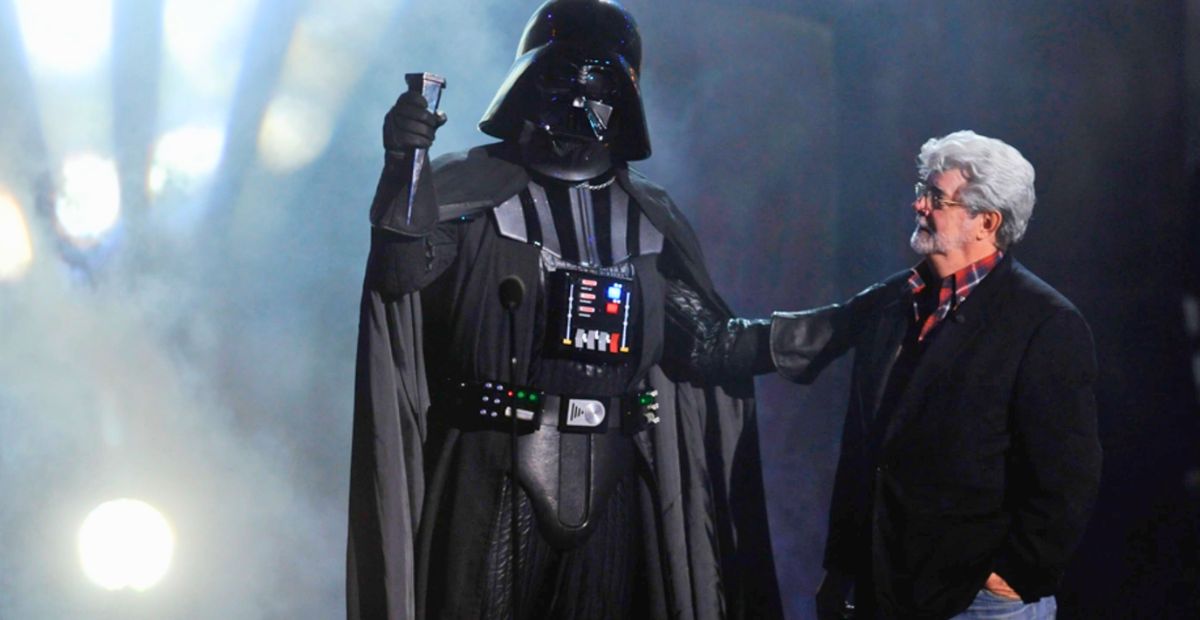
A lot of Star Wars fans connect with Darth Vader before they are even old enough to fully understand him. He is clearly one of the saga’s villains, yet he is also one of the most loved characters in the entire franchise. George Lucas had his own explanation for that, and it is a lot more interesting than just saying Vader looks cool.
In a 1999 interview with Bill Moyers, Lucas said, “Children love power because children are the powerless. And so their fantasies all center on having power. And who’s more powerful than Darth Vader?” That idea gets right to the center of why Vader connects so strongly with younger audiences. It is not necessarily that kids are drawn to evil. It is that Vader represents the kind of absolute power children naturally fantasize about when they spend most of their lives with very little power of their own.
Lucas Thought Kids Saw Vader as Pure Power

Lucas’s theory starts with something simple. Children live in a world where adults make the decisions, set the rules, and control nearly everything around them. From that point of view, a character like Darth Vader becomes easy to understand. He walks into a room and instantly controls it. He commands soldiers, terrifies enemies, and rarely looks vulnerable. Even before a child can fully process the morality of the character, they can understand what he represents: power, authority, and the ability to impose your will on the world.
That also helps explain why Vader’s appeal goes beyond just being scary. He is not like a monster who lashes out randomly. He feels controlled, certain, and unstoppable. For a child, that can be even more fascinating than simple heroism. Luke Skywalker has to struggle, learn, and fail. Vader already seems complete. He is the finished version of power, and that makes him easier to latch onto at a glance.
That idea also lines up with the way kids latch onto superheroes. One of their favorite things to argue about is which hero would win in a fight, because so much of that imagination centers on strength, control, and the ability to overpower everyone else. Vader taps into that same instinct. He is not a superhero, but he carries the same kind of larger-than-life presence, the kind that immediately reads as the strongest person in the room.
Lucas also pointed out that the reveal of Vader as Luke’s father makes that image even more powerful. For a child, a father can feel like the closest thing to ultimate strength and authority in everyday life. Turning the saga’s most overwhelming figure into Luke’s father only reinforces the sense that Vader is not just powerful, but the highest form of power a child can imagine. At the same time, Lucas never wrote that strength as something noble. Star Wars presents it as frightening, both in the violence Vader can inflict and in the way that power has twisted him into something tragic.
For Lucas, Vader Was Ultimately Redeemed by His Children
That is what makes Lucas’s view of Vader more interesting than just “kids love powerful villains.” He understood why children would be drawn to Vader’s strength, but he never saw that strength as the final point of the character. In Lucas’s own words, “ultimately Vader is redeemed by his children,” and he ties that directly to his belief that having children can bring out the best in a person.
That changes the way Vader works in the story. On the surface, he looks like the ultimate symbol of fear and control, the kind of figure children might be fascinated by because he seems to have absolute power. But Lucas’s larger idea is that power is not what saves Vader in the end. What reaches him is the one part of himself the dark side never fully destroyed: his connection to his children. Luke is the one who forces Vader back into contact with the person he used to be, and that is why his redemption comes through family rather than through strength.