
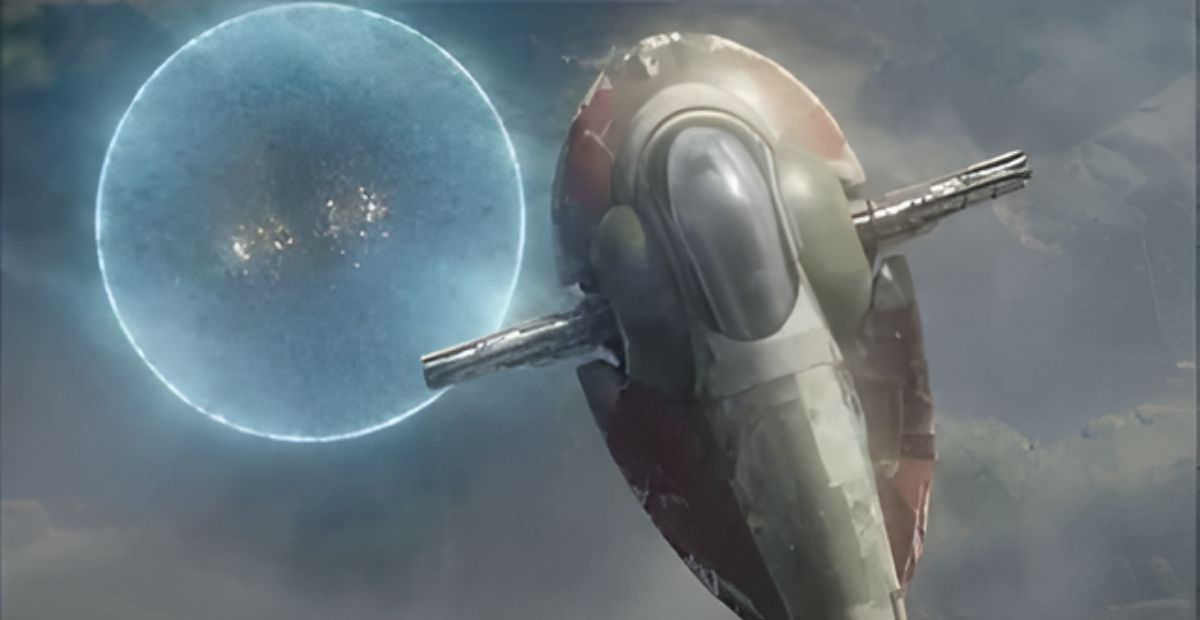
When Jango drops a seismic charge in Attack of the Clones, most of us just sit there and enjoy it. Slave I flies low through the asteroid field, a flat disc falls out the back, there’s a brief pause, and then a blue wave snaps out and slices rocks clean in half while Obi-Wan tries not to die. It’s one of the coolest weapons in the prequels.
But if you stop and think about it, a question pops up: this thing goes off in open space, we clearly hear it, and it’s even called a “seismic” charge—so how is any of that supposed to work in a vacuum where sound can’t travel?
Table of Contents
How Did Seismic Charges Actually Work?
The Star Wars databank description calls seismic charges “devastating weapons that drew sound in from their immediate vicinity and exploded in concussive waves of brilliant blue light, shattering everything in [their] wake.” That sounds dramatic, but we can break it down into something a bit more readable.
When Jango drops one from Slave I over Geonosis, it falls as a flat disc and just hangs there for a second. Inside the casing is the charge core, the component that actually holds the explosive payload and the systems that shape the blast. That’s the part that stores up the energy we see released a moment later. The “drawing sound in” line matches what we see on screen — everything goes unnaturally quiet right before it goes off, like the whole scene is being pulled tight.

Then the charge detonates, and instead of a normal round explosion, all that stored energy is dumped into a single, flat concussive wave. That’s the blue sheet we see snap outward. It doesn’t expand as a sphere; it cuts across space in one plane. Anything that happens to sit in that plane—asteroids, rock, or a starfighter that picked the wrong path—gets hit by a sudden, violent pressure jump and basically shears in half. The asteroids don’t burn, they just fail along that slice.
Why Do Seismic Charges Make That Sound in Space?
The sound of the seismic charge isn’t just some random “cool explosion.” It comes straight from Ben Burtt, the longtime Star Wars sound designer behind lightsabers, TIE screams, and blaster shots. In a Q&A on FilmSound.org titled “Ben Burtt answers questions about sound design of Star Wars” and later in Star Wars Insider, Burtt talks about the idea he’d been chasing for years: what he calls an “audio black hole.”
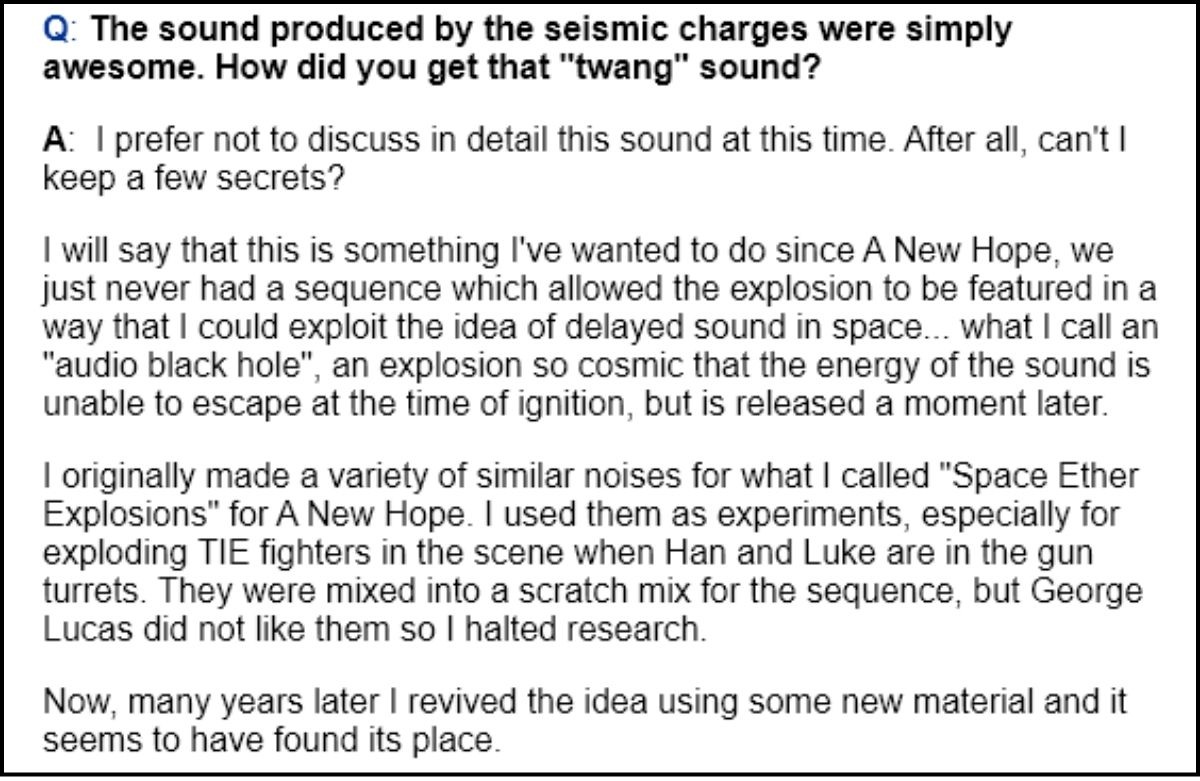
In his own words, he wanted an explosion “so cosmic that the energy of the sound is unable to escape at the time of ignition, but is released a moment later.” That’s exactly what we hear in episode II: the charge drops, everything goes silent for a beat, and only then does that sharp metallic bwamm hit.
Burtt explains that he first tried this back on A New Hope, when he created a series of strange “space ether explosions” because he felt that space battles shouldn’t sound like ordinary Earth explosions. He experimented with them on the TIE fighter turret sequence, mixing in those odd blasts, but George Lucas didn’t like the result and other people thought they sounded “too crazy and weird.” The idea was shelved, and the sounds sat in Burtt’s personal archive for decades.
By the time Attack was in production, sound technology had improved and Lucas finally gave him a sequence that could hang on one big, distinctive effect: Jango dropping seismic charges in an asteroid field. Burtt pulled out his old “space ether” experiments, rebuilt them with modern tools, and attached them to that shot.
In a Slashfilm retrospective on the sound, they quote Burtt explaining why the silence is so important. He says that if you take all the sound away for a moment, people are left with an unsatisfied expectation, and then you hit them with the blast:
“If you have no sound for a moment, people are left with an unsatisfied expectation, and then you surprise them with the sound. That’s what I called an audio black hole. The explosion seems much bigger because there’s been this silence.”
Conclusion
At the end of the day, a seismic charge is two different things at once. In-universe, it’s a shaped explosive with a charge core that dumps its energy into a flat concussive wave, sharp enough to slice asteroids in half. Out in the real world, that silence and that impossible bwamm exist for one reason: Ben Burtt wanted a moment that would punch straight through the audience.
Space doesn’t carry sound, and the movies know it. They just don’t care. Star Wars has always treated space like a stage, not a vacuum, and the seismic charge is one of the clearest examples of that. The weapon’s “how it works” is there for the lore. The sound is there so that, every time Jango drops one of those discs, we all stop what we’re doing and feel it.