
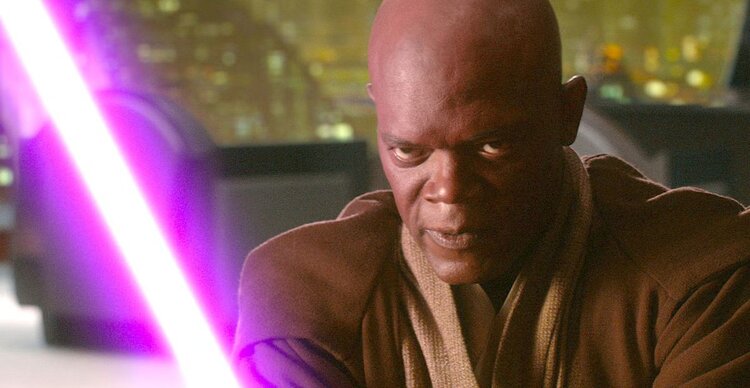
Most of us meet Mace Windu when he’s already sitting on the Jedi High Council, a purple lightsaber at his side and a reputation as the Order’s champion. By the time he appears in The Phantom Menace, he looks like someone who’s always been a Jedi, calm, disciplined, completely at home in the Council chamber.
But Mace Windu: The Glass Abyss finally pulls back the curtain a little. It shows us his life on Haruun Kal, the moment he lost his parents, and the strange little ritual where his entire tribe watched to see which path the child would choose. It also shows an older Mace looking back and asking a hard question: did the Jedi choose him, or did he choose them?
Mace Windu’s Past Life on Haruun Kal
Long before he was a Council member, Mace Windu was just a child on Haruun Kal.
In The Glass Abyss, we see that his parents lived in a small community close to the jungle. One day they take their infant son out to a clearing they love, and everything goes wrong. A pack of garu-bears attacks. Mace’s father grabs a spear and tries to hold the creatures off. His mother climbs a thorn-tree with Mace, ties him into the branches so he won’t fall, and then climbs back down to help her partner. Both parents die fighting to protect him.
By the time the other villagers arrive and kill the beast, Mace is still in the tree, watching. The adults expect a child screaming or sobbing. Instead, he’s silent. He doesn’t cry, doesn’t thrash, doesn’t look away from the bodies. It’s like he’s retreated somewhere deep inside himself. The warriors are more unsettled by that calm stare than by the garu-bear.
After the attack, his community takes him in. Life doesn’t just “go back to normal,” though. Word spreads about the orphaned boy who never cried, and eventually offworld visitors arrive, Jedi Knights who’ve come “from the stars” and immediately sense there’s something different about him. They tell the tribe that this child is strong in the Force, that his path might lie far away from Haruun Kal, and that he could be trained as one of them.
The elders don’t want to simply hand him over. They know they can raise him and love him, but they also accept what the Jedi are saying: this boy is not ordinary, and his life may always be pulled toward something bigger than the village. So they gather everyone in the community hall and decide the choice has to be made in front of his people, not just in some off world report.
That’s where the ritual comes in. They sit little Mace on a woven mat and place three objects around him in a triangle: a piece of lush fruit, a pyramidal puzzle toy, and a lightsaber shell borrowed from the Jedi, with one of the Knights standing silently behind it. The Grand Elder tells him, even though he’s barely old enough to crawl, that this is the moment where he chooses his fate.
From there, you get the scene we already talked about: he crawls toward the food, pauses near the puzzle, then leaves both behind and reaches for the empty lightsaber hilt, grabbing it like he already understands what it means. The Elder simply says, “It is done. The child has chosen.”
Windu’s Early Years in the Jedi Order
Once the Grand Elder says “The child has chosen,” Mace’s life shifts from the jungle of Haruun Kal to the stone corridors of the Jedi Temple.
In The Glass Abyss, the Temple is described not as some distant holy place, but simply as home. By the time of the prequels, Coruscant’s Jedi Temple is “the only home he had ever known.” For Mace, there is no memory of growing up anywhere else. Whatever childhood he might have had on Haruun Kal ends with that choosing ritual. Everything after that happens under the Temple’s spires.
The book walks us through the place the way Mace sees it as an adult: towering ziggurat, pale stone, gardens, training halls, archives. But buried in that description is one of his earliest happy memories. As he passes the training grounds, he remembers the first time a young Mace Windu beat one of his Jedi instructors in a duel. The instructor is T’ra Saa, and he can still picture the look on her face—“astonishment, surprise, and genuine respect.” His fellow Jedi don’t resent him for it; there’s “no envy or jealousy. Just ‘Welcome, brother.’”
That’s our clearest glimpse of him as a Temple kid: not just a prodigy swinging a blade, but someone who’s learning that excellence is allowed, that the Order will embrace him when he shines instead of pushing him down. For an orphan who watched his parents die and then left his planet behind, that sense of being welcomed as “brother” matters.