
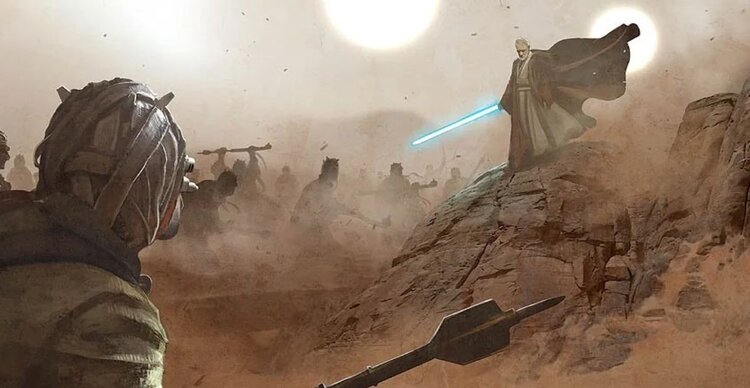
Among the Jedi, Obi-Wan Kenobi is often seen as the one who would never fall to the dark side. His dedication to the light, even after the collapse of the Jedi Order, makes him feel unshakable — a Jedi who endures without compromise.
But during his early exile on Tatooine, while waiting for the future to unfold, Obi-Wan Kenobi comes dangerously close to abandoning everything the Jedi taught him. Not for power, and not for control — but for revenge. In The Last One Standing, Obi-Wan briefly feels the pull of striking back at Emperor Palpatine, for what was done to the Jedi Order and to Anakin Skywalker.
Table of Contents
Haunted by His Failure
In the short story The Last One Standing, we see Obi-Wan Kenobi during the earliest days of his exile on Tatooine. This isn’t the calm, resolved guardian we later meet. This is Obi-Wan at his most haunted. In his own mind, he believes he failed the galaxy — that the Sith rose because of him, and that Anakin Skywalker was lost because he did not see the warning signs in time.
That failure becomes an endless loop in his thoughts. As the story describes it, “Every day and every night he violated every principle the Jedi had taught him about staying in the present moment, about acceptance. Going over every argument, every talk, to find the key that he should have turned in order to unlock the secrets of Anakin’s heart.”
Obi-Wan can’t stop asking himself the same questions. “Why had he turned to the dark side? When did it happen? The Anakin he knew and loved couldn’t have done it.” He knows that understanding the answers won’t change the outcome, yet he’s unable to let it go, replaying every moment again and again — “the chances he’d missed, the things he’d seen, the things he hadn’t.”
Not long after those thoughts, Obi-Wan’s isolation is broken by a very real problem. Owen Lars arrives with news that cuts through Obi-Wan’s self-reflection. Tusken Raiders have struck nearby farms. Vaporators have been destroyed, equipment stolen, and the threat isn’t abstract, it’s already at their doorstep.
Owen is frustrated, scared, and practical. He wants the damage fixed and the danger stopped, but he doesn’t want a war. Beru argues for caution, for survival. Obi-Wan listens quietly, knowing exactly what the Sand People are capable of — and also knowing how easily fear can spiral into bloodshed.
Still, he can’t ignore what’s happening. Not because he’s a Jedi looking for purpose, but because people will suffer if he does nothing.
That night, Obi-Wan tracks the Tusken Raiders alone. He moves carefully, deliberately avoiding unnecessary violence, retrieving stolen vaporators rather than striking back blindly. Even in combat, he restrains himself. When he fights, it’s controlled, efficient, and defensive, not the release of anger he’s been wrestling with internally.
Obi-Wan Would Fall to the Dark Side for Anakin
Tracking the Tusken Raiders forces Obi-Wan to confront more than stolen equipment. As he moves through the desert, the anger he has been holding back finally surfaces. This isn’t rage for himself, or even for the Lars family. It’s anger for Anakin — for everything that was taken from him, and for the life that was twisted into something unrecognizable.
For a brief moment, Obi-Wan allows himself to imagine vengeance. Not as cruelty, but as justice. He thinks about what it would mean to make someone pay, to exact a price for the suffering Anakin endured and for the destruction of the Jedi Order. In his mind, the thought feels almost righteous.
It was so clouded that Obi-Wan believe he would revenge for Anakin to fall into the darkness and slaughter every single Tusken Raiders.

As the book shows us “He could do this for Anakin. His Padawan was dead, his brother, his son, his friend. He could give him this. A fearsome anger unleashed. Vengeance. Vengeance against beings in the world with so much darkness inside them that life meant nothing to them. They swallowed life and hope. That was what the Sith counted on, beings like these.
He stopped. His stillness intrigued them. He held his lightsaber in a way that any Jedi would recognize as the beginning of aggression. He had no hesitation, no doubt that he could vanquish them all, destroy this camp and destroy every breath of life in it.
He felt his anger rise, and he took pleasure in it. It was growing inside him and obliterating everything else. He wanted to be overtaken. He didn’t want to be careful. He wanted only the white heat of satisfaction.”
Qui-Gon’s Voice Pulls Obi-Wan Back
In a brief moment, Obi-Wan almost loses himself. And in that same instant, the memory of Qui-Gon returns. Obi-Wan hears his master’s voice: “Do not become your enemy.”
At first, Obi-Wan tries to ignore it. He doesn’t want guidance, he wants revenge. But the memory is too strong to push away. He remembers Qui-Gon, and the way his master connected to the living Force.
Qui-Gon had always taught him that the Force was not something to dominate, but something to listen to. In that moment, Obi-Wan realizes that acting on rage won’t bring clarity, it will only narrow his vision.
The temptation doesn’t disappear. The anger is still there, sharp and immediate. But it no longer feels righteous. Obi-Wan recognizes it for what it is: vengeance disguising itself as justice.
So he stops.
Obi-Wan reins himself in and lowers his lightsaber. Standing in the middle of the Tusken camp, he chooses not to slaughter them. Instead, he turns their own customs against them, striking with precision rather than fury. He targets belts and wrappings, tearing away the cloth that conceals them.

Among the Tusken Raiders, exposure is a fate worse than death. To be revealed is to be shamed, stripped of identity and honor. Obi-Wan understands that, and he uses it deliberately.
It is force without vengeance. Victory without surrendering to anger. And when it’s over, Obi-Wan walks away, still burdened by loss, but no longer standing on the edge of the dark side.