
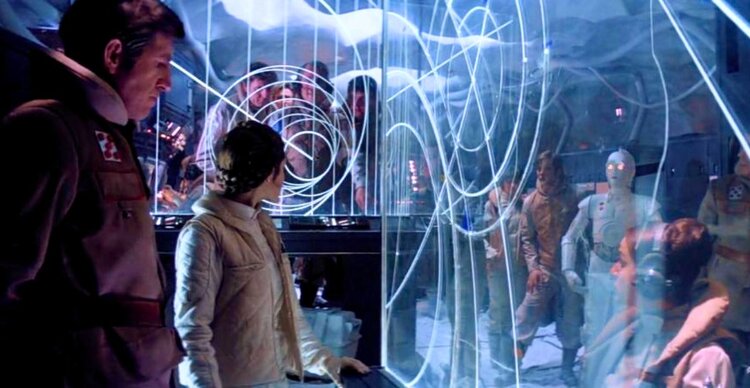
In The Empire Strikes Back, there’s this one piece of Rebel tech that always makes people pause: the glowing glass panels in Echo Base’s command center. Han and Leia stand in front of them, bright lines and circles criss-crossing the surface while officers bark orders in the background. They don’t look like normal holo projectors, and they don’t look like regular computer screens either.
So what are they supposed to be in-universe—and were they based on anything real?
Tactical Screens, Not Holograms
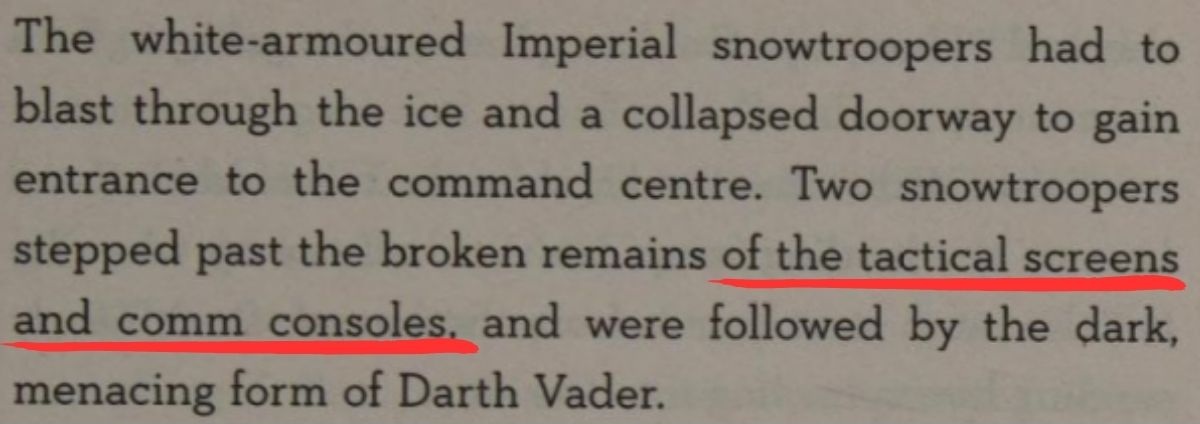
In Legends, we actually get a name for them. The Empire Strikes Back junior novelization describes Imperial snowtroopers blasting into the command center near the end of the battle and stepping over the wreckage of the equipment. In that scene, the book mentions “the broken remains of the tactical screens and comm consoles,” which tells us exactly how they were intended to function: they’re part of Echo Base’s battlefield command setup, not decorative glass or random lighting.
The way they’re staged in the movie backs that up. Every time we see one of these panels, it’s parked right next to communications and sensor stations. When the Imperial probe droid is detected, the comms operator has one beside him as he reports in.
During the evacuation, Toryn Farr—explicitly identified as a communications officer—is seated directly in front of another. Elsewhere in the base, there’s a quick shot of someone literally drawing on one of the boards, updating the lines by hand. Taken together, they’re not background art pieces; they’re working displays that Echo Base staff use to track what’s happening outside.
So rather than holograms, the best way to think of them is as live tactical maps. They show the current situation around Hoth as readouts come in from sensors and patrols, and the officers in the command center mark and re-mark those paths as new information arrives.
Radar and War Maps in a Star Wars Skin
If the design feels oddly familiar, it’s because it’s very close to how real-world navies used to plot information before digital displays took over. On World War II and Cold War–era ships, combat information centers used large transparent boards, and operators would stand behind them with grease pencils, copying what they saw on radar and sonar scopes. From the commander’s side of the glass, the marks formed a live map of nearby ships, aircraft, and threats. It was a way to turn a scatter of blips and numbers into something visual that the whole room could read at a glance.

Echo Base’s tactical screens are basically that idea run through a Star Wars filter. The bright straight lines and angled paths read like flight or patrol routes. The circles look like sensor ranges or predicted positions a short time into the future.
The fact that we can see people physically changing the markings tells us they’re meant to be constantly updated as new contacts are found, walkers advance, or snowspeeders redeploy. Functionally, they sit halfway between a radar plot and a status board, the sort of thing you’d expect in any military command bunker—just with glowing graphics instead of chalk and pencil.
So if someone asks whether they’re “holograms,” the honest answer is no. They’re not volumetric 3D holo like the Dejarik table or the Death Star briefing sphere. They’re flat tactical displays: transparent boards that show trajectories, ranges, and live intel in a way the Rebel command team can read quickly.