
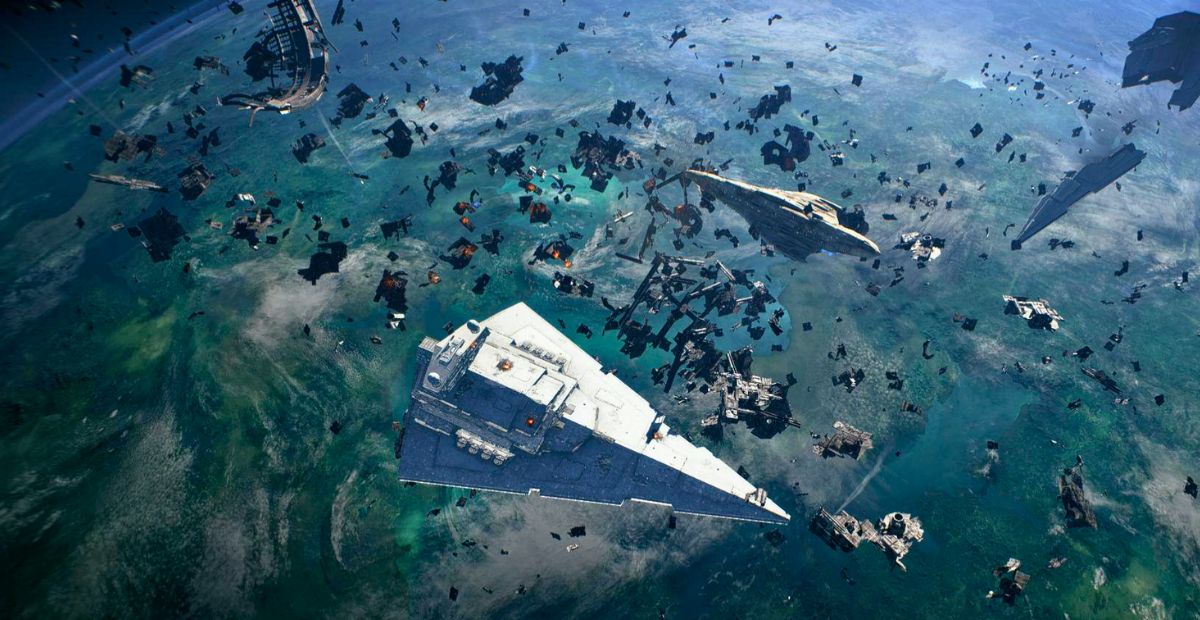
When a Star Wars battle ends, we hear the blaster fire stop, the music swell, and then the camera just cuts away—but in-universe, all that wreckage doesn’t magically vanish. The Death Star II blows apart over Endor. Star Destroyers get dragged out of the sky above Jakku. Frigates, starfighters, escape pods, droids, everything we just watched get torn to pieces has to end up somewhere once the shooting stops.
So what actually happens to all that space debris? Where does it go after the big heroic moment is over? And who, exactly, is stuck cleaning up the bones of the Galactic Civil War?
Salvage Teams Clean Up the Space Debris
Once the blaster fire stops, the next ships into a Star Wars battlefield usually aren’t heroes or admirals. They’re the people with cutting torches, tugs, and cargo bays. In-universe, there are salvage crews whose whole job is to sweep up what’s left in space before it falls or drifts away.
We see the Empire do this very directly after the first Death Star. They don’t just shrug and leave the wreckage over Yavin. Canon and Legends both mention an Imperial Salvage Station in orbit around Yavin Prime, set up specifically to collect, catalog, and analyze Death Star debris and keep an Imperial presence there after the Rebels run.

The Empire runs the same kind of operation on its own junk. Reklam Station, from Star Wars Rebels, is an Imperial salvage yard hanging in the atmosphere of Yarma.
In Star Wars Rebels, Reklam Station is an Imperial salvage yard hanging in the atmosphere of Yarma, introduced when Hondo Ohnaka proudly tells the Ghost crew, “I give to you the planet Yarma, and hidden in its cloudy heavens, Reklam Station, a secret Imperial salvage yard,” where thousands of old Republic starfighters are being cut up for scrap.

On the smaller end of the scale, there are named salvage outfits and guilds working the edges of these disasters. Wroonian salvagers form a Salvage Guild that offers straight bounties, after one Imperial Star Destroyer is destroyed, they pay 100 credits for every escape pod recovered in good condition.
On Yavin 4, a Selonian called Nagem Dr’Lar leads a salvage team into the jungle crater where Death Star wreckage came down, camping among the debris and selling what they pull out to the Empire. These aren’t Rebel heroes or Imperial elites; they’re the people who show up after the medal ceremony and start cutting into the wreck.
By the time of the New Republic, the same idea scales up even more. We hear about huge salvage yards and depots where captured and decommissioned ships are dismantled. On Coruscant, the New Republic’s Shipyard Depot is a vast salvage yard used to strip down Imperial Star Destroyers and even their own old Alliance warships, with soldiers guarding the whole operation while crews pick the hulls clean.

Some of the Wreckage Ends Up on the Ground
Not all of that junk stays drifting in orbit. In a lot of the big battles, we’re actually seeing the beginning of a decades-long mess down on the surface.
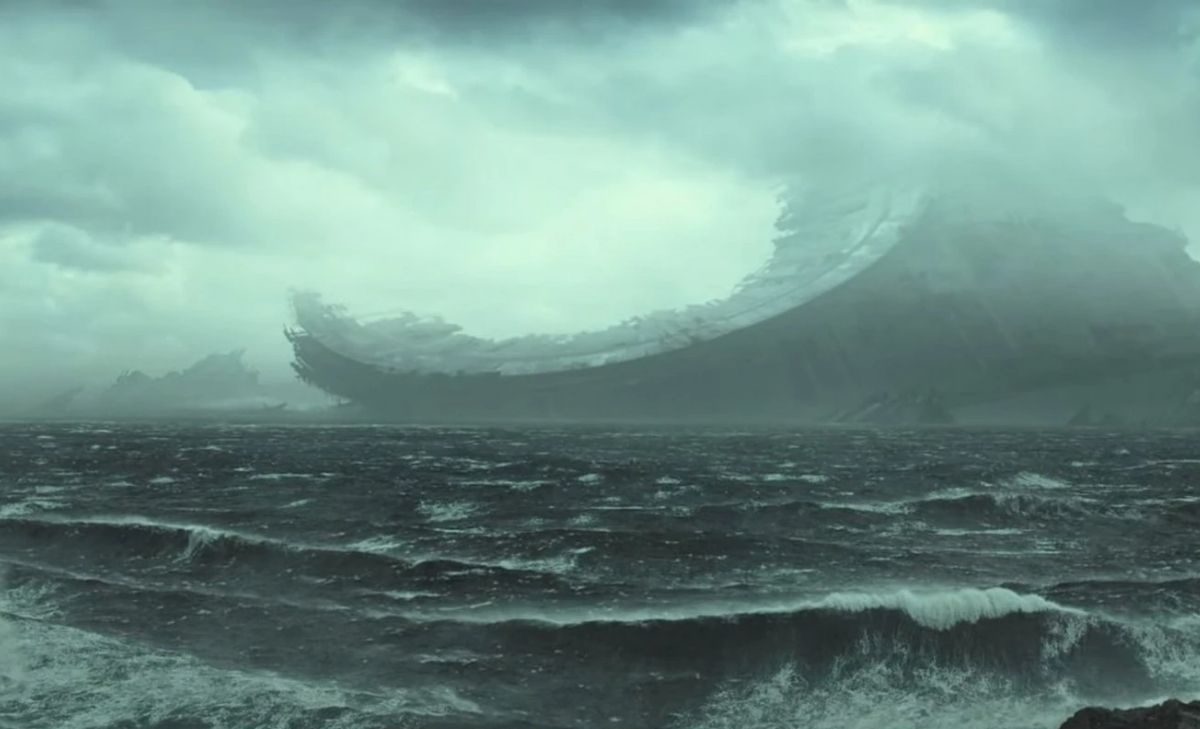
The obvious one is the second Death Star. We watch it blow apart over Endor, and for years it was easy to assume it all vaporized. Then The Rise of Skywalker shows us what really happened: huge chunks of the station survive re-entry and slam into the oceans of Kef Bir. When Rey climbs through the wreck, she’s walking across the broken superlaser dish and into the Emperor’s old throne room.
We see the same pattern on Jakku, just with desert instead of waves. The final battle between the New Republic and the Empire doesn’t end with ships politely blowing up in a neat ring over the horizon. A Super Star Destroyer, the Ravager, is dragged out of orbit by a New Republic Starhawk and crashes into the sand. Other Star Destroyers and capital ships follow it down, turning the surface into the Starship Graveyard we see in The Force Awakens. By the time we meet Rey, kids have grown up never knowing the sky without those hulks on the horizon.

Down on the ground, “space debris” turns into something a lot more personal. It becomes work sites, shelters, hazards. People carve homes into crashed hulls, hang nets off old turbolaser barrels, and risk their lives climbing through unstable corridors for a bag of parts.