
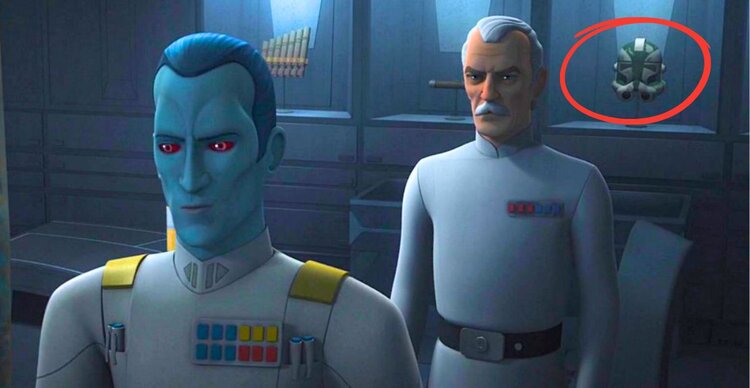
Out of all the clone troopers who carried out Order 66, why did Grand Admiral Thrawn specifically keep Commander Gree’s helmet in his office? Thrawn was never the kind of man to surround himself with meaningless objects, which is exactly why that detail stands out. So why Gree in particular? Was there something about Gree’s history, his reputation, or the meaning of that helmet that made Thrawn choose it over every other clone relic?
Gree May Have Meant More to Thrawn Than We Realize
One possible reason Gree’s helmet stood out to Thrawn is that it was more than just a piece of clone armor. Official Star Wars material describes Thrawn’s office as a place where he studied art and clues he had gathered while trying to understand the people around him. That means the helmet was likely there for a reason.
Commander Gree was also not just another clone trooper in the ranks. He led the 41st Elite Corps, fought on major Clone Wars battlefronts like Kashyyyk, and became tied to one of the most important moments of Order 66 when he tried to kill Yoda. Seen that way, Gree’s helmet would not have been just a war relic to Thrawn. It would have been the kind of artifact that carried military history, strategic value, and a direct link to the fall of the Jedi. That alone could explain why Thrawn chose to keep Gree’s helmet specifically rather than some ordinary piece of clone gear.
![Star Wars - Episode 3: Revenge of the Sith - Commander Gree's Death [HD] | Jesse](https://may4bewithyou.com/wp-content/plugins/wp-youtube-lyte/lyteCache.php?origThumbUrl=https%3A%2F%2Fi.ytimg.com%2Fvi%2FgnhOh-r4KtY%2F0.jpg)
Thrawn May Have Been Drawn to What Made Gree Different
Another possible reason Thrawn kept Commander Gree’s helmet is that Gree was not just another clone officer. In Legends, Gree became highly knowledgeable about alien cultures, and that shaped the way the 41st Elite Corps operated. His unit developed a specialization in hostile environments, counterinsurgency, and long-term deployment on alien worlds, especially in operations where understanding local conditions and populations mattered as much as firepower. Gree’s value, then, was not only that he could lead troops in battle. It was that he could command in unfamiliar worlds by understanding the people and environments around him.

That overlap becomes much more interesting once you bring in Thrawn. Official Star Wars material says Thrawn had a deep fascination with art and culture, because he believed studying both could reveal more about an enemy than battle alone. On Ryloth, for example, he used that way of thinking to bait Hera and Cham Syndulla by setting up in their family home and understanding what its treasured heirlooms meant to them. In other words, Thrawn won not just by force, but by understanding the culture of the people he was fighting.
That is why Gree’s helmet may have meant more to Thrawn than just a clone relic. Gree was a soldier who, in his own way, also looked beyond standard military thinking. And Thrawn, as a Chiss officer who rose through a largely human Imperial system, was himself someone defined by being different inside the Empire. Official sources describe him as an alien Imperial officer whose whole reputation came from seeing what other commanders missed. So if Thrawn knew anything about Gree’s record, it becomes easier to imagine why Gree’s helmet might have stood out to him. It may have belonged to one of the rare Republic soldiers who also understood that war was not just about weapons and rank, but about learning how other people lived and thought.