
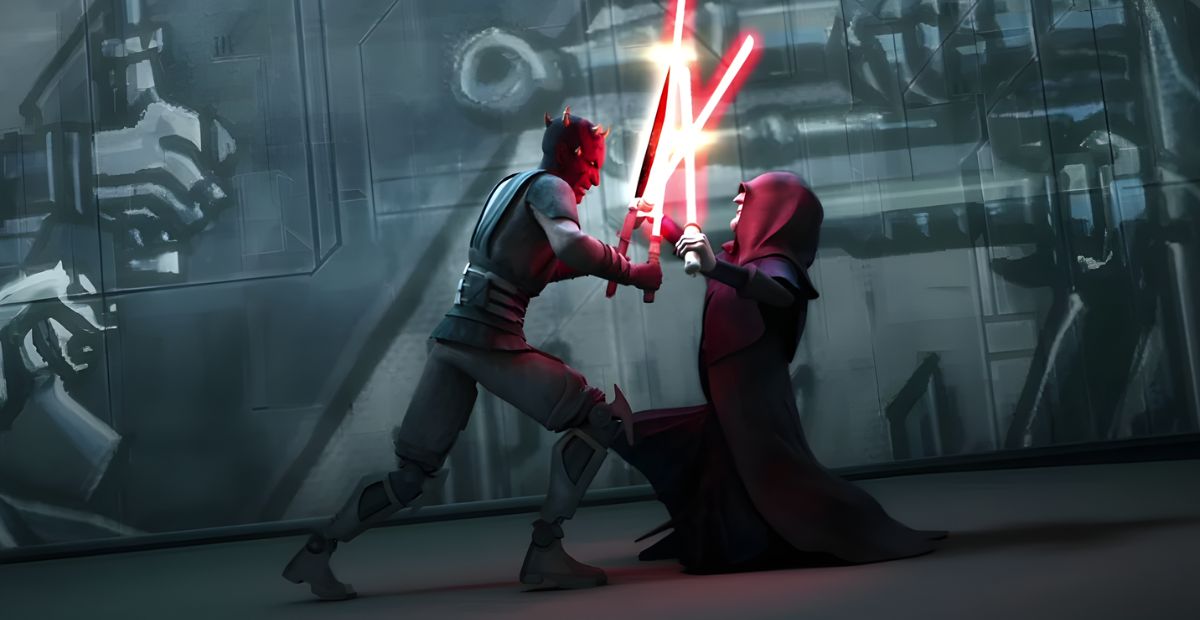
During the Clone Wars, we learn that Maul didn’t just survive, he came back with a mission. He rebuilt himself in the shadows, gathered power, and made a clear play to get back into Darth Sidious’s orbit. And when Sidious finally tracks him down on Mandalore, Maul doesn’t even pretend otherwise. He puts it out in the open: he wants to return to his master’s side.
So if Maul is basically offering himself up again, why doesn’t Sidious take the deal?
Table of Contents
Maul Was Too Much of a Threat to Keep as an Ally
It’s easy to picture how strong Sidious could’ve been if he took Maul back. Maul isn’t just alive again—he’s got real power behind him now, and he even has a new apprentice in Savage Opress. If Palpatine’s whole thing is building weapons in the dark, then on paper this looks like an upgrade. Before, Sidious had one Sith assassin in Maul. If he welcomes Maul back, suddenly he’s sitting on two.
But that’s not how Sidious looks at it.
To Palpatine, Maul isn’t a “bonus.” He’s a threat—someone building momentum outside of Sidious’s control. And we’ve seen Sidious shut that down before. When Ventress starts getting too strong, Sidious doesn’t treat it as extra firepower for the Sith. He orders Dooku to get rid of her, because in Sidious’s eyes Ventress isn’t just an assassin anymore—she’s the kind of apprentice who could become a replacement. If Dooku keeps training her, Ventress eventually becomes someone who can threaten Sidious.
So Sidious cuts it off early. And that single order doesn’t just remove Ventress—it’s what eventually sets off the chain that ends with the Nightsisters getting wiped out later on.

Maul follows the same pattern. His return doesn’t just add muscle to Sidious’s side. It creates a second dark-side power center, one with its own apprentice, its own army, and its own ambitions. And Sidious doesn’t keep those around as allies. He removes them.
Allying With Maul Would’ve Disrupted Sidious’s Plan
Another reason Sidious couldn’t just “add Maul back” is because Maul would’ve created the wrong kind of chaos—the kind that can screw up the plan Sidious had been building toward from the start.
Once Maul resurfaces and starts stacking power—pirates, syndicates, Mandalore—the Jedi get worried enough to bring it to Chancellor Palpatine. And this is where Palpatine’s reaction is telling. He doesn’t say, “Good, let’s eliminate this Sith and get back to the war.” Instead, he brushes it off and keeps steering the Jedi toward one priority: ending the Clone Wars.
![Palpatine states that Darth Maul is not a matter of The Republic [1080p]](https://may4bewithyou.com/wp-content/plugins/wp-youtube-lyte/lyteCache.php?origThumbUrl=https%3A%2F%2Fi.ytimg.com%2Fvi%2FBjtVhqUl0fQ%2F0.jpg)
Why? Because Sidious’s real endgame isn’t winning battles. It’s Order 66.
If the Jedi turn Maul into a major campaign, they don’t just send a small team. They start moving clone units, fleets, and commanders around to fight an army with an army. We see the proof at the Siege of Mandalore—Ahsoka and the 501st go in, and suddenly it’s a full military operation.
And to Sidious, that’s the danger. The clones aren’t just troops; they’re the trigger. He needs them in position, under clean command, ready to flip at the exact moment he chooses. A Maul alliance doesn’t help that. It risks pulling clones into messy side wars, reshuffling forces, and creating variables Sidious doesn’t need right when he’s trying to set the board for the kill switch.
Maul Would’ve Gotten in the Way of Sidious Claiming Anakin
Last but not least, in Sidious’s mind the final prize was always Anakin Skywalker. The Clone Wars aren’t just about breaking the Republic or wiping out the Jedi—they’re also about turning the Chosen One. That’s why Palpatine is perfectly willing to discard people the moment they’ve served their purpose. Dooku is the clearest example: once Anakin is ready, Dooku is no longer an ally or an apprentice. He’s just something that needs to be removed.
Maul doesn’t fit into that endgame.
If Sidious accepts Maul back at his side, Maul instantly becomes a complication standing between Sidious and Anakin becoming the official Sith apprentice. Maul isn’t the kind of former apprentice who would quietly step aside and watch a replacement take his place. And if Sidious lets Maul keep growing stronger under him—especially with Maul’s own ambition and the power base he’s already built—then removing Maul later becomes harder, messier, and riskier.
![Maul Tells Ahsoka About Anakin & The Republic's Fate [1080p]](https://may4bewithyou.com/wp-content/plugins/wp-youtube-lyte/lyteCache.php?origThumbUrl=https%3A%2F%2Fi.ytimg.com%2Fvi%2F-p5HKp1r38I%2F0.jpg)
When Maul talks to Ahsoka during the Siege of Mandalore, he straight up lays out what Sidious is really after: Anakin. Maul isn’t thinking like a loyal returnee to the Sith—he’s thinking like someone trying to ruin Sidious’s succession plan. He tells Ahsoka that the Clone Wars have been engineered for this moment, and that Sidious has been grooming Anakin as the final prize. And Maul’s solution isn’t “join Sidious.” It’s the opposite—he wants Ahsoka’s help so he can stop it, because if Sidious gets Anakin, everything is over.
That’s why an “alliance” was never going to last. Maul already understood that Anakin was the future Sidious wanted… and he was already positioning himself as the obstacle.