
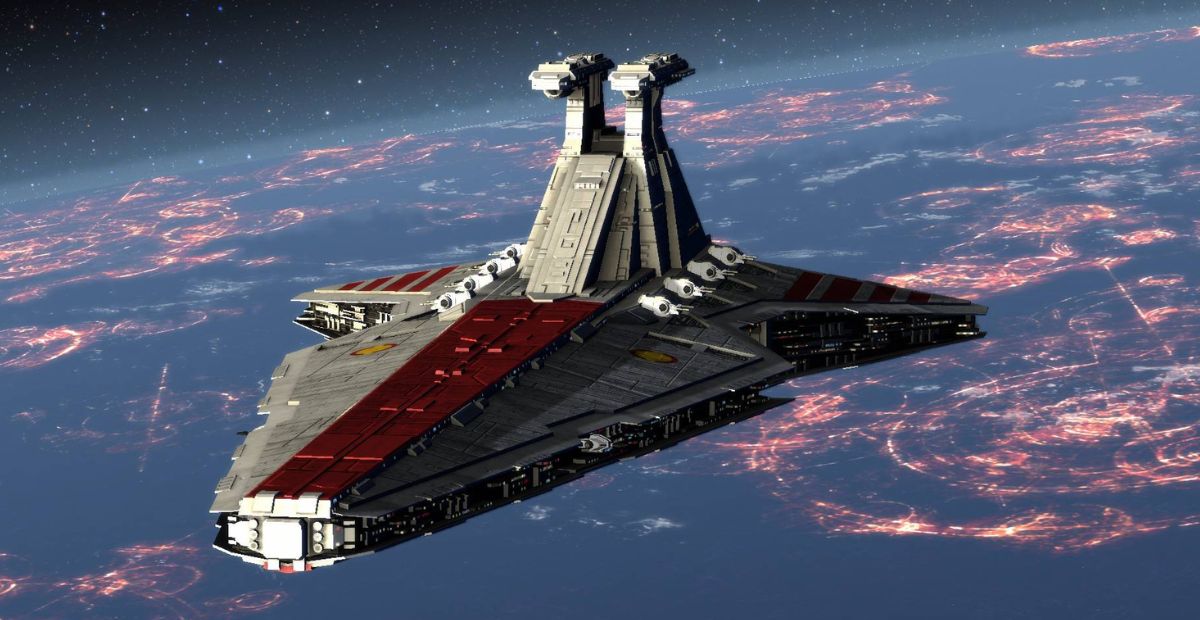
We understand how Venator-class Star Destroyers helped the Republic defeat the CIS throughout the Clone Wars. Without those massive ships, the Republic would have struggled to project power across the galaxy.
But by the time of the Empire, we no longer see Venator Star Destroyers in service. Instead, we only see Imperial Star Destroyers dominating the battlefield. So if those massive ships were no longer being used, why didn’t the Rebels take some of them and use them to fight back against the Empire?
Table of Contents
1. Most Venators Were Already Gone Before the Rebellion Even Existed
By the time the Rebel Alliance began to take shape, many Venator-class Star Destroyers were already gone. As early as 19 BBY, not long after the end of the Clone Wars, older Venators from the first production lines were being decommissioned and sent to scrapyards. One of the most well-known locations was Bracca, a planet used by the Empire as a massive ship-breaking yard.
We actually see this process firsthand at the start of Star Wars Jedi: Fallen Order. The opening sequence shows enormous Republic-era ships, including Venators, torn apart piece by piece. Entire hull sections are dismantled, and everything of value is stripped down under Imperial supervision.
![Star Wars Jedi: Fallen Order - [Part 1] The Shipbreaking Yard (Bracca) - No Commentary](https://may4bewithyou.com/wp-content/plugins/wp-youtube-lyte/lyteCache.php?origThumbUrl=https%3A%2F%2Fi.ytimg.com%2Fvi%2F0Cv4bq94it8%2F0.jpg)
The scrapping of Venators continued for years, lasting well into 14 BBY. Salvaged components were carefully sorted and reused to support the construction of newer Imperial machinery and warships, including the growing fleet of Imperial Star Destroyers.
So by the time the Rebellion truly emerged as a military force, there simply weren’t many Venators left to take. Most had already been dismantled, repurposed, or reduced to raw materials, long before the Rebels had the means to challenge the Empire head-on.
2. Any Surviving Venators Were Under Imperial Control
Even after the initial wave of scrapping, any Venator-class Star Destroyers that remained intact were firmly under Imperial control. These ships didn’t drift into neutral space or get abandoned. They were tracked, cataloged, and stored in Imperial shipyards or reassigned to controlled systems.
We actually see this during the early Imperial era in Star Wars: The Bad Batch. In the immediate aftermath of Order 66, Venators are still actively used by the Empire. They are commanded by Imperial officers, crewed by clone troopers, and later by enlisted Imperial personnel as the transition away from clones begins. None of these ships operate independently, and none fall outside Imperial oversight.
![The Bad Batch - The End of Kamino [4K HDR]](https://may4bewithyou.com/wp-content/plugins/wp-youtube-lyte/lyteCache.php?origThumbUrl=https%3A%2F%2Fi.ytimg.com%2Fvi%2FJCUIaFem21o%2F0.jpg)
A Venator is a massive capital ship. It requires thousands of crew members, trained officers, fuel, maintenance crews, and secure facilities just to stay operational. All of that infrastructure belonged to the Empire. The Rebels didn’t have shipyards where they could quietly refit a Venator, nor did they have the manpower to crew one without being noticed.
More importantly, Venators were registered Republic warships. Their transponder codes, hull signatures, and specifications were already known to Imperial authorities. The moment a Venator powered up or jumped to hyperspace, it would immediately flag Imperial sensors. There was no realistic way for the Rebels to operate one without announcing their location to the entire Imperial Navy.
3. Rebel Tactics Favored Starfighters, Not Capital Ships
The Rebel Alliance didn’t fight the Empire head-on. From the beginning, their strategy was built around speed, mobility, and surprise. Instead of trying to match the Imperial Navy ship for ship, the Rebels relied heavily on starfighters like the X-wing and Y-wing, supported by small fleets that could strike quickly and disappear before the Empire could respond.
We see this clearly throughout the Galactic Civil War, especially in A New Hope and The Empire Strikes Back. Rebel attacks focus on precision strikes, hitting supply lines, installations, or weak points, rather than prolonged fleet engagements. Starfighters could be launched from hidden bases, operate independently, and regroup elsewhere if things went wrong.
A Venator-class Star Destroyer doesn’t fit that kind of warfare. It’s large, slow to deploy, and impossible to hide. Operating one would have forced the Rebels into open battles they couldn’t afford to fight. Even worse, protecting a Venator would require escorts, supply convoys, and permanent bases, all of which would become immediate Imperial targets.
By contrast, Rebel starfighters could operate with minimal support. X-wings could jump to hyperspace on their own, strike deep into Imperial territory, and retreat before a full response arrived. That flexibility mattered far more than raw firepower.