

In Rogue One, during the fighting on Jedha, there’s a moment that’s easy to miss unless you’re looking for it. One of the AT-AT walkers has a clean hole blasted straight through its body. Not scorch marks. Not surface damage. A literal hole.
That’s strange, because AT-ATs are supposed to be walking tanks. They’re built to take sustained fire from ground forces and keep moving. We don’t usually see them breached that cleanly.
So what happened there? Was it just battle damage, or was something specific responsible for it?
The “Hole” Is Part of the AT-ACT’s Design
The walker you see in Rogue One is not a standard AT-AT. It’s an AT-ACT (All Terrain Armored Cargo Transport), a specialized variant designed specifically for construction and logistics on Imperial megaprojects like the Death Star.
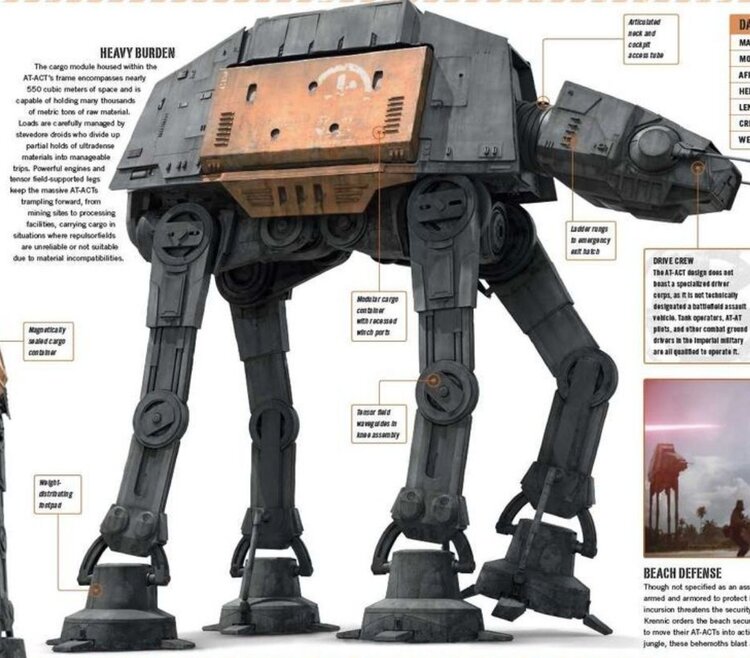
That “hole” in the body is intentional.
AT-ACTs are built with an open cargo frame running through the center of the walker. Instead of a fully enclosed troop compartment like an AT-AT, the AT-ACT has a reinforced open structure that allows it to carry massive construction components, machinery, structural modules, or sealed cargo, suspended inside its body as it moves.
We see this design used clearly during the Battle of Scarif. On the beachhead, AT-ACTs are shown actively transporting large Imperial cargo containers through their central frame while advancing with ground forces. The cargo is not mounted externally or dragged behind the walker, it is carried through the body, exactly where that open space is.
Canon reference material confirms this role. Visual guides for Rogue One describe the AT-ACT as a logistical walker adapted from the AT-AT chassis, trading full troop armor for cargo capacity. The design prioritizes moving oversized materials directly across secured construction zones, even during active combat, rather than functioning as a frontline assault platform.
The AT-ACT Was Built for Imperial Construction Zones
The AT-ACT exists because the Empire needed a way to move massive materials inside active construction sites without relying on repulsorlift vehicles or rail systems.
On Scarif, the Empire wasn’t just guarding data vaults. It was maintaining one of its most important military installations, tied directly to Death Star development. That meant constantly moving oversized cargo, power components, structural elements, and sealed containers, across uneven terrain while under heavy security.

A standard AT-AT wasn’t built for that role. Its enclosed body is designed for troops, not cargo. The AT-ACT solves that problem by turning the walker itself into a mobile transport frame. The open central structure allows cargo to be carried through the body, keeping weight balanced and reducing the risk of tipping or mechanical strain.