
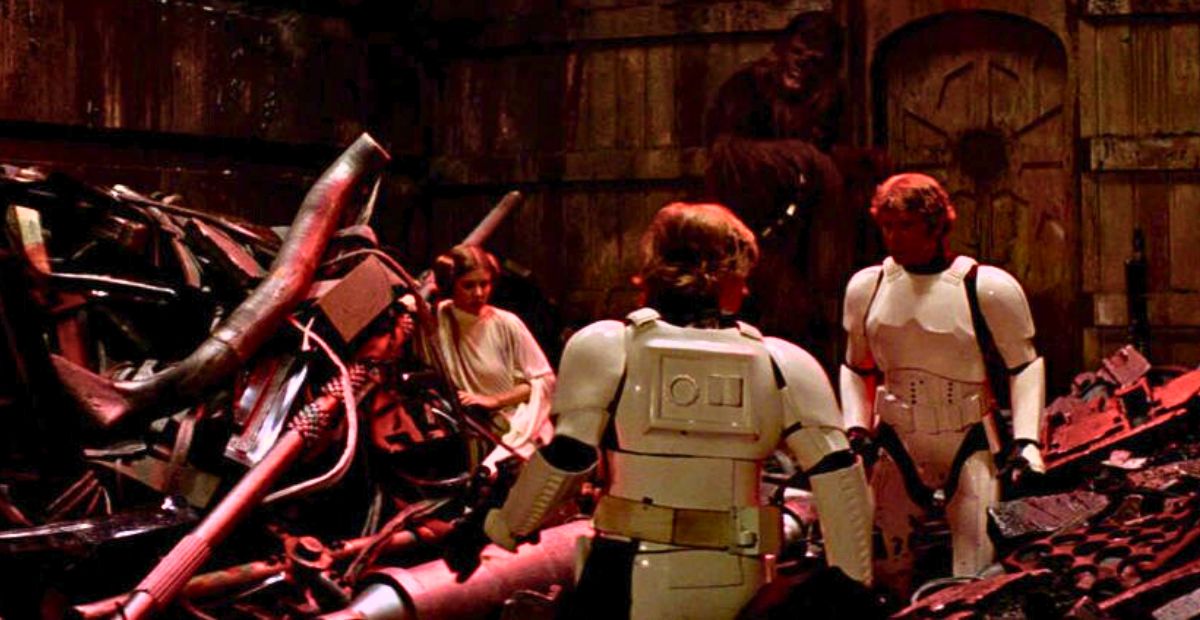
After rescuing Leia from the Empire, Luke and Han Solo end up trapped in a garbage compactor. The walls are closing in, water’s rising, everyone’s panicking, and Han does the most Han thing possible: he pulls out his blaster and shoots the door. Instead of blowing it open, the bolt slams into the metal and starts ricocheting all over the room, forcing everyone to dive back into the trash.
It’s a quick gag in the movie, but it raises a real question: why does that blaster bolt bounce around like a rubber bullet instead of just burning straight into the wall?
What Are the Compactor Walls Actually Made Of?

The film just shows a dirty metal box full of junk, but the tie-in material gives us more to work with.
The original A New Hope script already tells us what the movie only implies: the room is a small, fully metal chamber, and that metal is reflective enough to send a shot flying. In the script stage directions, when Han fires, it doesn’t just say “he misses” or “the bolt fizzles out.” It spells out that the laser bolt ricochets wildly around the small metal room, forcing everyone to dive back into the garbage until the charge burns out. The idea from the start was that this isn’t a normal corridor wall; this is a hard, enclosed metal box designed to shrug off damage and then crush whatever’s inside it. The script puts it like this:
“Han draws his laser pistol and fires at the hatch. The laserbolt ricochets wildly around the small metal room.
Everyone dives for cover in the garbage as the bolt explodes almost on top of them. Leia climbs out of the garbage with a rather grim look on her face.”
The junior novelization adds another detail on top of that: it calls the door and the walls magnetically sealed. In that version, the bolt slams into the metal, bounces all over the chamber, and finally ends in a little explosion that doesn’t even dent the wall. Later, when Chewie cowers against the side of the compactor, the text flat-out warns that the walls are magnetically sealed and dangerous to shoot at. In other words, you’ve got two layers stacked together: thick metal everywhere, and some kind of active magnetic sealing on top of it.
“Too late. Han fired at the hatch, and the laserbolt ricocheted wildly around the metal-walled chamber. Everyone dived for cover until the fired bolt’s charge ended in a small explosion that didn’t even dent the metal wall.”
“Chewbacca turned to a wall and cowered. Despite the hazard posed by the magnetically sealed walls, Luke and Han held their blasters out, ready to fire. Han said, ‘It’s worse.’”
“Magnetically sealed” shows up elsewhere in Star Wars as shorthand for fields and locks that keep metal plates locked together and energy contained. We’re not given a technical manual for how that works in a trash compactor, but it’s enough to tell us what kind of surface Han is firing at: a reinforced, field-hardened metal barrier that’s meant to handle huge forces without buckling.
Put a blaster bolt into that at close range and at a bad angle, and instead of the energy digging in and burning straight through, the shot can glance off and stay partly coherent for a moment. That’s exactly what the script and the junior novelization are describing in prose when they talk about the bolt ricocheting around the chamber before its charge finally dies.