
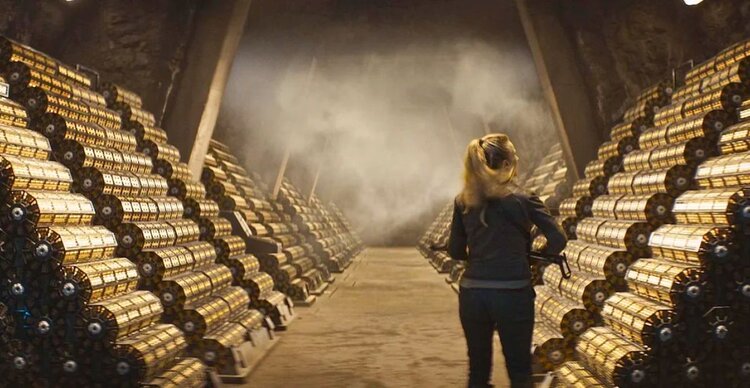
In Andor, money is always something you can hold. Cassian is forever trying to scrape together enough credits, Luthen pays him with a heavy case on the table, and the Aldhani mission is literally about stealing sector payroll packed into crates in an Imperial vault. For a regime that can throw Star Destroyers across the galaxy, it’s a very old-fashioned way to move value around.
So in this article, I want to look at a simple question: why does the Empire, at least in Andor, still lean so hard on physical credits instead of treating money as something abstract and distant?
Table of Contents
What Andor Actually Shows Us About Money in Star Wars
On Ferrix, credits are always something you can put on a table. Cassian owes people money, pays in person, and every deal we see is about hard credits he can carry or hide.
When Luthen hires him, it’s the same thing: no promises, just a case of payment right there in front of him. Then Aldhani takes that idea and blows it up to Imperial scale — the “sector payroll” is stacked into bars and sealed in a vault, then hauled out on rails in crates during the Eye.
We see the same logic pop up again in Skeleton Crew, with a mint world still producing and using physical credits locally while the wider galaxy has moved on to newer systems.

That’s really all we need for the setup: in Andor, whether you’re a dock worker, a spy, or an Imperial quartermaster, money is treated as cargo.
Why the Empire Still Uses Hard Credits
If we stay in-universe for a second, the Aldhani job already tells us a lot. The sector payroll is locked in a vault as stacked bars, moved on rails, signed off by officers, and loaded straight into an Imperial freighter. That’s a very old, very Imperial way of doing business: you don’t trust some distant system, you trust a vault, a manifest, and a chain of signatures. To steal it, you have to hit the base. You can’t sit in a safe house and “slice” a crate.

That fits how the Empire thinks about control. Physical credits have to pass through specific hands: quartermasters, paymasters, garrison commanders. Everyone along the chain knows they’ll be in serious trouble if those crates go missing. It’s slow and clumsy, but it gives the regime clear custody and a paper trail it understands. “We sent this much to this garrison, it left on this freighter, this officer signed for it.” That’s exactly the kind of bureaucracy we see everywhere else in Andor.
The wider galaxy is messy too. Not every world is plugged neatly into the same currency. You’ve got planets and systems that were never really part of the Old Republic, or only half-heartedly in the Empire, and they have their own mints and local money. Skeleton Crew leans into that with At Attin still stamping out old-style credits on a mint world that feels stuck in time while the rest of the galaxy has moved on. Way back in The Phantom Menace, Watto refusing Republic credits on Tatooine is the same idea: “your money doesn’t mean much out here.” A bar of something valuable you can weigh and test is a lot easier to move between those different pockets than a promise tied to Coruscant.
And then there’s the people Andor actually follows. Cassian, Luthen, Vel, Skeen, the thieves on Aldhani – none of them want their income to show up in some official ledger. They live in places where the Empire can freeze accounts, seize assets, or suddenly decide you’re suspicious. You pay in person, you get paid in person, and you stash the credits somewhere only you know. For rebels, smugglers, and anyone on the edge of the law, hard currency isn’t a quirk. It’s the safest way to get paid.
Why We Don’t Really See “Purely Digital” Credits
There’s also a basic practical issue in Star Wars: the galaxy just isn’t wired like ours. Long-distance communication is spotty, slow, and often controlled. Even in the prequels you see holograms cutting in and out, messages being relayed through intermediaries, and whole systems dropping off the grid during wars or blockades. That’s not the kind of environment where you can rely on a smooth, instant “galactic credit card” or constant wire transfers.
If you’re out on a rim world, stuck in a backwater system, or living under occupation, you can’t count on a bank on Coruscant always answering when you call. Physical credits don’t have that problem. You don’t need a signal, a node, or approval—if you’ve got the bars or chits in your hand, you can pay. For the parts of the galaxy Andor cares about, that’s really all that matters.
On top of that, every era of Star Wars is full of slicers, droids, and shady tech people breaking into systems. We’ve seen codes forged, identities stolen, security networks spoofed, and entire facilities compromised because someone got into the right terminal. If all your money lives as numbers in a system like that, it’s just one more thing that can be wiped, frozen, or stolen without you ever seeing who did it. A crate of physical credits is crude, but you can’t hack it from across the sector—you have to show up and take it. For the worlds and people Andor cares about, that’s a much safer bet.