
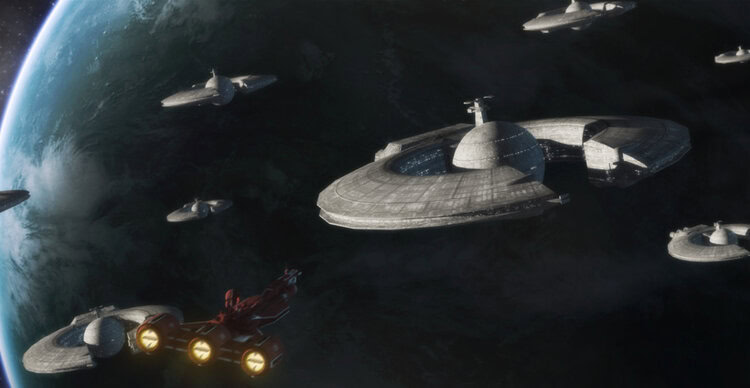
In The Phantom Menace, the blockade of Naboo set up the invasion and the climactic battle of the first prequel movie. The blockade established the central conflict, especially because of how effective it was. But why was it so effective? Several reasons explain it, including Naboo’s reliance on imports and its weak military.
Table of Contents
The Effectiveness of the Blockade on Naboo
We remember how the Trade Federation established a blockade to protest the taxation of trade routes. We also recall how this move was actually designed by Palpatine in his grand scheme to rule over the galaxy. The blockade worked tremendously well, but the reasons are not readily apparent.
The first reason why the blockade of Naboo worked so well was due to Naboo’s economic situation. This is really a two-part reason, reflected first in Naboo’s reliance on imports for basic necessities and focus on exporting plasma. Fans here emphasize this dual economic dependency to explain why the blockade impacted Naboo so much.
A second reason is that the Trade Federation took advantage of Naboo’s military vulnerability. We may know Naboo as a peaceful planet and home to the Gungans. As “a small pastoral world”, Naboo embraced pacifism and lacked a significant military force to counteract the blockade.

In comparison, the Trade Federation deployed a sizable fleet of modified Lucrehulk-class battleships for the blockade and subsequent invasion. They also positioned them at spaceports and distribution centers to make them even more effective. While a supply ship might “occasionally run the blockade,” the supplies needed to support the planet dwindled rapidly.
Beyond these reasons, Naboo was also isolated both in space and politics. The planet was on the border of the Outer Rim, about 34,000 light-years from the Core Worlds. Moreover, Palpatine had engineered Naboo’s political isolation by manipulating the Galactic Senate and delaying intervention. While the Senate debated the “legality” of the blockade, Naboo sank into desperation.
What Exports and Imports Did the Naboo Rely on so Heavily?
As noted above, plasma was the main export that Naboo heavily depended upon. As fans posted here, Naboo was “a great source of plasma” and “its planet core [was] full of the stuff.” Hence, this was the focal export that could earn revenue for the planet.
As such, the Plasma Refinery Complex was built next to the Royal Palace in Theed. This “triple-domed structure” was constructed to extract “vast quantities of rare plasma” from the Naboo’s core. Since plasma is at the heart of lightsabers, blasters, and cannons, it makes sense that this would be the main export.
As for imports, we can think of most everyday items, such as food and medicine, but other items too. Naboo needed to get manufactured goods and specialized technology that were not available on the planet. Central imports included machinery and metals for building starships, along with food sources that the agriculture on the planet didn’t produce.
The Blockade of Naboo
Ultimately, the blockade of Naboo was effective because it took advantage of Naboo’s reliance on imports and its key export. The Trade Federation could likewise manipulate the lack of military power on the planet and close down the space lanes with its own Lucrehulk-class battleships.