
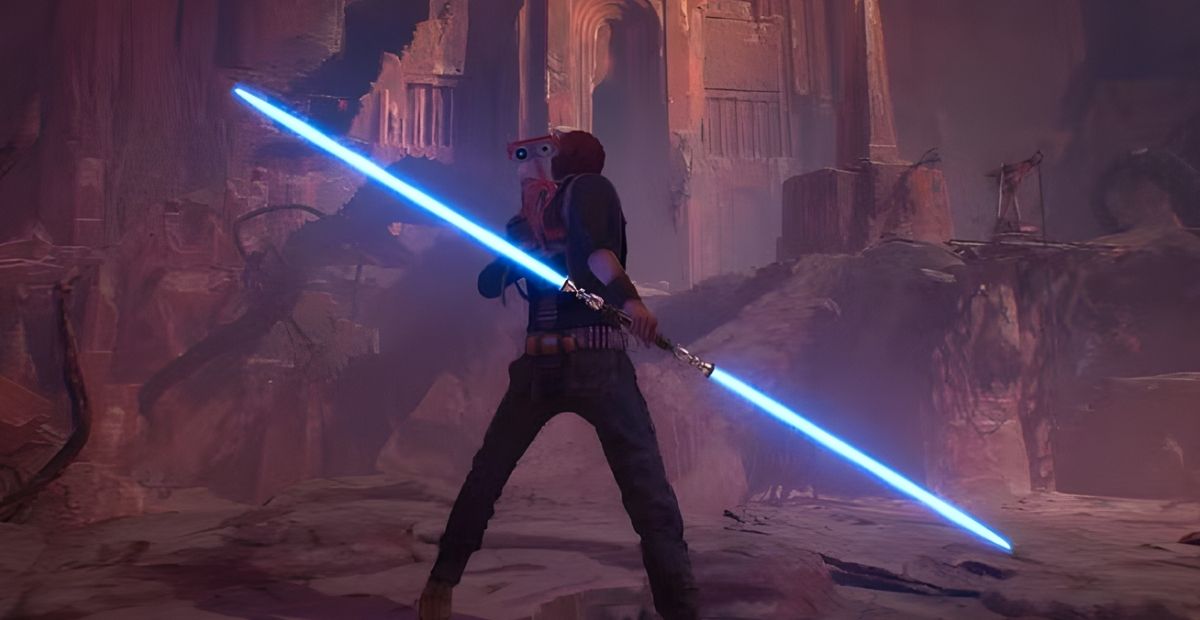
When Darth Maul ignited the second end of his lightsaber in The Phantom Menace, the weapon immediately felt like a Sith invention. But a double-bladed lightsaber was never automatically a dark-side weapon. Jedi carried them too. They were uncommon, partly because the extra blade changed the entire rhythm of a fight.
The five Jedi below did not all use the weapon the same way. One carried two saberstaffs at once. Another passed his broken weapon to the Padawan he died protecting. Two became famous faces of the Old Republic, while a High Republic Wayseeker carried one of the strangest Jedi lightsabers I have seen.
1. Pong Krell

Pong Krell did not carry one double-bladed lightsaber. He carried two.
One weapon produced two blue blades and the other produced two green blades. Both hilts were large enough for Krell’s Besalisk hands, and each one had a hinge in the middle that allowed him to fold it against his belt. According to the production material collected by Wookieepedia, these were the first hinged double-bladed lightsabers designed for Star Wars.
The design made sense for Krell in a way it would not for most Jedi. He had four arms, enormous physical strength, and enough reach to keep both staffs moving around his body. With every blade active, a clone approaching him had to get through four separate cutting arcs. Watching him fight in “Carnage of Krell” feels less like watching a traditional duel and more like watching soldiers try to stop a machine that has broken loose.
What bothers me most is how little he used those weapons while he was supposedly leading the Republic on Umbara. Krell stayed behind while his troops made costly frontal attacks. He dismissed their ideas, refused support, and treated clone names as if they were an insult to his authority. His record already carried a terrible number of clone casualties, but on Umbara the deaths were intentional.
Krell had seen a future in which the Jedi Order and Republic collapsed. Instead of warning anyone, he decided to save himself. He sabotaged the campaign and arranged for the 501st Legion and 212th Attack Battalion to fire on each other, hoping the betrayal would earn him a place beside Count Dooku.
That distinction matters: Krell had turned to the dark side, but he was not Dooku’s confirmed apprentice and he was never formally accepted as a Sith. He was a traitorous Jedi trying to make himself useful to the winning side.
Once the clones understood what he had done, Krell finally joined the battle personally. He drew both saberstaffs, deflected volleys of blaster fire, and killed several of the men he had commanded. The clones did not outduel him. They forced him into the Umbara wilderness, where a native vixus caught him with its tendrils. Krell cut himself loose, but the creature created the opening Tup needed to stun him.
Rex later prepared to execute Krell and could not pull the trigger. Dogma, the same soldier who had defended Krell’s authority for most of the campaign, shot him instead.
Those blue and green blades looked like Jedi weapons right to the end. That almost makes the scene uglier. Krell did not need red crystals or a Sith title to become a monster. He only needed to decide that everyone around him was expendable.
2. Jaro Tapal

Jaro Tapal’s saberstaff is remembered mostly because Cal Kestis inherited it, but the weapon had already survived a war before Cal carried its broken remains to Bracca.
Tapal was a Lasat Jedi Master and general who commanded the Republic’s 13th Battalion. He trained Cal during the Clone Wars with a strict but useful philosophy: failure was not something to hide from. Cal had to understand it, get up, and try again. That lesson became much more important after the Jedi Order fell.
When Darth Sidious issued Order 66, Tapal and Cal were aboard the Venator-class Star Destroyer Albedo Brave. Tapal sensed the betrayal before the clones beside him could kill him. He fought through the ship with his blue double-bladed lightsaber while Cal moved through its maintenance passages. Tapal also sabotaged the reactor, knowing the ship’s destruction could cover their escape.
He got Cal to an escape pod, but concentrated clone fire mortally wounded him. His saber had also been hit and split apart. Tapal handed what remained of it to Cal and told him to wait for a signal from the Jedi High Council and “trust only in the Force.” The signal would never come. The Council was already being destroyed across the galaxy.
Cal spent the next five years hiding on Bracca with that damaged weapon. It still worked from one end, but it was no longer the complete saberstaff Tapal had carried. This is where the weapon becomes more interesting than a cool game mechanic.
Cal was alive, but part of him was still trapped aboard the Albedo Brave. He blamed himself for Tapal’s death, cut himself off from the Force, and held onto the broken hilt as the last physical piece of his master. The saber and its owner were in roughly the same condition. Both still functioned. Neither was whole.
During Jedi: Fallen Order, Cal slowly rebuilt his connection to the Force while repairing and changing the weapon. On Dathomir, Tapal’s old kyber crystal finally shattered. Cal could not patch over the past again. He went to Ilum, found a new crystal, and constructed a new lightsaber using pieces associated with both Tapal and Cere Junda.
Cal’s completed weapon could operate as a double blade and later separate for dual-wielding attacks. That split function belonged to Cal’s reconstruction, not necessarily to Tapal’s original saber. Calling the finished weapon nothing more than “Jaro Tapal’s lightsaber” misses the point anyway. Tapal gave Cal the remains. Cal eventually had to decide what they would become.
I like this saber because its damage was never cleaned out of the story. It carried Tapal’s sacrifice, Cal’s guilt, Cere’s help, and finally Cal’s own choices. By the time he rebuilt it, he was no longer a frightened Padawan trying to preserve one terrible night exactly as it happened.
3. Bastila Shan

Bastila Shan is probably the first Jedi many Knights of the Old Republic players associate with a double-bladed lightsaber. The yellow staff fits her so well that it is easy to forget she did not always carry it.
During the Jedi strike mission that captured Darth Revan, Bastila used a single-bladed yellow lightsaber. She adopted her better-known double-bladed weapon afterward and carried it during the Jedi Civil War. When her escape pod came down on Taris, the Black Vulkars took her prisoner and their leader, Brejik, claimed her saberstaff. It was recovered after Brejik was killed following the swoop race.
Bastila was already a dangerous fighter, but her real importance came from battle meditation. Through the Force, she could strengthen the focus and coordination of an entire fleet while weakening the enemy’s will to fight. The Republic built operations around that ability. Darth Malak understood that capturing Bastila could do more for the Sith war effort than killing another Jedi ever would.
She proved how far she would go for the mission aboard the Leviathan. When Malak cornered Revan, Carth Onasi, and Bastila, she stayed behind so the others could escape. Malak defeated and imprisoned her. The torture that followed did not simply force information out of her. He used her pride, anger, and fear of failure until she gave in to the dark side.
Her saberstaff changed with her. Bastila replaced its yellow crystal with a red one and carried the altered weapon when she confronted Revan at the Rakatan Temple. She fought him again aboard the Star Forge while using battle meditation to support the Sith fleet.
In the light-side ending, Revan refused to give up on her. He defeated Bastila and convinced her that falling did not erase every choice she could still make. She turned her battle meditation against the Sith and helped the Republic destroy the Star Forge.
The color change is a simple detail, but it works. Bastila did not throw away her Jedi weapon and arrive with some grand new Sith hilt. She took the saber everyone recognized and made it red. Malak’s victory was supposed to be the corruption of Bastila herself, not the invention of a different person.
Bastila also keeps this list honest about what a saberstaff can and cannot do. It made her formidable in close combat, but it was not her greatest weapon. Her influence over a battle could reach far beyond anyone standing within range of her blades.
4. Satele Shan

Satele Shan is Bastila’s descendant, and the shared preference for a double-bladed weapon is an obvious visual connection. Still, Satele did not inherit Bastila’s actual saberstaff. She used several weapons of her own over a long career.
We first see her as Kao Cen Darach’s Padawan in the Old Republic cinematic “Return.” When the Sith Empire attacks the Republic station above Korriban, Satele fights Darth Malgus while Darach takes on Darth Vindican. Darach eventually gives Satele his own lightsaber and takes her blue saberstaff, using both weapons as he orders her to escape and warn the Republic.
She leaves the station knowing her master is staying behind to die. That first saberstaff becomes part of Darach’s final stand, not a weapon Satele carries untouched into every later story.
Fourteen years later, Satele uses another blue double-bladed lightsaber during the Battle of Alderaan in the “Hope” cinematic. She cuts through Sith troops, destroys part of a war droid, and confronts Malgus again. The duel ends with Malgus slicing her saberstaff in half and driving her backward.
The best part of that fight happens after the weapon fails. With Jace Malcom buying her a few desperate seconds, Satele catches Malgus’s blade with the Force between her bare hands. She then releases enough energy to smash him into the side of a mountain.
Satele built another saberstaff after Alderaan. At another point in the war, she changed to a conventional green single-bladed lightsaber. The published stories are not perfectly consistent about every weapon in this period, but her later appearances return her to a blue double-bladed design.
That repeated return matters more than pretending she owned one indestructible signature hilt. Kao Cen Darach had trained her in standard and double-bladed combat. Satele lost one staff with her master, watched Malgus destroy another, used a different type of saber for a while, and still chose the double blade again.
Her connection to Bastila is worth noticing, but I would not turn it into a family tradition the lore never confirms. Satele did not need to imitate an ancestor who had lived centuries before her. The saberstaff was a weapon she understood, rebuilt, and kept making her own.
5. Orla Jareni

Orla lived during the High Republic, when the Jedi Order had far more room for unusual weapons and personal styles than it would during its final years. She was an Umbaran with white skin and black markings around her eyes, and her lightsaber was just as difficult to mistake for anyone else’s. It had two white blades and a hinge joining the hilt sections.
The unusual weapon suited a Jedi who had stopped waiting for the Council to define her path. After years of doubting whether she was serving the Force or merely obeying the institution around it, Orla declared herself a Wayseeker. A Wayseeker remained a Jedi but operated independently of the Jedi High Council, listening for a direction in the Force rather than accepting assignments from Coruscant.
That did not make her a reckless loner. Orla questioned herself constantly. She understood that leaving the Council’s structure could be an honest spiritual choice or a very convenient way to avoid people who disagreed with her. That tension made her feel more human than the usual “maverick Jedi who was right about everything” character.
During the Great Hyperspace Disaster, Orla traveled aboard the Vessel with Cohmac Vitus, Reath Silas, and Dez Rydan. They became trapped near an abandoned Amaxine space station, where the group discovered a darkness connected to the Drengir. Orla’s instincts, visions, and willingness to question the obvious answer helped the stranded survivors understand that the station was much more dangerous than it first appeared.
She later worked with the Jedi based at Starlight Beacon and fought threats tied to the Drengir and the Nihil. One of her most meaningful contributions was quieter. After the attack on Valo left Elzar Mann angry, frightened, and dangerously unstable, Orla helped him regain control. She knew what it looked like when a Jedi’s inner certainty started turning poisonous.
Orla eventually returned to Starlight Beacon while searching for a threat hidden from normal Jedi perception. She found it, but not in time to survive. A creature connected to the Nameless attacked and killed her during the station’s destruction. The Jedi did not yet understand what these beings were or why Force-users reacted to them with overwhelming terror.
Her white saberstaff could not save her from something that preyed directly on a Jedi’s connection to the Force. That does not make the weapon meaningless. It makes Orla a good final entry for this list. She was never defined by the number of blades in her hand. The saber was simply one part of a Jedi life built around difficult choices, doubt, and the refusal to confuse obedience with wisdom.