
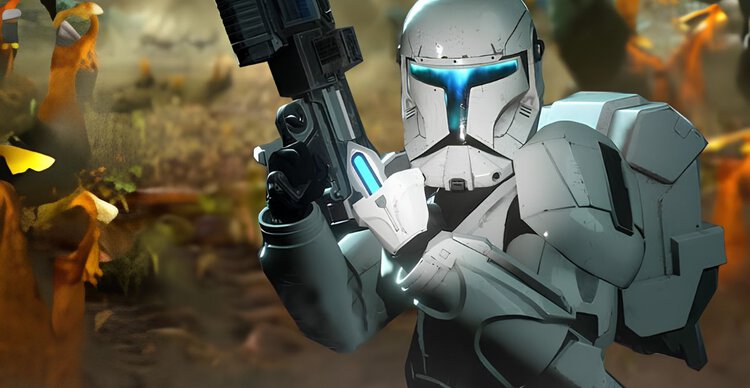
Clone commandos were rarely placed in ordinary infantry units because they had been trained for a completely different kind of warfare. Regular clone troopers fought in large formations, captured territory, and held the front lines, while commandos operated in small teams behind enemy lines. But if they were among the Republic’s most elite soldiers, why didn’t they usually fight alongside the rest of the clone army?
Clone Commandos Were Trained to Fight in Four-Man Squads
Clone commandos were organized into small, self-contained teams, usually consisting of four soldiers. Each member was trained to work closely with the others and could take on a particular role involving weapons, explosives, communications or battlefield medicine.
This structure can be seen throughout Star Wars: Republic Commando. Delta Squad does not march into battle as part of a large battalion. The four commandos infiltrate enemy facilities, sabotage important targets, gather intelligence and enter locations that regular troops cannot easily reach.
Their missions included destroying Separatist installations, rescuing captured personnel, eliminating priority targets and disabling enemy defenses before larger Republic forces arrived.
Regular clone troopers were designed to fight the main battle. They advanced in companies and battalions, defended Republic positions and confronted large droid armies directly. Commandos were instead expected to move quietly, complete a specific objective and withdraw.
That distinction became especially important after the First Battle of Geonosis.
Geonosis Showed Why They Should Not Be Used as Regular Infantry
During the First Battle of Geonosis, Jedi General Iri Camas was placed in command of approximately 10,000 clone commandos. However, Camas did not fully understand how specialized those soldiers were and deployed many of them like ordinary infantry.
The result was catastrophic.
Nearly half of the commandos were killed during the battle.
Instead of approaching specific targets in small teams, many were sent into an open battlefield filled with battle droids, artillery, armored vehicles and heavy Separatist fire. Their advanced armor and training could not protect them from being overwhelmed when they were placed into the same large-scale frontal assault as regular troops.
Their losses did not prove that clone commandos were ineffective. They showed what happened when elite special-operations soldiers were ordered to perform a job they had not been created for.
After Geonosis, the surviving commandos were far more valuable when deployed through the Republic’s special-operations forces. They could infiltrate an enemy position, destroy a shield generator or sabotage a facility while ordinary clone units handled the larger battle surrounding them.
Delta Squad’s missions in Republic Commando show how this system was supposed to work. The commandos would enter an area separately, complete an objective behind enemy lines and create an advantage for the rest of the clone army.
Commandos Could Fight Beside Regular Clones
A commando squad might be sent ahead of the main force to disable enemy defenses, recover intelligence or destroy an important target. Once the main clone army arrived, the commandos could support them, but they were not normally absorbed into standard infantry formations.
Gregor is one example. The official Star Wars Databank identifies him as the captain of a clone commando unit that fought during the Battle of Sarrish. He participated in a massive Republic campaign, but he still served as part of a specialized commando unit rather than as an ordinary frontline officer.
That is why clone commandos were usually seen operating separately from other clone troopers. Their four-man squads had been built for dangerous missions behind enemy lines, while regular clones were responsible for fighting and holding the main battlefield.