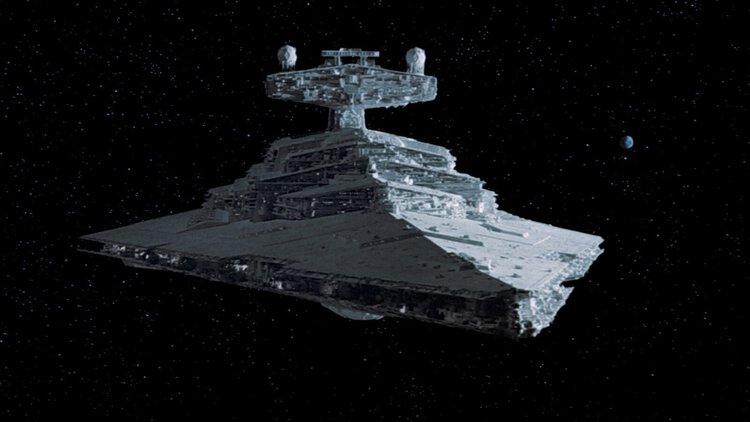
A single Imperial Star Destroyer appears above Earth and demands an unconditional surrender. Every country can see the same impossible warship, but Earth’s weapons have never faced anything like it. Can one vessel break the planet’s ability and willingness to keep fighting? That turns the debate into a contest between orbital power, Earth’s defenses, and political resolve.
Yes, One Star Destroyer Could Probably Force Earth to Surrender
The direct answer is yes. It does not need to destroy every army, invade every country, or control every city. It only needs to prove that continued resistance will cause unbearable damage while Earth has no reliable way to stop the ship.
This is also close to the vessel’s stated purpose in current Canon. The Canon entry for the Imperial-class Star Destroyer says a single Imperial I-class could subjugate an entire world or devastate it through orbital bombardment, citing the Canon reference book Starships and Speeders. The official Star Wars Databank describes the ship as a heavily armed capital vessel covered with turbolasers and tractor-beam projectors, with hangars for TIE fighters, boarding craft, land-assault units, and probes.
That does not mean Earth falls automatically. “A world” in Star Wars can have very different defenses from modern Earth. But Canon clearly treats one Imperial I-class as a ship built to break planetary resistance, not merely fight other spacecraft.
The Star Destroyer Wins by Staying in Orbit
Earth’s armies, tanks, artillery, and most aircraft are designed to fight enemies on or near the surface. A Star Destroyer has no reason to enter that battlespace. A disciplined commander would remain in orbit, where the ship can observe fixed targets and attack from a direction that conventional forces were never built to answer.
The first targets would not need to be whole cities. The Empire could strike a remote military installation, an empty section of ocean, or another visible target as a demonstration. Then it could demand that aircraft be grounded, missile systems be disabled, nuclear forces stand down, and national leaders accept surrender terms. If governments refused, the next attacks could hit air bases, naval facilities, command centers, launch sites, communications nodes, or other targets whose destruction would weaken Earth’s ability to coordinate a response.
The ship’s position is as important as its guns. Earth knows how to hit satellites, but a satellite follows a predictable orbit and does not carry shields, point defenses, starfighters, or a hyperdrive. The Center for Strategic and International Studies notes that the United States and other powers have demonstrated direct-ascent anti-satellite capabilities. That proves Earth can reach some objects in space. It does not prove that those weapons could track and destroy a maneuvering 1,600-meter Imperial warship designed for combat.
Could Earth’s Nuclear Weapons Destroy It?
Nuclear weapons are Earth’s strongest obvious answer, but cross-universe certainty is impossible. No real test tells us how a nuclear detonation would interact with fictional deflector shields. It would be dishonest to say that one warhead definitely breaks the shields, and equally dishonest to say that every nuclear weapon would bounce off harmlessly.
Delivery is the first problem. The Star Destroyer could operate above the normal range and flight profile of weapons intended for targets on Earth. A missile would also have to be detected, launched, guided toward a moving target, survive interception by TIEs or the ship’s weapons, and detonate close enough to matter. If the commander believed Earth was preparing a coordinated launch, the ship could change position, attack the launch infrastructure, or briefly withdraw and return.
A useful outside perspective comes from nuclear engineer T. Folse. In “Could the US Military beat just ONE Star Destroyer?”, he reacts to another creator’s power-scaling argument and agrees with its practical core: Earth has no proven answer to a shielded ship that can attack from orbit, intercept incoming weapons, maneuver away, or leave through hyperspace and return. He also stresses the absurd energy gap between human technology and a warship that powers shields, turbolasers, propulsion, and life support for tens of thousands of people.

Some numbers used in that video—including million-megaton turbolaser estimates, extreme acceleration figures, and claims that nukes would be like water balloons—come from sourcebook statistics or fan power-scaling rather than a clean current-Canon test against Earth. They are not necessary to reach the conclusion. The engineer’s strongest point is operational, not numerical: Earth must successfully hit and disable the ship, while the Star Destroyer can attack fixed targets, intercept threats, move, or disengage.
The Empire Has a Canon Example of Forcing Surrender From Above
The liberation of Lothal in Star Wars Rebels shows the method. Grand Admiral Thrawn returned aboard the Chimaera and bombarded Capital City. Ezra Bridger then went aboard the Star Destroyer to stop the attack. The official Thrawn Databank entry says Ezra voluntarily surrendered while the bombardment began, and the battle records that Ezra sought to end the bombardment by meeting Thrawn.
That is the model for conquering Earth. The Star Destroyer does not have to defeat every person who might resist. It attacks something leaders cannot protect, demonstrates that it can repeat the attack, and makes surrender the only way to prevent escalating destruction.
Lothal also shows what could change the outcome. The rebels activated large deflector shields around Capital City, limiting Thrawn’s ability to continue the bombardment. Modern Earth has bunkers, missile defenses, and hardened command sites, but it has nothing comparable to a Star Wars planetary shield. Without that defensive layer, every fixed target remains exposed.
Earth’s Best Chance Is to Refuse a Single Point of Surrender
The Star Destroyer can destroy targets much more easily than it can make every government sign the same document. Earth has nearly two hundred countries, several nuclear powers, separate chains of command, submarines, mobile missiles, hidden facilities, and no single world leader who can surrender for everyone.
That fragmentation is Earth’s best short-term advantage. One government might surrender while another continues fighting. Some military units might lose contact with their leaders and act independently. Submarines and concealed launch systems could survive the opening strikes. The Empire would need to identify which leaders and forces still had the ability to resist, then keep applying pressure until organized opposition stopped.
Yet fragmentation can also help the Empire. The commander could offer separate terms, threaten holdouts, and make examples of governments that continue launching attacks. Once several major powers surrender, others would face a terrible choice: keep fighting alone or accept the same terms before their own cities and military sites are hit. The Star Destroyer does not need perfect global obedience on the first day. It needs the remaining resistance to collapse faster than Earth can discover a reliable way to destroy the ship.
However, A Ground Battle Might Give Earth Its Best Opening
The Empire could make this fight harder than necessary by bringing the Star Destroyer into the atmosphere or landing large forces too early. Atmospheric operations reduce distance, make the ship easier to observe, and bring more human weapons into play. Scattered stormtroopers, walkers, and TIE bases would also become vulnerable to ambush, sabotage, captured equipment, and local knowledge.
The Canon specifications for an Imperial I-class list a standard contingent of about 9,700 stormtroopers. That is a frightening assault force, but conquering Earth does not require it to fight billions of people. The troops would be used selectively to seize surrender delegations, launch sites, command facilities, or other strategic locations after orbital pressure had already broken organized resistance.
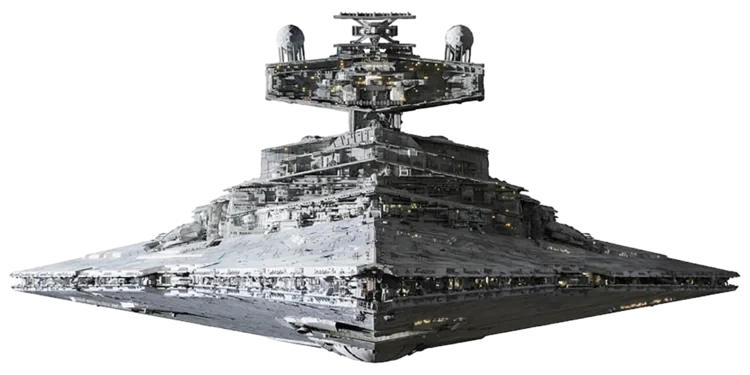
A reckless commander could lose by treating Earth like a normal ground invasion. A competent commander would not. The ship’s safest path to victory is to stay above the planet, preserve its forces, and use limited attacks to force a political and military surrender.