
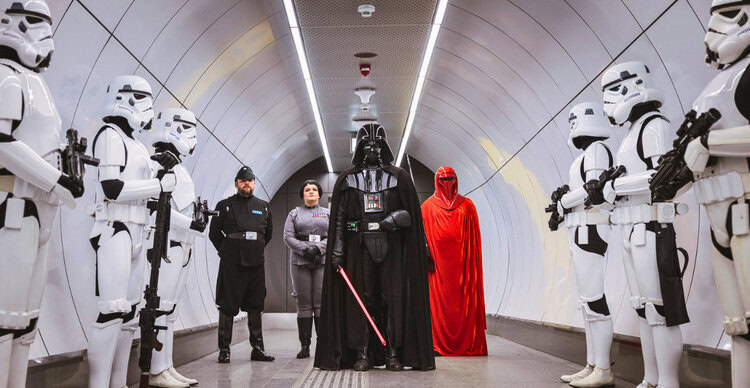
Darth Vader was hardly a friendly boss. He ruled through fear, punished failure brutally, and could kill a subordinate without warning. Yet Canon suggests that some stormtroopers genuinely admired him, not because he cared deeply about them, but because he was a powerful commander who fought beside them and usually delivered results.
Some Stormtroopers Clearly Respected Vader
The strongest evidence comes from the Canon novel Tarkin by James Luceno. Grand Moff Tarkin notices Vader’s natural rapport with the stormtroopers serving alongside him. Combined with Vader’s lightsaber technique, this helps Tarkin suspect that the mysterious Sith Lord was once Anakin Skywalker.
That detail matters because rapport is different from simple obedience. Imperial soldiers had to follow Vader’s commands, but Tarkin noticed a connection between him and the troops that reminded him of Anakin’s old leadership style.
Alexander Freed’s Canon novel Battlefront: Twilight Company also presents Vader as a legendary figure among Imperial forces. Even his enemies recognize the enormous reputation surrounding him. An official StarWars.com excerpt shows stormtroopers moving around Vader as an organized unit while he personally confronts the Rebels on Hoth.
This does not prove that every stormtrooper liked him. The Imperial military contained countless soldiers with different experiences and opinions. However, it does show that Vader inspired more than ordinary fear among at least some of the rank and file.
Why Vader Was Easy for Soldiers to Admire
Unlike many senior Imperial leaders, Vader regularly entered combat himself. He boarded enemy ships, attacked Rebel positions, piloted his own fighter, and personally hunted some of the Empire’s most dangerous enemies. The official Darth Vader Databank describes him as the Emperor’s ruthless enforcer, a role that repeatedly placed him near the fighting.
That probably mattered to stormtroopers. They were expected to advance into blaster fire and carry out dangerous orders, often for commanders who remained safely aboard a ship or inside a protected base. Vader, by contrast, was frequently at the front and he was usually the most dangerous person on the battlefield.
He also gave Imperial troops a visible symbol of strength. Palpatine was a distant political ruler, while Vader was the armored warrior they could watch cutting through the enemy. Imperial propaganda and military indoctrination likely made his reputation even larger.
For those reasons, “like” may not be the best word. Many troopers probably felt a mixture of respect, awe, loyalty, and fear. They did not need to think Vader was kind to see him as the Empire’s greatest warrior.
Stormtroopers Probably Had a Different View of Him Than Officers
Vader’s senior officers often experienced him as a terrifying judge of their mistakes as you can see how Vader killed Admiral Ozzel and immediately promoted Piett to replace him. The Captain Needa Databank similarly explains that Needa personally apologized after losing the Millennium Falcon, only for Vader to execute him.

Ordinary stormtroopers usually had simpler responsibilities: follow orders, hold a position, and attack the assigned target. They were less likely to stand before Vader and explain why an entire operation had failed. As a result, they could experience him mainly as the frightening commander winning battles beside them, while officers experienced him as the superior who might kill them for a bad decision.
However, this was only a general pattern. Vader did not automatically spare stormtroopers, nor did he execute every officer who failed. Admiral Piett survived several setbacks, while at least one innocent stormtrooper died simply because he saw something Vader wanted hidden.
Vader Did Not Always Value His Troopers’ Lives
One of the clearest examples appears in the Canon comic Star Wars (2015) #2, set during the Rebel attack on the Imperial weapons factory on Cymoon 1.
After an AT-AT attack damaged Vader’s helmet, an unidentified stormtrooper approached and accidentally saw his exposed face. The shocked soldier immediately apologized, but Vader used the Force to twist his head and kill him.
![Star Wars #2 [2015] (Audio Comic)](https://may4bewithyou.com/wp-content/plugins/wp-youtube-lyte/lyteCache.php?origThumbUrl=https%3A%2F%2Fi.ytimg.com%2Fvi%2FORbu1GC9PYU%2F0.jpg)
The trooper had not betrayed Vader, disobeyed an order, or deliberately removed his helmet. He was simply an unfortunate witness. Vader killed him to protect his identity and conceal his physical vulnerability.
The same comic storyline also shows Vader using stormtroopers as cover when Chewbacca fires at him. These moments make it difficult to argue that Vader consistently protected the soldiers under his command. He might have respected useful and capable troops, but he was still willing to sacrifice them when they became inconvenient or when the mission demanded it.
Was This a Remnant of Anakin’s Bond With the Clones?
There is a believable connection, although Canon does not state that it was the only reason Vader related well to stormtroopers.
During the Clone Wars, Anakin Skywalker was an active general who fought beside his soldiers. He developed close relationships with individual clones, especially Captain Rex. The official 501st Legion Databank describes the unit as tight-knit and fiercely loyal, while the Captain Rex Databank identifies Rex as a leader within Anakin’s forces.
Vader retained part of that command style. He continued to lead from the front, take battlefield risks, and inspire soldiers through visible strength. Tarkin recognizing his rapport with stormtroopers as an Anakin-like quality makes the connection especially convincing.
Still, Vader’s relationship with Imperial troops was not the same as Anakin’s friendship with the clones. Anakin knew soldiers personally, listened to them, and sometimes risked missions to save them. Vader was colder and more distant, and he served a regime built around fear and obedience. The instinct to fight beside his troops survived, but much of the personal compassion did not.