Star Wars has never been short on terrifying weapons, but the Death Star gets most of the attention. Beyond the films, ancient civilizations, Sith engineers, and even crime bosses found ways to destroy worlds, erase fleets, and turn entire populations into hostages. Their weapons could drain life, pull moons out of orbit, consume cities for raw materials, or attack from across the galaxy.
What Counts As A Major Superweapon?
A superweapon does not have to explode a planet. The label also covers weapons that devastate environments, wipe out fleets, or give one side an overwhelming military advantage.
That distinction matters when comparing their abilities. A fleet-killing ion cannon disables ships rather than breaking worlds apart. An automated factory threatens its enemies through production. A climate weapon can make a planet uninhabitable while leaving much of its physical structure intact.
This guide focuses on planet-devastating weapons and machines with exceptional strategic reach, rather than every experimental bomb. The Canon sections cover the current continuity. Everything under the Legends headings belongs to the older Expanded Universe, including the stories of Knights of the Old Republic and The Old Republic.
Where a weapon’s advertised power was never demonstrated, that limitation matters too. An inventor claiming to have built a universe-killer is different from a station actually destroying Alderaan.
Canon’s Planet Killers
1. The Death Star
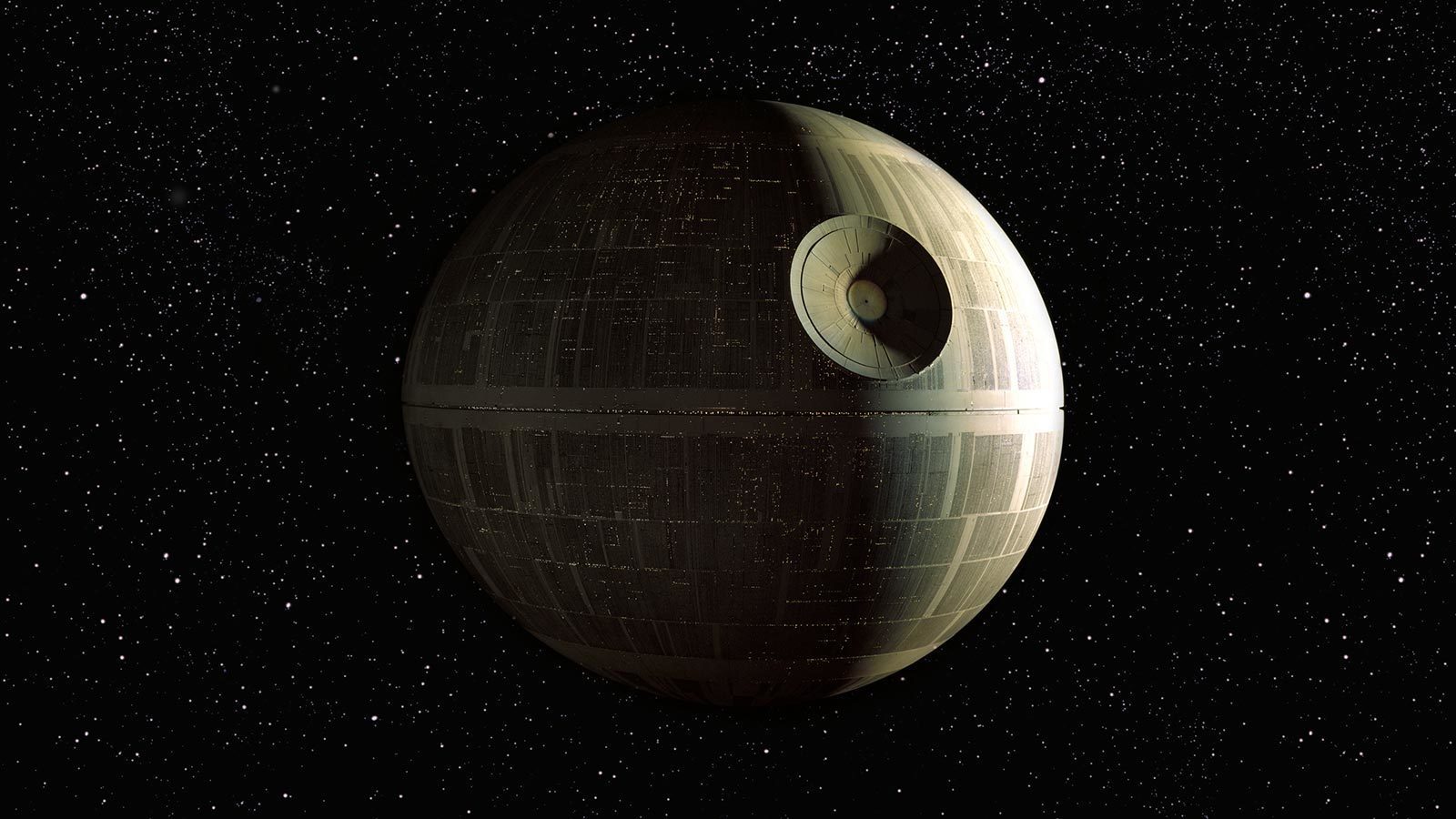
The original Death Star combined a mobile military base with a kyber-powered superlaser. Multiple tributary beams converged outside its focusing dish into one destructive beam, concentrating enough energy to destroy an entire planet. Alderaan’s destruction showed the result at full power: the Empire could eliminate a world without landing an army or fighting through its cities.
Its power could also be scaled down. In Rogue One, the single-reactor ignition attacks on Jedha City and Scarif devastated their targets without immediately blowing apart the entire planet. The beam’s direct impact was only the beginning. Expanding destruction carried the damage far beyond the point where it struck.
The station’s hyperdrive made that firepower mobile. The Empire could move its threat between systems, while its conventional guns, TIE fighters, troops, and internal facilities supported its role as a heavily defended base. The superlaser supplied the ultimate threat; the surrounding military infrastructure helped deliver it.
Its weakness was the connection between the station’s systems and its central reactor. Galen Erso deliberately introduced a reactor vulnerability, and the stolen plans allowed the Rebels to identify an attack route through a thermal exhaust port. Luke Skywalker’s proton torpedoes triggered the chain reaction that destroyed the station at Yavin.

2. The Death Star II
The second Death Star improved on the original’s most obvious battlefield limitation. Its operational superlaser could accurately engage Rebel capital ships, making it useful against moving military targets as well as worlds.
At Endor, that ability turned the unfinished station into an active participant in the battle. It could destroy major warships with individual shots while the Imperial fleet prevented the Rebels from escaping easily. The Alliance was caught between conventional naval firepower and a weapon capable of removing its largest vessels from the fight.
The important improvement was controlled, repeated fire against a fleet. The Empire did not need to unleash a planet-destroying discharge every time it fired. The station could use its main weapon at a level appropriate to a smaller target, giving it a role beyond threatening inhabited worlds.
Its protection also depended on an external shield projected from Endor. That shield prevented the Rebels from exploiting the incomplete superstructure until the ground team destroyed the generator. Once the shield fell, fighters could fly inside the unfinished station and attack its reactor directly.
The second Death Star therefore failed before its construction was complete, but after its main weapon had already demonstrated a dangerous new capability.

3. Starkiller Base
The First Order converted the former Jedi crystal world of Ilum into Starkiller Base, carving a weapon into a planet rather than constructing another artificial moon.
Its defining ability was combining stellar energy harvesting with extreme-range attack. Starkiller drew energy from a star and contained the accumulated power within the planet. Its weapon then sent that energy through hyperspace, allowing it to strike a distant system without moving a battle station into firing position nearby.
One discharge could attack multiple worlds. The beam divided into separate streams during the attack on the Hosnian system, destroying Hosnian Prime and neighboring planets. The First Order could therefore eliminate a political center and surrounding worlds in one operation, rather than firing at them individually.

That reach came with major operating requirements. Starkiller needed to harvest stellar energy before firing, and its thermal oscillator was essential to maintaining the energy stored inside the planet. Its enormous destructive output depended on keeping that containment system stable.
The Resistance exploited that dependence. Ground infiltration lowered the shields, explosives damaged the oscillator, and Poe Dameron’s attack finished the job. The resulting failure released the energy the planet had been holding, destroying the base before its next shot.
Xyston-Class Sith Star Destroyers
The Sith Eternal’s Xyston-class Star Destroyers distributed planet-killing firepower across a fleet. Each vessel carried a ventral axial superlaser, allowing a warship far smaller than the Death Star to destroy a world.
Kijimi’s destruction demonstrated the weapon’s actual output. A single ship could fire into a planet and trigger its destruction, making every deployed vessel a potential instrument of planetary extortion.
The fleet’s greatest advantage was simultaneous deployment. A single Death Star could threaten whichever system it occupied. Multiple Xystons could spread across the galaxy, forcing defenders to confront many independent planet-killers instead of concentrating their forces against one station.
However, the superlaser also created a dangerous vulnerability. Its connection to the ship’s power systems meant that destroying the exposed weapon could produce a catastrophic internal reaction. Resistance pilots exploited that weakness at Exegol.
The fleet also entered battle under especially unfavorable conditions. Its ships needed navigational guidance to escape Exegol, and they could not raise their shields while trapped in the planet’s atmosphere. Those circumstances allowed the Resistance and its reinforcements to attack the planet-killers before they dispersed.

Canon’s Other Ways To Devastate A World
4. The Malachor Temple Weapon
The Sith temple on Malachor concealed a kyber-powered superweapon whose ancient discharge left the surrounding battlefield filled with petrified combatants. Jedi and Sith alike remained frozen in the aftermath, showing that the weapon’s effects did not spare the side that built it.
Its destructive role was different from the Death Star’s. The temple could unleash devastating energy against life around it, rather than simply drilling a beam into a planet until the world exploded. The battlefield provided evidence of mass death, although the story does not establish a precise maximum range.
A Sith holocron functioned as the key to its activation. In Rebels, Ezra Bridger placed one in the temple’s obelisk, beginning a sequence that transformed the structure into an active weapon. That made access to Sith knowledge part of operating the machine, alongside its physical machinery.
Removing the holocron interrupted the activation. The temple then destabilized and collapsed while Ahsoka fought Vader inside.

This is not the Mass Shadow Generator from Knights of the Old Republic II. Canon’s Malachor weapon releases destructive energy through a Sith temple. Legends’ Malachor V weapon manipulates gravitational forces to crush ships and devastate the planet.
5. Starflash
The Chiss weapon Starflash used a star as an amplifier. It fired a burst of energy into the sun, provoking a vastly more powerful return discharge toward the weapon’s position.
That targeting arrangement explains its use during the ancient defense of Csilla. The operators brought Starflash into the middle of an invading fleet before activating it. The return blast struck the area around the weapon, destroying enemy ships gathered there.
Its destructive power came with a built-in sacrifice. Starflash was caught in the same discharge as its targets. The weapon and all twenty Chiss operating it were destroyed, making its positioning essential to the attack.
The damage also extended beyond the battlefield. Csilla’s sun gradually dimmed afterward, contributing to the freezing conditions that drove much of the population underground. The defenders had saved their world from invasion while damaging the star that sustained it.
Unlike the Legends Sun Crusher, Starflash did not simply induce a supernova. Its known effect was an amplified return blast, followed by a lasting change to the affected sun.
6. Operation Cinder’s Climate-Disruption Arrays
Operation Cinder attacked a world’s environment through orbiting climate-disruption arrays. Instead of firing one planet-breaking shot, the satellites provoked catastrophic storms and hurricanes across the surface.
The resulting destruction could spread through several systems at once. Violent weather threatened people directly, damaged buildings and power networks, and made evacuation more difficult. On Vardos, enormous electrical storms appeared within minutes of activation.
The weapon turned the atmosphere into a continuing attack. Defenders had to deal with worsening conditions on the ground while also reaching and destroying the satellites above them. Imperial ships and troops could further obstruct escape or interfere with attempts to stop the array.
Vardos also showed that loyalty offered no protection. Cinder targeted Imperial populations as part of Palpatine’s posthumous punishment campaign, helping drive Iden Versio away from the Empire.
Cinder was the operation, not the name of one enormous satellite. Its arrays were environmental weapons capable of devastating inhabited worlds without reducing those planets to rubble.

Legends’ Ancient Machines Could Move Worlds Or Build Armies
7. Centerpoint Station
Centerpoint Station operated on a scale far beyond ordinary tractor beams. Its ancient systems could project a powerful tractor-repulsor effect through hyperspace, allowing it to influence distant celestial bodies rather than only objects floating nearby.
That technology was associated with the assembly of the Corellian system. Moving planets and stars required the ability to exert forces that conventional ships could barely approach, making Centerpoint both an engineering marvel and a potential weapon.
Its reach was as dangerous as its raw power. A station capable of affecting distant targets through hyperspace did not have to sail toward an enemy world like the Death Star. Its systems could be weaponized to destroy stars or unleash catastrophic attacks against fleets.
That power demanded precise control. During the Yuuzhan Vong War, a discharge devastated allied Hapan ships as well as the intended enemy forces, showing how disastrous an imperfectly directed shot could become.
Centerpoint’s threat therefore went beyond being a very large cannon. It could turn the machinery of planetary construction into long-range destruction, with consequences extending far beyond the operator’s immediate surroundings.

8. The Star Forge
The Rakatan Star Forge was an automated manufacturing station that drew matter and energy from a nearby star and combined those resources with the Force. It produced warships, droids, weapons, and other military equipment on an extraordinary scale.
Its ability solved one of warfare’s most difficult problems: replacing losses. A conventional navy needs shipyards, workers, transported materials, and time. The Star Forge brought vast amounts of that production into one installation supplied by a star.
Its superweapon was the army it could keep building. An enemy might win an engagement and still face fresh ships and droids afterward. Destroying the forces already deployed did not remove the source producing them.
The station was also deeply connected to the dark side. It fed on dark-side energy and exerted a corrupting influence, making control of its production inseparable from the danger of the machine itself.
Its output was immense, but it was still a physical installation that could be attacked. In the established Legends outcome of Knights of the Old Republic, Revan defeated Malak and the Republic destroyed the Forge, removing the manufacturing center sustaining his war.

9. The Cosmic Turbine
The Cosmic Turbine was an immense gravity-manipulating machine in the Vultar system. It belonged to a collection of ancient devices associated with the construction or arrangement of celestial bodies.
Its known ability was large-scale gravitational manipulation. That placed it in the same broad category as machinery capable of moving planets, although surviving accounts do not provide a complete explanation of its controls or operating limits.
Its demonstrated destructive effect was the Vultar Cataclysm. Dark Jedi attempted to use the ancient machinery against the Jedi Order, but their activation destroyed the system and killed the would-be operators.
That outcome establishes enormous destructive potential, but it does not establish a reliable targeting system. There is no successful demonstration of the Dark Jedi selecting a distant system and destroying it on command.
10. The Infinity Gates
The Kwa built Infinity Gates as a transportation network, allowing movement between distant locations without an ordinary voyage through space. The gates could also channel destructive energy in the form of Infinity Waves.
That second function turned the network’s reach into a weapon. An Infinity Wave could be directed toward a distant world, threatening destruction without a conventional fleet first appearing in orbit.
The same infrastructure that connected worlds could deliver an attack between them. Its danger came from combining exceptional range with a devastating energy phenomenon, rather than mounting a larger gun on a warship.
In Infinity’s End, the Nightsister Zalem attempted to use the Dathomir gate against Coruscant. Quinlan Vos stopped the attack by redirecting the wave back toward its source.
That reversal also exposed the weapon’s dependence on control of the gate. The energy could be redirected, and the installation unleashing it could become its victim.

11. The Sun Razer
Darth Mekhis’s Sun Razer extracted stellar matter and energy for industrial production. Its enormous structure surrounded a suitable star, using that supply to support the manufacture of advanced ships and superweapons.
It followed the Star Forge’s strategic idea: turn a star into the resource base for a military production system. The Sun Razer could support projects whose construction would otherwise demand enormous conventional infrastructure.
Its power lay in enabling several different weapons programs. Destroying one of the ships it supplied would not necessarily stop the next project. The factory behind the weapons was the more valuable target.
Its proximity to the star also imposed a major weakness. Protective shielding was essential to surviving the environment it exploited. Disabling that protection exposed the installation to the stellar forces surrounding it.
Legends Turned Gravity And Space Rocks Into Weapons
12. Planechanga
The ancient Hutts built Planechanga, enormous tubular railguns designed to accelerate asteroids to planet-destroying velocities.
The mechanism relied on electromagnetic acceleration. Rather than producing a destructive beam, the weapon imparted tremendous speed to a solid projectile. The asteroid delivered the energy when it struck its target.
The projectile did not need an exotic warhead. Its mass and velocity supplied the destructive effect, turning naturally occurring material into planetary ammunition.
That distinction separates Planechanga from weapons such as the Galaxy Gun, whose guided projectiles carried specialized disintegrator warheads. Planechanga’s essential concept was the impact itself.
The surviving descriptions establish their intended planetary destructive role, but provide less detail about their targeting, firing rate, or defensive systems. Their history belongs to the ancient Hutt Empire, when Hutt power included industrial warfare on a scale far beyond the criminal organizations familiar from the films.
13. Hammer Station
The Republic’s Hammer Station combined asteroid collection with a massive gravity cannon. Tractor technology captured space rocks, and the cannon hurled them at planetary targets or enemy capital ships.
That made surrounding debris a source of ammunition. The station did not need every destructive projectile manufactured in a distant factory before deployment; it could weaponize material already available in space.
Its damage extended beyond the impact crater. A strike could devastate a city, while groundquakes and atmospheric dust spread the consequences farther. Repeated bombardment threatened destruction on a planetary scale without requiring one shot to physically break the world apart.
Its ability to engage capital ships also gave it a naval role. The same system used for planetary bombardment could launch massive projectiles at an opposing fleet.
The Republic abandoned the project because its effects were too indiscriminate. The Advozse Hegemony later recovered the station and used its gravity cannon to intimidate and conquer other worlds.

14. The Mass Shadow Generator
Bao-Dur designed the Mass Shadow Generator under Revan’s orders. The weapon exploited Malachor V’s gravitational conditions, producing a catastrophic effect across the battlefield above and around the planet.
When Meetra Surik ordered its activation, ships were dragged downward and crushed. Hull strength, formation, and ordinary maneuvering offered little protection against the gravitational catastrophe engulfing them.
The weapon did not distinguish between allied and enemy vessels. Mandalorian and Republic forces were destroyed together, making its use a decision to sacrifice part of the Republic’s own fleet to end the battle.
Malachor V was shattered and left as a broken, unstable world. The mass death also created consequences through the Force, becoming central to Surik’s separation from it and her later identity as the Jedi Exile.
Its known operation was tied to Malachor V, so it should not be treated as a proven portable device that could reproduce identical results anywhere. Years later, Bao-Dur’s remote activated it again, destroying the planet’s remains in the established Legends outcome.

15. Yo’gand’s Core
Yo’gand’s Core was a Yuuzhan Vong tactic built around the abilities of a dovin basal, a living organism capable of manipulating gravity.
Placed on a planet, a sufficiently powerful dovin basal could exert a gravitational pull on an orbiting moon. As the moon’s orbit deteriorated, the satellite fell toward the world below.
The moon became the weapon. Its immense mass supplied the destructive impact, allowing the attackers to threaten a planet without constructing a mechanical planet-killing cannon.
The tactic also shifted the defensive problem. Finding the organism and stopping its gravitational influence mattered more than exchanging fire with an enemy fleet. A planetary disaster was being driven by a comparatively concealed living weapon.
The invaders used the tactic at Sernpidal, bringing down the moon Dobido. Chewbacca died during the evacuation after helping save Anakin Solo, making the attack one of the Yuuzhan Vong invasion’s most devastating early events.
16. The Shock Drum
The Republic’s Shock Drum emitted concentric ultrasonic waves into the ground. It was designed to weaken enemy fortifications, using sustained vibration to compromise defenses.
Its effects escalated the longer it remained active. Vibrations could disrupt equipment, injure living beings, and produce increasingly severe seismic disturbances. The danger therefore came from continued operation rather than one instantaneous detonation.
A local siege weapon could become a planetary threat. Researchers concluded that prolonged activation could destabilize the world on which it stood, potentially leading to planetary destruction. The Republic shut the project down after recognizing that risk.
That escalation made locating the device urgent. Fighting the troops protecting it would not stop the accumulating damage unless the Shock Drum itself was disabled.
The prototype later threatened Tatooine after the Sith seized it. Its ability to destroy an entire planet remained the feared outcome of leaving it active, rather than a completed test that had already shattered a world.
Legends’ Force Relics And Doomsday Projects
17. The Dark Reaper
The Dark Reaper combined destructive energy projection with a particularly horrifying power source. Its associated Force Harvester drained Force energy from living beings, killing victims to supply the weapon.
That energy could then be focused into destructive beams. The system therefore threatened enemies in two ways: through the harvesting process and through the attacks powered by what it collected.
Being outside the path of its main gun did not necessarily mean being safe. Living beings within the Harvester’s effective area could become fuel before the Reaper fired at another target.
That also made its defenses unusual. Ordinary battlefield protection did not address the life-draining effect. Knowledge of how to resist that process was essential to approaching and fighting the weapon successfully.
Dooku recovered the ancient Sith machinery during the Clone Wars in the Legends game Star Wars: The Clone Wars. Anakin learned how to resist its effects through knowledge left by Ulic Qel-Droma, then destroyed the Reaper on Thule.
This story belongs to the older game continuity, rather than an unshown episode of the current animated series.

18. The Desolator
Darth Angral’s Desolator combined stolen Republic weapons research into a multi-stage attack system aboard his flagship.
Its first stage used technology derived from the Planet Prison project to ionize a world’s atmosphere. That effect disabled ships attempting to pass through it, trapping the population and interfering with escape.
The next stage ignited the ionized atmosphere, turning the air above the surface into a planetary firestorm. Technology derived from the Shock Drum then supplied intense seismic vibrations intended to destabilize the planet’s core.
Each stage made the next more lethal. First the weapon prevented evacuation, then it attacked the surface through the atmosphere, and finally it threatened the world’s internal stability. Its purpose was comprehensive devastation rather than a single clean impact.
The combination also inherited operating limitations, including substantial charging requirements. This was a process that needed time and power, not an unlimited sequence of immediate shots.
Uphrades became its first and only successful test target. Angral later threatened Tython, but his flagship and weapon were destroyed before he could repeat the attack.
19. The Infant Of Shaa
The Infant of Shaa concealed its danger inside a small religious statuette. The artifact stored Force energy that could be released to trigger catastrophic destruction.
Its planned use against Coruscant depended on placing it near a massive power installation. The stored energy and the surrounding infrastructure would combine to produce a disturbance feared capable of tearing the world apart.
Its size was its delivery advantage. A person could carry it into a target area. Defenders would not receive the obvious warning of a battle station arriving overhead, and conventional planetary defenses would be poorly suited to stopping an artifact already inside a power facility.
That does not establish that it could destroy any planet simply by being dropped anywhere. The chosen location and its enormous energy supply were central to the Coruscant plot.
Ashaar Khorda intended to use it for that attack, but Yarael Poof stopped the catastrophe with help from Jango Fett and Zam Wesell. Its world-ending potential remained a threat prevented before completion.
20. The Shawken Device
The Shawken Device was designed around a proposed chain reaction beginning with the destruction of its own world.
Its creator imagined fragments of Shawken striking other planets, destroying them and generating more debris. That process would supposedly continue outward until it consumed the universe.
The proposed ability was self-propagating destruction. Unlike a gun requiring another shot for every target, the device was intended to make its first victim create the conditions for the next catastrophe.
However, the story never demonstrated that the chain reaction would work. Neither its spread between worlds nor its ultimate universal reach was confirmed.
Luke Skywalker and Kiro shut the device down after an accidental activation. It belongs among Star Wars’ most extreme doomsday designs, but calling it a proven universe-killer would turn its creator’s theory into an established accomplishment.
Legends’ Empire Kept Reinventing The Death Star
21. The Death Star Prototype
The Death Star prototype was a skeletal test platform built at the Maw Installation. It retained the essential relationship between a huge reactor, a superlaser, and the structure needed to operate them, without the finished station’s enclosed military city.
Its weapon had less power than the completed Death Star’s. It could nevertheless inflict catastrophic damage on planetary targets and demonstrated enough output to destroy a moon.
It was a dangerous artillery platform with much less surrounding infrastructure. The missing outer structure made its experimental nature obvious, but did not make its main weapon harmless.
Its performance also exposed the difference between having destructive power and using it effectively. During its escape from the Maw, a shot intended for Kessel missed the planet and destroyed its moon instead.
The prototype was therefore neither a fully functional third Death Star nor an empty construction frame. It was a surviving weapons test bed whose central experiment remained capable of mass destruction.
22. The Tarkin
The Tarkin concentrated the Death Star concept around its primary weapon: a planet-destroying superlaser supported by propulsion, defenses, and the machinery needed to fire it.
Its destruction of Aeten II demonstrated a practical application beyond terror. The blast broke the planet apart and exposed deeply buried stygium crystals, allowing the Empire to collect materials for cloaking technology.
One superweapon could therefore support another military program. The laser supplied access to resources that ordinary mining had not made available on the same scale, linking planetary destruction with the development of stealth technology.
The design still depended on safely controlling and directing enormous energy. During a Rebel infiltration, Leia sabotaged its firing systems, turning that dependence against the station.
The weapon destroyed itself when it attempted to fire. Its final weakness lay in the machinery controlling its own destructive output, rather than any lack of power against external targets.
23. The Conqueror
The Conqueror mounted an experimental superlaser on an Imperial Star Destroyer, placing unusually destructive firepower inside a more conventional naval platform.
Its projected output included breaking apart a small moon or cracking a continent. A test against a small planetoid demonstrated destructive capability, although that result should not be treated as equivalent to destroying an inhabited planet the size of Alderaan.
Its advantage was combining a warship’s mobility with a much heavier main weapon. A commander could deploy it as part of a fleet rather than depend on an enormous spherical station.
The distinction in power matters. A weapon that can devastate a continent would still be strategically terrifying, even without the ability to make every target planet explode.
Renegade Squadron stopped the project by infiltrating the ship and planting explosives near its reactor. The weapon’s unusual firepower did not protect it from sabotage inside its own hull.
24. Eclipse-Class And Sovereign-Class Dreadnoughts
The Eclipse class combined a massive warship with an axial superlaser aligned along its length.
Its main weapon could penetrate planetary shields, vaporize cities, devastate a world’s surface, and destroy huge capital ships. It did not need to match the Death Star’s full planet-shattering output to make normal defenses inadequate.
Shield penetration made it especially dangerous against fortified worlds. A planetary shield that could withstand conventional bombardment was much less reassuring when a dreadnought could direct a superlaser through it.
The class also carried extensive conventional armament and gravity-well projectors. Those systems supported a wider role: fighting fleets, controlling escape routes, and delivering devastating attacks with the axial weapon.
The planned Sovereign class pursued a related combination in a smaller dreadnought, including an axial superlaser and interdiction capability. Its intended specifications should be distinguished from the Eclipse class’s demonstrated service.
The Legends Eclipse class should also not be confused with the Canon ship named Eclipse. The shared name does not transfer the older design’s superlaser into current continuity.

25. The Darksaber
Durga the Hutt commissioned the Darksaber battle station as a stripped-down Death Star. Bevel Lemelisk removed much of the surrounding structure, leaving a superlaser inside a long cylindrical casing.
The intended ability remained planetary destruction. Durga wanted the threat of a Death Star without paying for the enormous station around its weapon, creating a tool for extortion on a scale ordinary criminal forces could not match.
The design reduced the platform, not the ambition. Its lightsaber-like shape gave it the Darksaber name, but it had no connection to the black-bladed Mandalorian weapon.
The actual construction failed to deliver that intended power. Poor materials, unreliable components, and errors during assembly left the firing system unable to function when needed.
When Durga tried to use the laser to clear a path through an asteroid field, it failed. The station was crushed between asteroids before it demonstrated the planetary destruction its owner had purchased.
Legends’ Strangest Ways To Destroy A World
For a visual guide to the Galaxy Gun, World Devastators, and other Legends designs:

26. The Sun Crusher
The Sun Crusher placed system-threatening power inside a small spacecraft. Its resonance torpedoes penetrated stars and triggered the instability that produced a supernova.
Instead of attacking every planet separately, the craft attacked the star supporting the entire system. The resulting stellar catastrophe threatened surrounding worlds regardless of their surface defenses.
It carried eleven resonance torpedoes. That gave a comparatively small vessel a limited but extraordinarily destructive supply of specialized ammunition. Its ability to destroy systems depended on those weapons, rather than on an endlessly firing onboard planet-killing beam.
Its quantum-crystalline armor supplied the other half of the threat. The hull could survive punishment and environments that would destroy ordinary ships, making interception exceptionally difficult.
That durability was not absolute invulnerability. The craft could still suffer damage or lose functions, and its armor did not prevent it from being lost into a black hole.
Kyp Durron’s destruction of Carida demonstrated the consequences of placing that combination in one person’s hands. The threat eventually ended in the Maw’s black holes.
27. The Galaxy Gun
The Galaxy Gun fired guided projectiles equipped with hyperdrives and particle-disintegrator warheads. Its ammunition traveled through hyperspace to distant targets, allowing the launcher to remain near the heavily defended Imperial stronghold of Byss.
After reaching the target, the warhead produced a destructive disintegration reaction. At sufficient power, that effect could consume a world.
Its projectiles were protected delivery vehicles. They carried armor, deflector shields, and defensive weapons, making them much harder to intercept than an ordinary unprotected missile.
The destructive effect could also be adjusted for targets smaller than planets. That flexibility allowed the weapon to attack installations or ships as well as threaten total planetary destruction.
Its main strategic advantage was separating the launcher from the battlefield. Defenders could face an incoming attack without an enemy battle station appearing in their system, while striking back required reaching the weapon at its distant base.
That made the Galaxy Gun an instrument of long-range coercion during Palpatine’s return in Dark Empire.
28. World Devastators
World Devastators used powerful tractor beams to tear material from a planet’s surface and feed it into molecular furnaces. Their internal factories processed that material into military equipment.
Cities, terrain, and infrastructure became raw resources. The machines could destroy territory while producing ships, droids, and weapons to continue the campaign.
Their attack supplied their own war effort. Conventional invaders must maintain supply lines to replace equipment. World Devastators could consume the battlefield and manufacture replacements locally.
Their autonomous systems also allowed them to grow and improve as they acquired material. Given sufficient resources and time, they could expand their capabilities and produce additional Devastators.
That made them progressively more dangerous if left operating. They did not need one Death Star-style explosion to destroy a civilization; they could dismantle its inhabited surface while building the forces that prevented resistance.
Their assault on Mon Calamari demonstrated that cycle. However, their automated control systems also offered a vulnerability: interfering with their programming could turn the machines’ own processes against them.
29. The Orbital Nightcloak
An orbital nightcloak deployed a network of satellites around a planet to block incoming sunlight and other electromagnetic energy.
The immediate effect was darkness. The longer-term consequences included falling temperatures, the failure of photosynthesis, and worsening ecological conditions. A world could become increasingly difficult to inhabit without being struck by a conventional bombardment.
It attacked the energy supply of the entire environment. Farms, natural ecosystems, and settlements all depended on conditions that the nightcloak could steadily undermine.
The system also interfered with communications, isolating the population while conditions deteriorated. Imperial forces could use that isolation to increase pressure for surrender.
Its barrier did not physically prevent ships from passing through. A separate naval blockade was therefore important if the Empire wanted to stop evacuation or outside intervention.
The nightcloak was a siege weapon whose effectiveness grew with time. Its operators could threaten a world’s survival while preserving the possibility of occupation if the population surrendered.
30. Trigon One
The Trigon One was a weapons satellite developed by the Fromm Gang. Tig Fromm claimed that its full power could destroy a planet, giving his family a potential advantage far beyond ordinary criminal firepower.
Its appeal lay in concentrating that threat inside a controllable orbital weapons platform. Rival gangs could resist troops or hired gunmen; a credible threat against an entire world would change the balance of power.
However, the story never demonstrated its advertised planetary output. Its reputation should therefore be described as a claim, rather than an accomplishment comparable to Alderaan’s destruction.
Its guidance system proved to be a more immediate weakness. Thall Joben and R2-D2 sabotaged it, sending the weapon into the Fromms’ own base.
Trigon One showed how the superweapon arms race could reach criminal organizations, but its limited operational history leaves much less evidence about its abilities than the galaxy’s proven planet-killers.
Other Superweapons Worth Knowing
These weapons operated on a smaller scale than the greatest planet-killers, but their specialized abilities could still decide a battle or devastate a population.
31. Malevolence
The Separatist Malevolence carried enormous ion cannons that released expanding energy pulses against enemy vessels.
Its main weapon disabled electrical systems rather than relying on direct hull destruction. Ships caught in the pulse could lose the functions needed to maneuver, defend themselves, or escape, leaving them vulnerable to the cruiser’s conventional weapons.
That made it a weapon for breaking an entire formation’s ability to fight. An enemy ship did not need to be physically destroyed by the ion blast to be effectively removed from battle.
The system’s size also created a valuable target. During the attack on the Republic medical station, Anakin’s strike force damaged one of the ion weapons, and the attempted firing caused a catastrophic malfunction.
32. The Arc Pulse Generator
Sabine Wren’s Arc Pulse Generator, nicknamed the Duchess, targeted the beskar alloy in Mandalorian armor.
Its energy pulse superheated the metal, killing the person wearing it. Armor that normally offered exceptional protection became the mechanism delivering the attack.
Its selectivity was the central ability. The weapon could attack Mandalorians while sparing nearby Imperial stormtroopers whose armor used a different material.
However, that distinction depended on its settings. Sabine demonstrated that it could be retuned against Imperial armor, showing that its apparent loyalty to one side came from engineering rather than any inherent limitation.
Its destructive effect did not require planetary scale. The ability to kill armored troops across an engagement made it a weapon capable of breaking Mandalorian resistance.
33. The Defoliator
Lok Durd’s Defoliator used specialized artillery warheads to destroy organic matter while leaving battle droids intact.
Its detonation spread a destructive effect across the target area, killing vegetation and living beings without treating mechanical troops the same way.
That gave a droid army a selective battlefield advantage. Separatist forces could use it against living defenders and their surroundings while retaining the machines needed to advance afterward.
The weapon was deployed from a modified Armored Assault Tank equipped with a heavy launcher. That made it battlefield artillery, rather than a space station or an independently demonstrated planet-killer.
Its cruelty came from what it selected: the presence of life itself.
34. The Electro-Proton Bomb
The Republic’s electro-proton bomb delivered a large-scale electromagnetic attack designed to disable droid forces.
Used on Malastare, its expanding pulse swept across the Separatist army and neutralized machines over a wide area. It offered the Republic a way to stop a mass droid assault without having to destroy every unit individually.
Its intended advantage was destroying the enemy’s ability to function while sparing living troops from the same disabling effect. That did not mean its use was free of other physical consequences.
The detonation destabilized the ground and opened a huge sinkhole, awakening the Zillo Beast below. Its first major use therefore demonstrated both its anti-droid effectiveness and the danger of treating an experimental weapon’s intended effect as its only effect.
35. The Skara Nal Walker
The ancient Skara Nal walker combined a towering mobile body with a powerful head-mounted energy weapon.
Once activated in The Bad Batch, it emerged from its resting place and began firing across the surrounding landscape. Its beam could sweep through terrain and destroy structures, giving the machine a clear ability to devastate its immediate environment.
Its mobility allowed it to continue that destruction beyond one fixed firing position. The walker was not merely a dormant temple cannon; it could physically advance while attacking.
The Heart of the Mountain crystal controlled its dormant state. Removing it awakened the machine, while returning it stopped the attack and led to the walker’s destruction.
The episode establishes a dangerous ancient war machine, but does not demonstrate the ability to explode an entire planet or define its maximum range.

36. The Silencer
Legends’ Silencer was a ship-mounted megalaser developed for the Sith Empire.
Its main ability was destroying capital ships with concentrated fire, then recharging quickly enough to engage further targets. That combination allowed it to threaten a fleet through successive devastating shots.
Its firing cycle mattered as much as the power of one blast. A weapon that can destroy one warship becomes much more decisive when it can repeat the attack before the surrounding formation can respond effectively.
Installing the system also required substantial space aboard its host vessel, including modifications to the forward hangar area on Silencer-equipped dreadnoughts.
It belongs among the fleet-killers, rather than being treated as another proven planet-destroying Death Star. Its purpose was to dismantle an enemy navy quickly enough that the worlds behind it would lose their protection.
The most dangerous weapon was not always the one with the biggest explosion. Some bypassed fleets, some turned armor against its wearer, and others destroyed the systems that allowed a world to survive. Understanding what each one attacked explains why the galaxy had so many different reasons to fear them.