
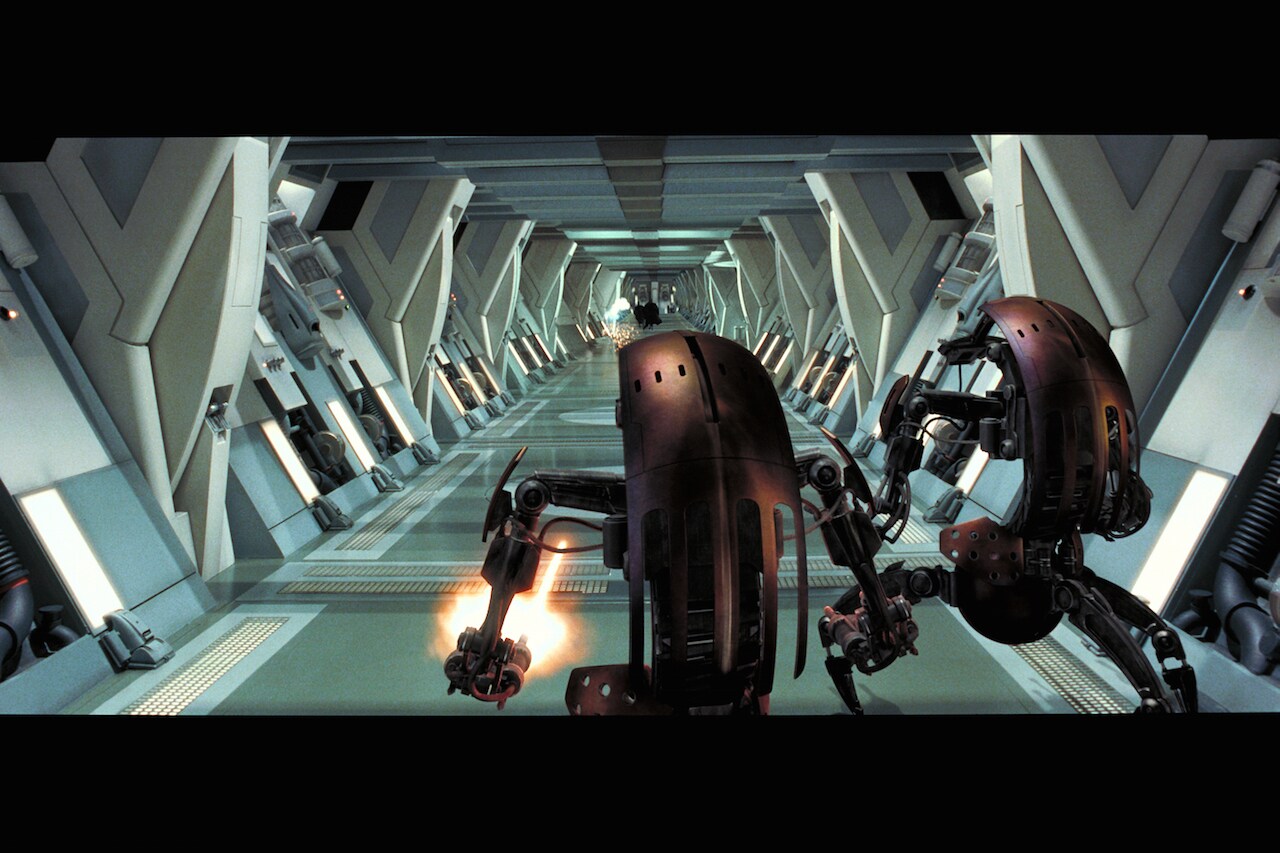
Droidekas enter a fight like a punchline: a metal wheel rolls into the room, unfolds, and suddenly everyone has a problem. In The Phantom Menace, even Qui-Gon Jinn and Obi-Wan Kenobi decide that standing their ground is a bad idea. Later stories show Jedi and clones beating the same type of droid with rockets, grenades, speed, or very clever timing. So how can all of those scenes be true at once?
The Phantom Menace Already Shows the Real Threat
The cleanest test is the first major droideka scene. Qui-Gon and Obi-Wan are already cutting through ordinary battle droids aboard the Trade Federation flagship when destroyer droids arrive. The two Jedi can block the incoming shots, but their lightsabers cannot break the shields. They retreat instead of staying in a fight where they have no reliable way to hurt the enemy.

That does not mean two droidekas are stronger than two Jedi in every situation. It means they have created a terrible tactical problem. The Jedi are in a corridor with blaster fire coming straight down a narrow lane. The droids are protected, while every missed block could injure a Jedi or damage the ship around them. There is no prize for remaining inside that kill zone.
StarWars.com also includes droidekas among its deadliest droids and notes that the pair could not handle the destroyers in that encounter. Retreat was not cowardice. It was the sensible answer to a weapon designed to win a head-on infantry fight.
What Makes a Droideka So Dangerous?
A droideka is basically a fast-deploying, shielded heavy-weapons platform. Its danger comes from combining three abilities that ordinary battle droids do not have.
First, it can curl into a wheel and move quickly into position. Second, it unfolds and surrounds itself with a personal deflector shield. Third, it fires a pounding stream of shots from two twin blaster cannons. Those blasters as immense and says the shield can completely envelope the droid.
That combination matters more than any one feature. A stationary gun can be avoided or attacked from another direction. A fast droid without protection can be shot while it advances. A shielded unit with weak weapons can be contained. A droideka arrives quickly, protects itself, and immediately fills a doorway or corridor with sustained fire.
This makes it especially effective at controlling space. Put one near a door, a bridge, a hangar entrance, or a narrow street and ordinary troops cannot simply rush through. Even if its shots do not hit anyone immediately, the droideka forces the enemy to stop, seek cover, or change plans. In practical terms, suppression can be as valuable as a kill.
The Shield Is Powerful, Not Magical
The shield is the center of the problem, but it comes with a major tradeoff. According to the official Databank, the shield protects the droid at the expense of mobility. A deployed droideka is slow and awkward on three legs. Its wheel form is much faster, but the droid does not use the same protective firing stance while rolling.
This creates two very different modes:
Deployed: shielded, heavily armed, and difficult to approach, but slow.
Rolling: fast enough to relocate or chase an enemy, but exposed and unable to fire in the same way.
The droid is most dangerous after it has reached the right position but before the enemy has brought up a proper counter. Its shield can shrug off the kind of direct small-arms attack that would destroy an ordinary battle droid. However, it cannot make the droideka equally safe from every weapon, every angle, and every tactic.
Canon also gives the shield a more unusual weakness. In The Clone Wars, Anakin explains that the shield stops high-speed attacks but allows slow or stationary objects through. Onderon’s rebels therefore practice rolling grenades slowly enough to enter the bubble before exploding. The official history gallery highlights that lesson and also makes the important point that doing it under fire is much harder than doing it in training.
That last detail is easy to overlook. A weakness is not the same thing as an easy counter. A soldier has to judge the distance and speed correctly while twin cannons are firing at them. If the grenade moves too fast, the shield blocks it. If it moves too slowly or stops outside, the droideka keeps shooting. The trick proves the shield follows rules; it does not make the shield useless.
Why So Many Characters Eventually Find a Workaround
By the Clone Wars, Jedi and clone troops have fought droidekas for years. They know that trading blaster shots with a deployed destroyer is usually the wrong plan. Their victories come from changing the conditions of the fight.
1. Attack while it is rolling.
On Christophsis, Anakin teaches Ahsoka to draw droidekas into pursuit, then turn on them while they are moving and unprotected. The tactic uses the droids’ own need for speed against them. An official clip of the battle is available here:
![Anakin Trains Ahsoka on Christophsis [4K HDR] - Star Wars: The Clone Wars Extended 2008 Film Cut](https://may4bewithyou.com/wp-content/plugins/wp-youtube-lyte/lyteCache.php?origThumbUrl=https%3A%2F%2Fi.ytimg.com%2Fvi%2FYckmGwLfnD8%2F0.jpg)
The important point is timing. Shoot too early and the droid is still shielded. Wait too long and it may stop, unfold, and restore the advantage.
2. Bring weapons heavier than ordinary blasters.
The history gallery shows that clone rockets can destroy droidekas and that Anakin uses an N-1 starfighter against them in the Naboo hangar. On Geonosis, AT-TE firepower cuts through droideka squads in the official “Weapons Factory” episode gallery. This is not a flaw unique to destroyer droids; infantry units generally lose when a tank or starfighter gets a clean shot. It does show that their shields are not invulnerable.
3. Bypass the shield instead of overpowering it.
Slow grenades are one example. Ahsoka uses a far riskier version in Nuvo Vindi’s laboratory: she gets close enough to place her lightsaber inside the shield before activating it. It works, but it requires Jedi reflexes and a willingness to enter the firing space of two cannons. That is not a normal infantry solution.

4. Use the Force, terrain, and teamwork.
Yoda uses the environment on Rugosa rather than fighting the droids on their terms. Obi-Wan uses the Force to push droidekas away aboard the Malevolence. Other encounters are solved by flanking, crossfire, explosives, or forcing the droid to move. All of these answers share one idea: do not stand in front of a deployed droideka and hope your blaster wins.
How Dangerous Are Droidekas to Different Opponents?
There is no useful universal power ranking because the matchup changes sharply with preparation and terrain.
Civilians and ordinary security: A deployed droideka would be overwhelming in most direct encounters. Personal weapons struggle against the shield, while exposed people cannot safely return fire or cross its firing lane.
Regular infantry without anti-droid gear: Extremely dangerous, especially in corridors, open approaches, and chokepoints. A squad may be able to distract or flank one, but a frontal exchange favors the droid. Several droidekas supporting ordinary battle droids are much worse because the shielded units can pin troops while the rest of the force advances.
Prepared clone squads: Still serious, but manageable. Clones have discipline, teamwork, explosives, ion or anti-armor options, and experience with Separatist doctrine. They are more likely to recognize the trap and call for the right weapon instead of wasting shots on the shield. That does not make every encounter easy; it means training changes the odds.
Jedi: Dangerous enough to force retreat or tactical improvisation. The scene with Qui-Gon and Obi-Wan proves that even skilled Jedi cannot assume their lightsabers solve everything. Experienced Jedi have unusual counters – speed, precognition, telekinesis, acrobatics, and the ability to redirect fire – but most of those require room and timing. A corridor full of overlapping droideka fire can still become lethal.
Vehicles and heavy weapons: The matchup turns against the droideka. A tank, starfighter, rocket team, or artillery unit can attack with power the personal shield was not built to absorb indefinitely. The destroyer remains dangerous infantry support, but it is not a replacement for armor.
Numbers matter too. One droideka can be flanked or distracted. A pair can cover different angles. A group can create overlapping shields and firing lanes, which is why surrounded heroes sometimes surrender instead of attempting a flashy escape. StarWars.com specifically notes that the droids are difficult to counter in small groups. Their threat rises faster than a simple count suggests because each one makes it harder to approach the others.