Yoda could listen to a different opinion and still struggle to let it change how the Jedi operated. In Claudia Gray’s Master & Apprentice, that tension becomes clear when the Council offers Qui-Gon Jinn a seat, and Yoda turns out to have voted against him. The invitation gives Qui-Gon a chance to change the Order from within, but his next mission exposes why that might be harder than it sounds. Years later, Yoda would have to learn from the very Jedi he had opposed.
The Council Wanted Qui-Gon’s Perspective. Yoda Had Voted Against Him.
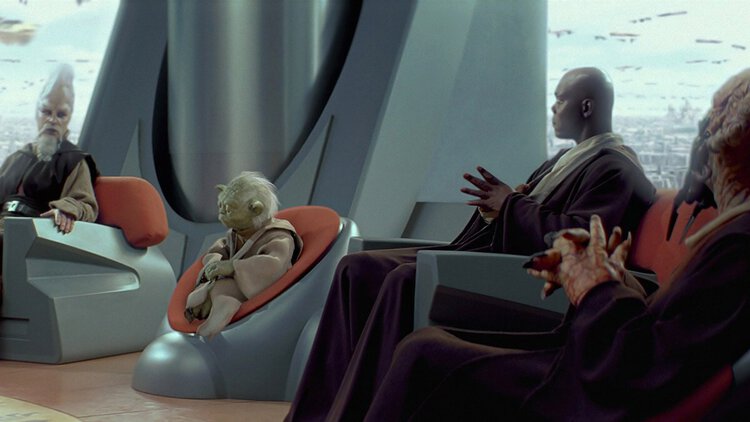
In the official excerpt from Master & Apprentice, Qui-Gon arrives at the Council expecting questions about his troubled partnership with Obi-Wan. Instead, the Masters invite him to join them.
Depa Billaba says they need “more perspectives.” Mace Windu values Qui-Gon’s ability to respect the Council without surrendering his convictions. After years of disagreements, Qui-Gon sees an opportunity to influence the decisions he has so often challenged.
But during the Pijal mission, Obi-Wan learns that Yoda voted against the appointment.
That does not mean Yoda rejects everything Qui-Gon believes. In the same conversation, he challenges the other Masters to consider whether Qui-Gon’s visions might genuinely carry meaning. He asks for evidence rather than treating an unfamiliar idea as automatically wrong.
The contradiction is more revealing than simple stubbornness. Yoda can defend Qui-Gon’s right to be heard while remaining unconvinced that he belongs among the Order’s leaders. He is willing to question a judgment, but less willing to change who helps make those judgments.
Pijal Exposed the Cost of Yoda’s Caution

On Pijal, Qui-Gon and Obi-Wan are assigned to help secure a political agreement connected to a new hyperspace corridor. The route promises trade and assistance for worlds that badly need both.
But the treaty also protects Czerka’s interests, including its use of enslaved people. Supporting the agreement means helping preserve an injustice alongside its promised benefits.
Qui-Gon asks whether the Jedi should withhold their support unless the terms change. Yoda warns him against jeopardizing the corridor, pointing to the suffering on other worlds that could benefit from it.
Yoda’s reasoning deserves to be taken seriously. Delaying the agreement could hurt people, too. He condemns slavery and offers to raise the issue with the Chancellor, but he also insists that the Jedi must respect the limits of their authority.
That concern is central to the book. In an interview about the novel, Claudia Gray explains that the Jedi work within a mandate because their power would make direct rule dangerous.
The problem is what happens when those reasonable limits repeatedly protect an unreasonable situation.
For Qui-Gon, the injustice is part of the agreement the Jedi are being asked to endorse. He cannot treat it as an unrelated problem to address later. Yoda sees the wider consequences of refusing; Qui-Gon sees the people who will pay for accepting.
Neither perspective makes the decision painless. But their disagreement exposes a weakness in the Order’s relationship with the Republic: a mission can fulfill the government’s goals while compromising the Jedi’s own purpose.
Qui-Gon Decided the Council Seat Was the Wrong Path
The invitation also threatens to end Qui-Gon’s partnership with Obi-Wan. Joining the Council would normally mean transferring his apprentice to another Master because of the demands of the position.
There is no absolute ban on Council members training Padawans. The issue is whether Qui-Gon could take on both responsibilities fairly while adjusting to his new duties.
At first, a transfer seems like a possible solution to their difficulties. Pijal changes that. Working through the crisis helps Qui-Gon and Obi-Wan rebuild their trust rather than escape their disagreements.
When Qui-Gon returns to Coruscant, he declines the Council’s offer. His experiences have changed his understanding of the Force, and he believes the position would pull him away from the path he needs to follow.
This matters because Yoda’s vote did not keep him out. The Council offered him a seat anyway, and the choice remained Qui-Gon’s.
Yet the outcome still exposes the difficulty of bringing change into the Order. The Council wants his perspective, but accepting its responsibilities would take him away from the work that shapes that perspective: teaching Obi-Wan, following the Force, and responding directly to the people he encounters.
Qui-Gon initially believes the Council chamber is where he can make the greatest difference. By the end, he no longer believes it is where he belongs.
Yoda Eventually Had to Learn From the Jedi He Opposed

During the Clone Wars, their relationship takes an unexpected turn. Qui-Gon is dead, yet Yoda hears his voice and discovers that his understanding of the Force is incomplete.
Qui-Gon guides him to Dagobah and toward further trials. The Grand Master must become a student again.
In “Destiny,” Yoda confronts his own darkness. He initially denies it, then recognizes that refusing to acknowledge it gives it power over him. His wisdom and experience do not make him immune to the weaknesses he teaches others to overcome.
The official Yoda biography connects this journey to his recognition of his own hubris and the Jedi’s mistake in becoming warriors.
That is the strongest basis for seeing Yoda as part of the Order’s problem. He eventually recognizes a failure in the institution he helped lead, but that understanding does not arrive in time to free it from the war. The Jedi remain generals serving the Republic until Sidious turns their army against them.
Yoda’s choices were only part of that disaster. Still, his story shows how a compassionate leader can help preserve a failing system by continuing to trust its familiar methods.
He could explain why the Jedi needed restraint, why the Republic needed their service, and why a difficult compromise might help more people. What he struggled to recognize was how those explanations could keep the Order on a path it needed to question.
By the time Yoda accepts how much he still has to learn, Qui-Gon is guiding him beyond the Temple. The Grand Master can change. The tragedy is that he cannot bring the Order through that change before it falls.