
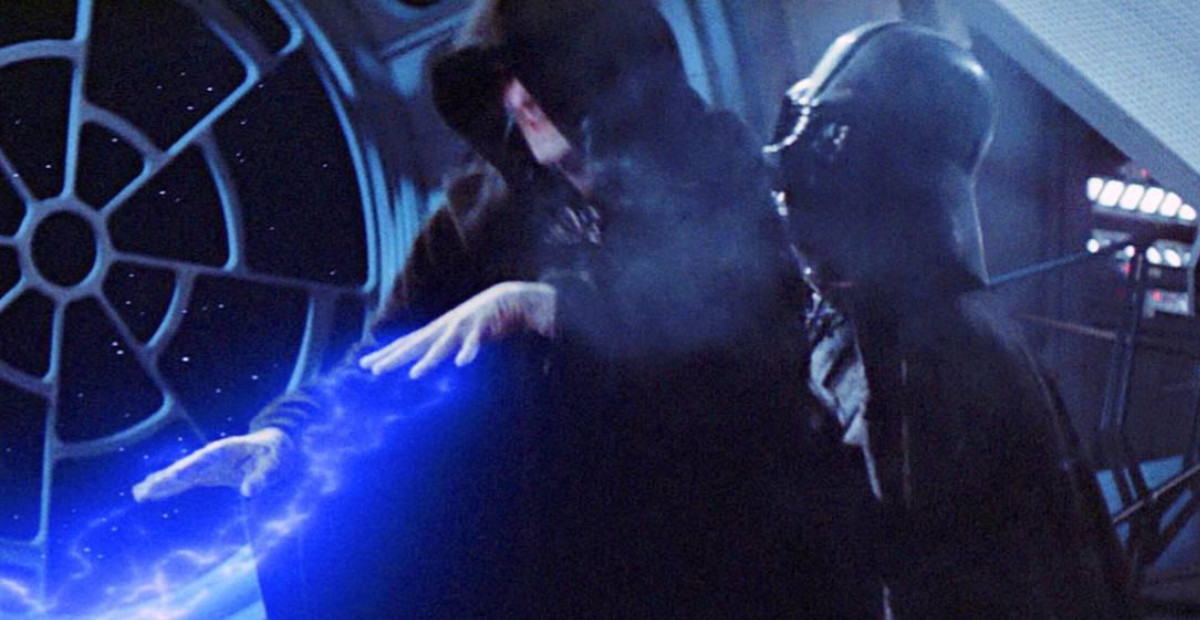
When Darth Vader throws Emperor Palpatine into the Death Star II’s reactor shaft, the battle station is already under attack. Rebel forces have destroyed the shield generator on Endor, and Lando Calrissian is leading starfighters directly into the station’s unfinished superstructure.
Even if Vader had remained loyal and allowed Palpatine to kill Luke, the Death Star would still have been destroyed only a short time later.
Wouldn’t both Sith have died in the explosion anyway?
Luke’s Escape Proves There Was Enough Time
After Vader betrays Palpatine, Luke does not immediately run toward the nearest shuttle. He has just been tortured with Force lightning and needs time to recover. He then lifts Vader’s heavily armored body and slowly drags him away from the throne room.
Vader is barely alive. His mechanical breathing is failing, he cannot walk without assistance, and Luke must carry most of his weight through the station.
They eventually stop so Vader can ask Luke to remove his mask. Luke helps his father sit down, removes the helmet and remains with him throughout their final conversation.
Only after Vader dies does Luke continue toward the hangar. He takes his father’s body with him, reaches an Imperial shuttle and escapes moments before the Death Star explodes.
That entire sequence shows that Vader and Palpatine were not trapped aboard the station when the shield fell.
Had Vader remained loyal, Luke likely would have died beneath Palpatine’s lightning. The Emperor would still have been alive and physically unharmed, while Vader would have suffered only the loss of his mechanical hand during the duel.
Instead of Luke dragging a dying Vader through the station, both Sith could have moved under their own power. Even with Vader’s damaged hand, they should have reached a hangar much faster than Luke did while carrying him.

Palpatine was also not buried deep inside the Death Star beside its main reactor. His throne room was located inside a 100-story isolation tower rising from the station’s north pole. The tower contained his private chambers and other areas reserved specifically for the Emperor.
That placed Palpatine and Vader in a separate structure near the outer surface of the battle station rather than at the center of its superstructure. Once the shield generator was destroyed and Rebel fighters entered the station, they could have left the throne room and moved toward an available hangar.
They also had transportation waiting aboard the Death Star.
Both Palpatine and Vader had arrived aboard Lambda-class Imperial shuttles, which were regularly used by the Empire’s highest-ranking figures. The station contained multiple hangars, and Luke ultimately escaped aboard one of those shuttles himself.

Palpatine’s Arrogance Was the Real Danger
The real question is not whether Palpatine had enough time to escape. It is whether he would have accepted that escape was necessary.
Palpatine had constructed the Battle of Endor as a trap.
He deliberately allowed the Rebels to discover the location of the second Death Star. The station’s superlaser was already operational, the Imperial fleet was waiting nearby, and the shield protecting the station was controlled from the forest moon below.
He believed the Rebel fleet would arrive, discover that the Death Star was protected and then become trapped between the battle station and the Imperial Navy.
Palpatine was so confident that he brought Luke into his throne room and allowed him to watch the Rebel fleet being destroyed. Everything was meant to convince Luke that resistance was useless and push him toward the dark side.
The plan failed because Palpatine underestimated nearly everyone involved.
The Ewoks helped the Rebel strike team defeat the Imperial forces on Endor. The shield generator was destroyed. Rebel starfighters entered the Death Star, and Vader chose his son over his Master.
If Vader had remained loyal, Palpatine might initially have dismissed the destruction of the shield generator as a temporary problem. He still had the Imperial fleet outside, countless troops aboard the station and defensive weapons protecting its interior.
He may have believed that Rebel fighters could never reach the reactor.
That confidence could have kept him inside the throne room longer than was safe.
Once Lando and Wedge reached the main reactor, however, the remaining time became extremely limited. After they destroyed it, the station began collapsing from within. Anyone who had not already reached a shuttle would have had almost no chance of escaping.
Palpatine and Vader therefore could still have died, but not because their deaths were guaranteed from the moment the shield fell.
They would have died only if Palpatine refused to evacuate until it was too late.
The film strongly suggests they had a window in which to escape. Luke used that same window to recover from the lightning, carry Vader away, stop for their final conversation, take his body to a hangar and launch a shuttle.
Two living Sith Lords could have completed that journey much faster.
Had Vader never betrayed the Emperor, the most likely outcome is that Luke would have been killed. Once the Rebels entered the Death Star’s interior, Palpatine and Vader could have left the isolation tower, reached one of the station’s hangars and escaped aboard an Imperial shuttle.
The only thing that might have stopped them was Palpatine himself.
Vader’s betrayal did not prevent an inevitable death in the explosion. It killed the Emperor before he could escape and left Vader mortally wounded, ensuring that neither Sith Lord would survive the Battle of Endor.