
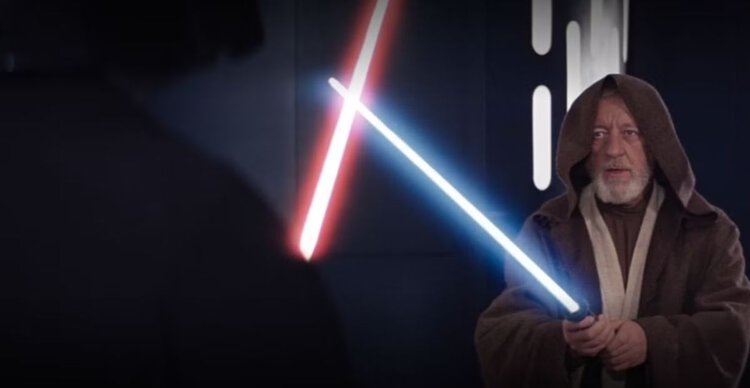
During his duel with Darth Vader aboard the Death Star, Obi-Wan Kenobi suddenly lowers his lightsaber and allows his former apprentice to strike him down.
His body disappears, but Obi-Wan’s voice soon returns to guide Luke during the attack on the Death Star. The moment became one of the most important scenes in the original film, yet Obi-Wan was not originally supposed to die there.
In earlier versions of Star Wars, he survived the duel, escaped aboard the Millennium Falcon and returned to the Rebel base with Luke and the others.
Why did George Lucas change the story and decide that Obi-Wan had to go?
Obi-Wan Originally Survived the Death Star
In an earlier version of the script, Obi-Wan escaped from Darth Vader and remained alive during the Battle of Yavin.
He would have stayed inside the Rebel command center while Luke attacked the Death Star. Instead of speaking to Luke through the Force, Obi-Wan would have delivered his guidance through a normal communications channel.
However, while revising the film, George Lucas realized that Obi-Wan no longer had an active role after the heroes escaped from the Death Star.
Lucas later explained: “Ben Kenobi really didn’t serve any useful function after the point he fights with Darth Vader.”

Obi-Wan had already introduced Luke to the Force, given him Anakin Skywalker’s lightsaber and helped rescue Princess Leia. Once the Millennium Falcon reached Yavin IV, there was little left for him to do except stand inside the command room and watch Luke complete the final battle.
Luke also needed to face the Death Star attack without a Jedi Master physically beside him. If Obi-Wan remained alive and continued directing him, Luke’s victory would feel less like the moment he finally trusted the Force for himself.
Killing Obi-Wan during the duel solved both problems.
It gave the confrontation with Vader a meaningful ending and removed Obi-Wan from the physical action, while still allowing him to guide Luke at the most important moment.
Marcia Lucas Suggested Vader Should Kill Him
Marcia Lucas, one of the film’s editors and George Lucas’s wife at the time, later said that she suggested Obi-Wan should die during the escape from the Death Star.
In the documentary series Icons Unearthed: Star Wars, she recalled asking: “What if Darth Vader kills Obi-Wan Kenobi?”
Her idea was that Obi-Wan could disappear when Vader struck him, then continue delivering the same guidance during the final battle as a spiritual presence.
George Lucas reportedly liked the solution.
The change allowed most of Obi-Wan’s remaining dialogue to stay in the film, but it transformed what that dialogue meant. Luke was no longer hearing instructions from an older man sitting safely at the Rebel base. He was hearing the voice of a Jedi who had somehow continued existing after death.
Alec Guinness later gave his own version of the story. He claimed that he encouraged Lucas to kill Obi-Wan because dying would make the character more powerful and allow him to escape dialogue he disliked.
Guinness said: “I just couldn’t go on speaking those bloody awful, banal lines.”
His account does not perfectly match the explanations given by George and Marcia Lucas. It is possible that several people supported the idea once it was discussed, but the clearest storytelling reason remained the same: Obi-Wan had completed his physical role in the movie.

Obi-Wan’s Death Changed the Rest of Star Wars
The decision created an idea that had not been fully established before: a Jedi could preserve their identity after death and continue communicating with the living.
Obi-Wan’s voice helps Luke destroy the Death Star, and his spirit later appears physically in The Empire Strikes Back and Return of the Jedi.
His death also created a new problem for the sequel.
Luke still needed a living teacher who could complete his Jedi training. Obi-Wan could offer advice as a spirit, but he could no longer physically train Luke or demonstrate the abilities he needed to learn.
That role eventually went to Yoda.
Instead of one Jedi Master guiding Luke through the entire trilogy, Obi-Wan became his connection to the past while Yoda became the teacher who prepared him to confront Vader.
The change also made Obi-Wan’s final words to Vader more important:
“If you strike me down, I shall become more powerful than you can possibly imagine.”
Obi-Wan understood that remaining alive was no longer the only way he could help Luke. By surrendering himself, he allowed the others to escape and became something Vader could not destroy with a lightsaber.
The real reason Obi-Wan had to die was not that Alec Guinness made him too powerful or that George Lucas had always planned his sacrifice.
Obi-Wan originally survived, but once his part in the escape was over, Lucas realized that the character had nothing meaningful left to do in the final act. His death gave the duel an emotional conclusion, forced Luke to act independently and introduced the idea that a Jedi could continue guiding others after death.