
In Rogue One, Jyn Erso finds six mysterious project names before reaching Stardust, the Death Star file. Their threatening names make them sound like six more Imperial superweapons. However, canon tells a more complicated story: three helped hide parts of the Death Star program, one built the Empire’s new army, and two remain almost complete mysteries.
What Did Jyn Find in the Scarif Vault?
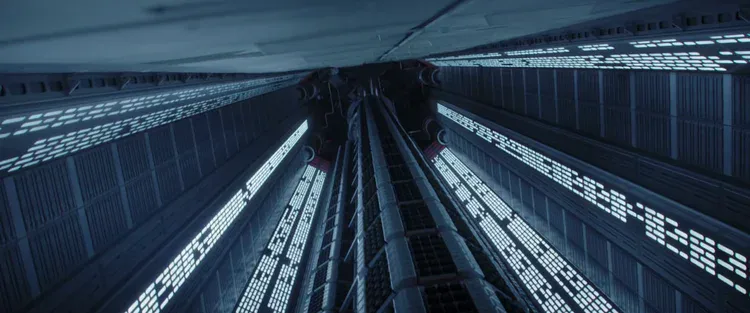
Near the end of Rogue One: A Star Wars Story, Jyn reads six project names while Cassian searches the archive:
Stellarsphere, Mark Omega, Pax Aurora, War-Mantle, Cluster-Prism, and Black-Saber.
![Data Vault Scene ( Project War Mantle, Project Stardust and Mark Omega ) | Rogue One [4K 60]](https://may4bewithyou.com/wp-content/plugins/wp-youtube-lyte/lyteCache.php?origThumbUrl=https%3A%2F%2Fi.ytimg.com%2Fvi%2F1RUWtaOzVPg%2F0.jpg)
She then sees “Stardust,” the childhood nickname Galen Erso gave her, and realizes that it must be the Death Star file.
The movie confirms that all seven names appeared on separate data tapes, but it never says that the first six were superweapons. Scarif’s Citadel Tower held vast Imperial databanks, including military schematics and records from many classified programs. A file stored there could describe a weapon, a research project, a military operation, or something else the Empire wanted to protect.
Stellarsphere, Mark Omega, and Pax Aurora Hid the Death Star’s Development
The canon novel Catalyst: A Rogue One Novel explains that the Death Star was built through a heavily divided network of departments and cover organizations. Scientists worked on conventional weapons, tractor beams, hyperdrives, hull materials, and other systems without necessarily understanding the full project.
The novel names Stellarsphere, Mark Omega, and Pax Aurora as examples of the cover names used to hide this work. In other words, these projects were connected to the Death Star’s development, but canon has not identified the exact system assigned to each one.
That distinction is important. They were not three additional Death Stars waiting to be built. They were more likely separate sections of the enormous program behind the first battle station.
Stellarsphere
Stellarsphere was one of the secret names associated with Death Star development. Its specific purpose remains unknown.
Because the name suggests a giant structure linked to a star, some fans believe it could have been an early plan for Starkiller Base. The theory is interesting because the First Order later converted Ilum into a planet-sized weapon that absorbed energy from stars. The Empire had also mined Ilum for kyber crystals.
Still, no canon source connects Stellarsphere to Starkiller Base. The name alone is not enough to prove that relationship.
Mark Omega
Mark Omega was another cover name used somewhere inside the Death Star program. Canon has not revealed whether it referred to a weapon, a component, a research team, or a construction department.
“Omega” sounds like a final model or ultimate stage, so fans have linked it to several later Imperial plans, including Operation: Cinder and Palpatine’s secret cloning work. None of those connections has been confirmed.
For now, the safest answer is simple: Mark Omega helped conceal part of the Death Star’s development, but its exact job remains unknown.
Pax Aurora
Pax Aurora was also named in Catalyst as one of the projects hiding Death Star-related work. However, canon does not tell us which part of the station it supported.
The name roughly suggests “peace at dawn,” making it a fitting Imperial cover name. A peaceful title could help disguise military research from scientists, suppliers, and local governments.
Some fans compare Pax Aurora with the Orbital Nightcloak, a Legends weapon that prevented sunlight from reaching a planet. That idea is based only on the name. No canon source connects the two projects.

War-Mantle Created the Empire’s Stormtrooper Army
For several years, fans could only guess what Project War-Mantle meant. Its name inspired theories about planetary weapons and even the World Devastators from Legends. The Bad Batch eventually revealed the real answer.
War-Mantle was the Imperial program that introduced recruited soldiers as replacements for the Republic’s clone army. Vice Admiral Rampart argued that ordinary recruits were cheaper, more plentiful, and could be trained to place their loyalty directly in the Empire.
At the secret base on Daro, 50 clone commandos were training 1,000 TK troopers. These recruits would become some of the Empire’s first stormtroopers.
War-Mantle therefore was not a superweapon. It was the foundation of the military force that would occupy worlds, crush resistance, and enforce Imperial rule across the galaxy.

Black-Saber and Cluster-Prism Remain Unexplained
Unlike the other four names, Black-Saber and Cluster-Prism still have no confirmed purpose. Later material has mentioned them, but it has not explained what the projects were designed to do.
Black-Saber
Black-Saber is currently known only as the codename of a data tape stored at Scarif. Canon has not identified its designers, location, technology, or mission.
The most obvious comparison is the Darksaber superweapon from Legends. That weapon was a narrow battle station built around technology copied from the Death Star’s superlaser. “Black-Saber” may be an out-of-universe reference to that older story, but Lucasfilm has never confirmed that the two are connected.
There is also no evidence that Black-Saber referred to the Mandalorian Darksaber. The similar names make the theory tempting, but they are still separate concepts unless future canon says otherwise.
Cluster-Prism
Cluster-Prism was another classified project recorded at Scarif. The Rebel Files later revealed that Rebel intelligence found its name in an intercepted Imperial data packet, but its purpose remained unknown.
The words “cluster” and “prism” have inspired theories about a weapon that could divide one energy beam across several targets. Kyber crystals can focus and amplify energy, so the idea fits the technology seen in the Death Star and later Imperial weapons.
However, canon has not revealed a Cluster-Prism prototype, technical description, or test. The multi-beam weapon idea is still only a fan theory.
What Was Really Lost When Scarif Was Destroyed?
The destruction of Scarif’s Citadel Tower likely erased a huge collection of Imperial schematics, test results, reports, and manufacturing records. It may have delayed several secret programs, but there is no evidence that every project existed only inside that archive. Engineers, laboratories, prototypes, and backup records could have survived elsewhere.
More importantly, Jyn’s search reveals how the Empire protected its most dangerous work. The Death Star was divided among separate departments and hidden behind harmless or confusing names. Most people working on one component may never have known what they were helping to build.
So were six more Imperial superweapons hidden on Scarif? No, not according to current canon. Three names concealed parts of the Death Star program, War-Mantle created the stormtrooper army, and the final two projects remain genuine mysteries.