
The Empire was beaten, disarmed, and forced to pay reparations. Three decades later, its successor appeared with larger Star Destroyers, a planet-sized superweapon, millions of troops, and a flagship wide enough to dwarf a city. That kind of military buildup should have left a financial trail across the galaxy. Yet the First Order managed to hide most of it until the moment it was ready to attack.
It Started With An Imperial Head Start
The First Order did not begin from nothing. After the Empire’s defeat, selected officers, nobles, and technologists withdrew into the Unknown Regions. While the public Imperial remnant faced strict disarmament and heavy reparations, these hidden loyalists built fleets and armies far from New Republic oversight.
They carried more than uniforms and ideology. The surviving movement had trained personnel, military knowledge, secret routes, old vessels, research, and access to Imperial projects. The First Order therefore began as the continuation of an existing war machine, not as a new group trying to create one from scratch.
Its navy makes that connection clear. The lost vessels of the Imperial fleet became the fighting core from which the new fleet grew. The First Order later built modern ships around that core, but inherited capital gave it years of work that a true startup would have needed to fund itself.
Starkiller Base is the biggest example. The weapon was built on Ilum, a planet the Empire had already mined heavily for kyber crystals. That earlier work cut the enormous equatorial trench that the First Order later used for its superweapon. The founders also recovered research from secret Imperial laboratories, so they inherited both a prepared site and useful knowledge.

This does not mean Starkiller Base was free. Converting Ilum still required a staggering amount of engineering, labor, equipment, and energy. It means the First Order was completing and expanding an Imperial project instead of paying to find a suitable world and begin every stage from zero.
It Took Resources Instead Of Buying Them
Credits matter most when an organization has to purchase materials from someone else. The First Order often avoided that problem by controlling the source.
During its rise in the Unknown Regions, it attacked isolated kingdoms and seized worlds and resources. Under that kind of system, ore is not bought at a fair market price. A conquered territory is ordered to provide it. Existing facilities can be absorbed, and local infrastructure can be redirected toward military production.
That is why the First Order is better understood as an occupation economy. It expanded by turning the territory under its control into fuel for further expansion. Every captured mine, depot, factory, and transport route reduced the amount it had to obtain through open trade.
The same logic applied to people. The First Order built its forces in secret and used coercive recruitment and indoctrination to fill its ranks. That does not erase the cost of feeding, housing, equipping, and training troops, but it is very different from maintaining a voluntary professional military with transparent salaries and normal civilian oversight.
Bloodline Novel Reveals The Hidden Money Loop
The clearest look at the First Order’s secret financing appears in the canon novel Bloodline. It shows that the regime used layers of proxies rather than openly transferring money under its own name.
The First Order worked through the Amaxine warriors, a paramilitary group with hidden ties to it. The Amaxines helped channel billions of credits into the cartel run by Rinnrivin Di. That money turned a minor criminal operation into a major network involved in smuggling and gambling.
The cartel and its partners also raided legal shipping and collected protection money from merchants. The profits then moved through shadow corporations in the Outer Rim and through Centrist connections. Those funds returned to the First Order and helped rebuild the old Imperial fleet into the foundation of its navy.
At first glance, putting billions into a criminal cartel might sound like spending money rather than raising it. The scheme makes sense as an investment and laundering operation. The cartel used the starting capital to grow, produced continuing criminal revenue, and moved funds through channels that hid the First Order’s involvement. It also created disorder that weakened trust in the New Republic.
This was not simply a donation drive from sympathetic politicians. Centrist insiders were useful because they could move money, protect contacts, and undermine the Republic from within. Lady Carise Sindian, for example, was both a prominent senator and a clandestine First Order agent. The network blended politics, organized crime, and military financing so that no single transaction revealed the entire plan.
The First Order Built Its Own Supply Chain
The strongest answer is not only about finding credits. The First Order built the mines, factories, shipyards, and research centers needed to turn resources into weapons.
Station Theta Black shows this system on a practical scale. The station was hidden inside an asteroid field and mined dedlanite, a mineral that could be used to make a vast quantity of blasters. When the operation was discovered, Captain Phasma destroyed the evidence rather than let the true scale of the First Order’s capabilities become known.

The same secrecy surrounded the fleet. Resurgent-class Star Destroyers were constructed at new shipyards and hidden frontier facilities, in violation of the Galactic Concordance. Kuat-Entralla Engineering produced the design, while the First Order protected the program from the New Republic’s view.
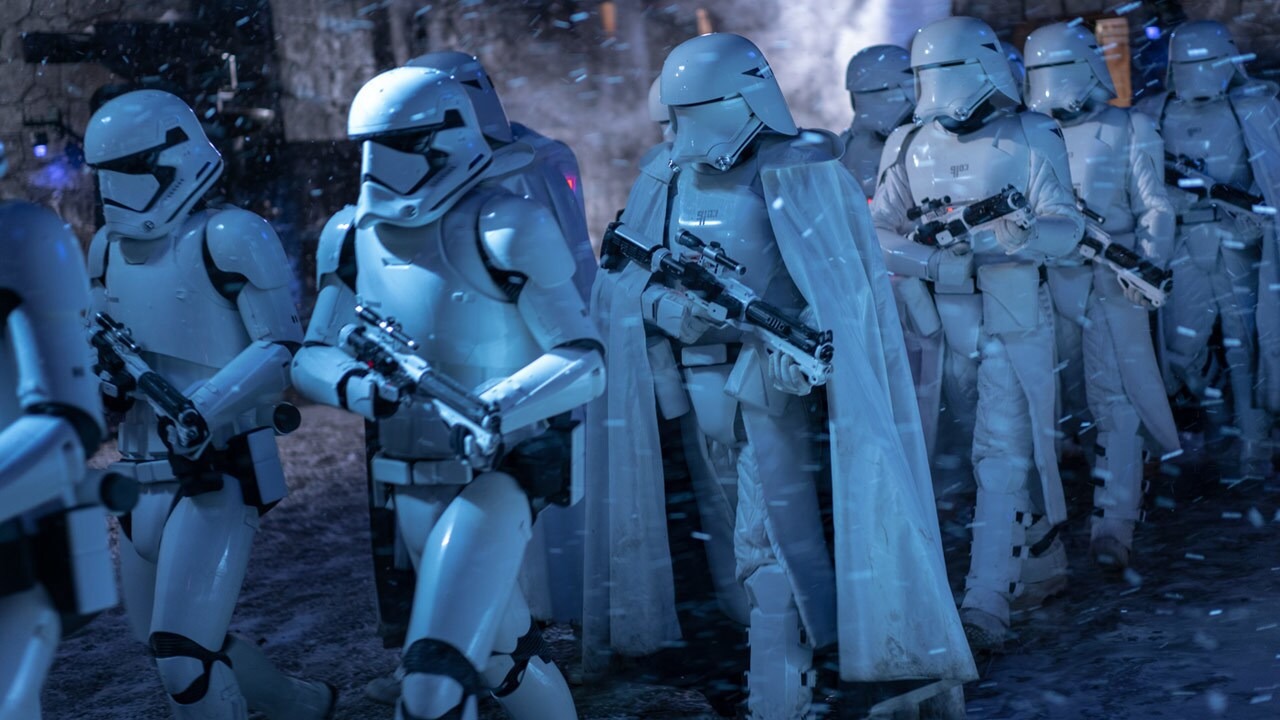
These ships were not cheap copies of Imperial vessels. A Resurgent-class Star Destroyer was almost twice the length of an Imperial-class ship and carried improved weapons, faster fighter deployment, assault craft, and a full stormtrooper legion. Even official descriptions emphasize its more efficient turbolasers and improved launch capability. The First Order spent heavily, but it concentrated its resources on fewer, more advanced capital ships because it could not waste vessels as freely as the old Empire.
The Supremacy Was A Moving Industrial World
The Supremacy looks like the hardest ship to explain because its scale is absurd even by Star Wars standards. It was more than 60 kilometers wide and served as Snoke’s flagship and the First Order’s mobile capital. Calling it only a battleship misses the part that explains how the regime supported its navy.
The ship carried factories, repair arrays, shipyards, research laboratories, training areas, and huge reserves of raw material. It had eight durasteel foundries and an asteroid-mining complex. Two of its internal hangars were large enough to hold and repair Resurgent-class Star Destroyers.

In other words, the Supremacy did not only consume supplies. It helped create them. It could mine raw material, refine metal, manufacture vehicles and droids, test new technology, repair warships, and support the fleet from one moving base.
That kind of vertical integration changes the funding question. The First Order still paid the enormous cost of constructing the ship, but once operational, the Supremacy reduced its dependence on visible commercial shipyards and vulnerable outside suppliers. It was headquarters, factory, laboratory, depot, and repair yard at the same time.
Centrist Secession Gave It A Public Economic Base
For years, the First Order used sympathetic Centrists while remaining hidden in the Unknown Regions. Later, Centrist systems formally left the New Republic and joined the First Order. That changed the movement from a secret remnant with proxies into a recognized territorial power.
Canon does not list the exact tax payment or industrial contribution of every system. Still, the economic effect is easy to understand. More member worlds meant access to population, infrastructure, trade routes, factories, and resources. Facilities that once had to be hidden behind front groups could now serve the First Order directly.
This also explains why the New Republic’s political division mattered so much. The First Order was not only building ships beyond the frontier. It was preparing friendly systems inside Republic politics to break away at the right moment, taking their economic strength with them.