
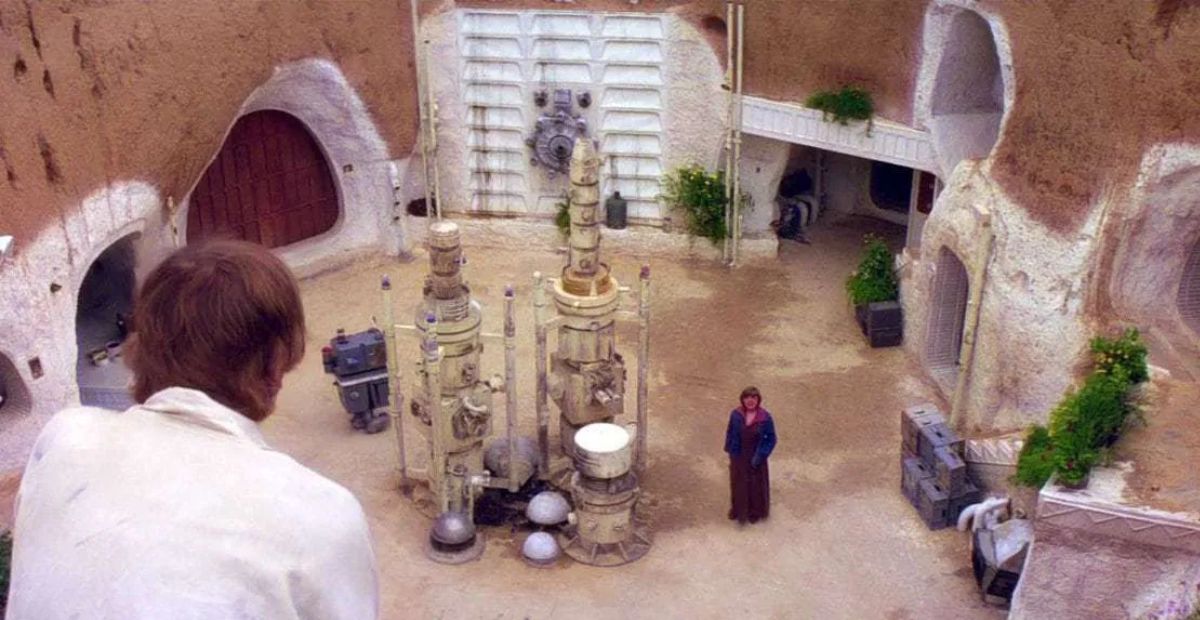
When you look at Luke’s home on Tatooine, something about it feels off right away. The Lars homestead sits in the middle of a desert world known for massive sandstorms, yet the main courtyard is wide open and sunk into the ground like a giant bowl. It almost looks like it should be the worst possible design for that environment.
Every time a sandstorm hits Tatooine, wouldn’t that entire place just fill up with sand? Wouldn’t the courtyard, the entrances, everything be buried after a single storm?
The Lars Homestead Was Built Underground
The first thing to understand is that Luke’s home is not a normal surface house. What we see from the outside is only a small part of the structure. Most of the Lars homestead is built underground, with rooms, storage areas, and living spaces extending beneath the surface.
That design alone solves a big part of the sand problem. The deeper sections are naturally protected from wind and shifting dunes, and they stay cooler in Tatooine’s extreme heat. Instead of being fully exposed to the environment, the homestead is anchored into the ground, which makes it far more stable during storms.
So even if sand does blow into the open courtyard, it is not filling up the entire home. The important areas, where people actually live and work, are already shielded below the surface.
But we’ve also seen what happens when the homestead is abandoned. When Rey visits Tatooine, the entire place is covered in sand. So it’s fair to ask: during A New Hope, or while Luke was living there, with sandstorms hitting over the years, wouldn’t the whole place eventually get buried anyway?

The answer is no. Because the homestead wasn’t just relying on its underground design. It also had a built-in system that actively prevented sand from piling up in the first place.
The Device That Kept the Homestead Clear of Sand
The Lars homestead was not just relying on its underground design. It also used a device specifically built to deal with Tatooine’s constant sandstorms. According to Star Wars cross-section material, the farm was equipped with an electrostatic repeller, sometimes described as a kind of sand trap.

This device generated a static field that pushed away airborne particles like sand and dust, especially around key areas such as the courtyard, ramps, and entrances. Instead of letting sand settle and build up, the system actively kept those spaces clear.
That is why the homestead did not slowly fill up over time. Even with frequent storms, the electrostatic repeller helped prevent sand from accumulating where it mattered most, keeping the main access points usable.
