
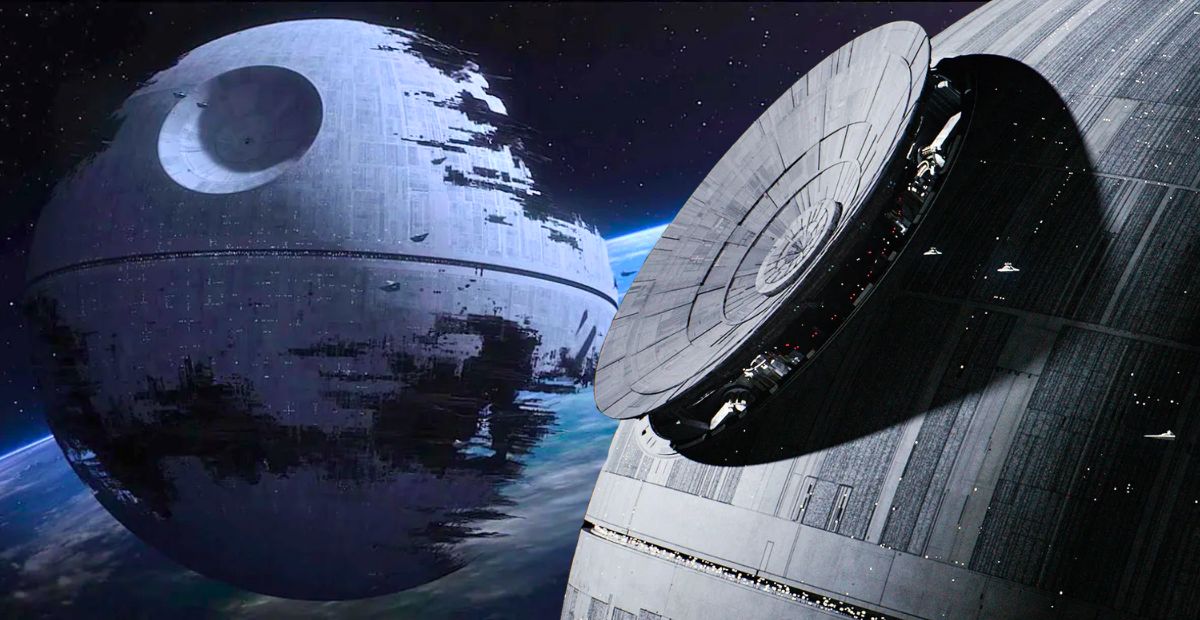
The Empire built two Death Stars, and both were destroyed. The first was lost at Yavin, and the second fell at Endor. Because of that, they’re often remembered the same was, as identical failures.
But the Empire didn’t build the second Death Star just to repeat the first. It was constructed after a catastrophic loss, and its design reflects that. In several key ways, the second Death Star was more advanced than the first.
The First Death Star Was a Massive Weapon
The first Death Star was built to overwhelm through scale alone. Measuring roughly 160 kilometers in diameter, it was unlike anything the galaxy had ever seen. Entire fleets could operate from within it, and its presence in a system was meant to end resistance before a single shot was fired.

Its superlaser reflected that same philosophy. When fully charged, the weapon was capable of destroying an entire planet in one blast, as seen with Alderaan in Star Wars: A New Hope. But that power came with limits. After firing at full strength, the Death Star’s main superlaser required many hours, often described in Imperial technical sources as nearly a full day to recharge before it could be fired again.
Defensively, the station relied on its size and intimidation rather than flexibility. It carried thousands of TIE fighters and heavy turbolasers, but internally it was vulnerable. As later revealed in Rogue One: A Star Wars Story, the station contained a single catastrophic flaw within its reactor system. Once that weakness was discovered, the Death Star’s size worked against it.
The first Death Star was massive, powerful, and terrifying, but it was also rigid. It was built to dominate through fear, not to adapt once that fear failed. The second Death Star was designed with that failure in mind, and in several key ways, it was even more deadly.
How the Second Death Star Improved on the First
The second Death Star was not simply a larger replacement for the first. It was built after the Empire had already suffered a catastrophic defeat, and even its physical scale reflects that lesson. The first Death Star measured roughly 160 kilometers in diameter. The second was expanded to nearly 200 kilometers, making it about 25 percent larger overall.
One of the most important upgrades was the superlaser itself. Unlike the first Death Star, the second station’s weapon could fire every few minutes rather than once every many hours. During the Battle of Endor in Star Wars: Return of the Jedi, the superlaser is shown destroying Rebel capital ships in rapid succession, with only brief pauses between shots, consistent with technical sources that place its recharge time at roughly two to five minutes when firing at reduced power.

Defensively, the Empire also changed its approach. Instead of relying on secrecy and internal design alone, the second Death Star was protected by a planetary shield generator on Endor. As long as that shield remained active, the station was completely immune to attack, even while unfinished. This was a direct response to the internal sabotage that destroyed the first Death Star.