
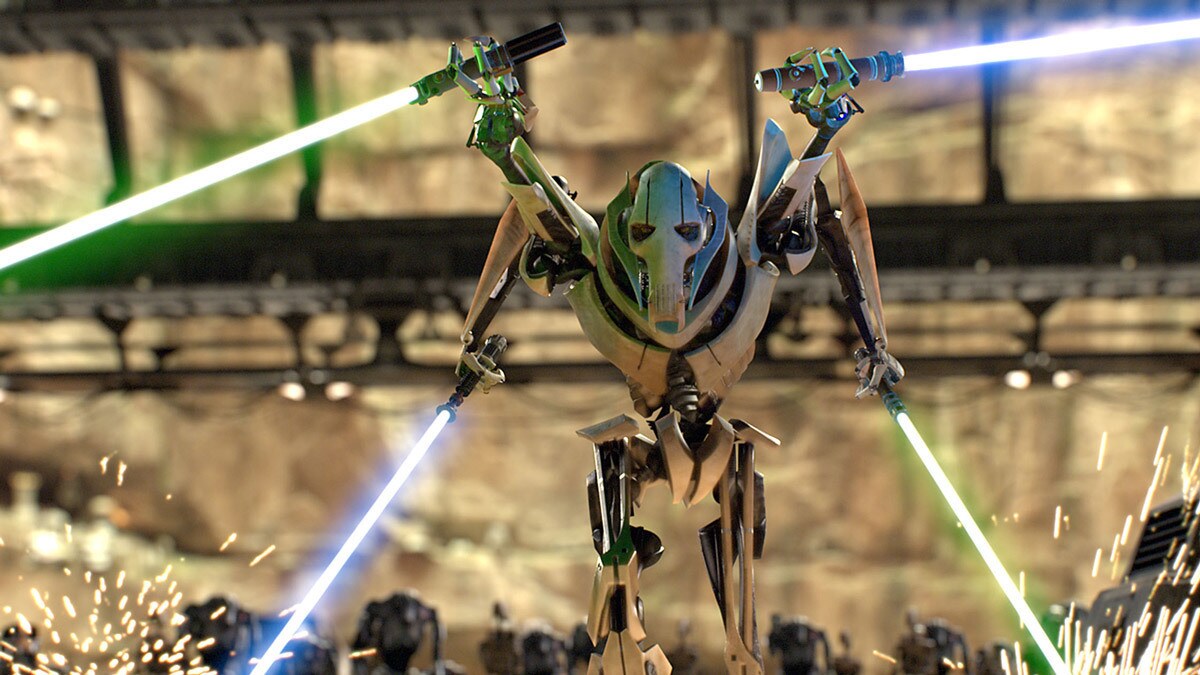
Grievous was one of the most heavily modified cyborgs in Star Wars, yet his final moments look strangely easy to ignite. Obi-Wan fires several shots, and the Separatist general suddenly burns from the inside like his body was packed with fuel. The scene is quick enough that the important setup is easy to miss. To understand it, we have to look at what Grievous still carried under all that armor and exactly where Obi-Wan aimed.

Grievous Was Never Just A Droid
Calling Grievous a robot is convenient, but it is not accurate. He was a living Kaleesh who had most of his body replaced with machinery. His cybernetic frame gave him four arms, powerful legs, fast reflexes, and enough strength to fight Jedi at close range. It did not remove his need for living organs.
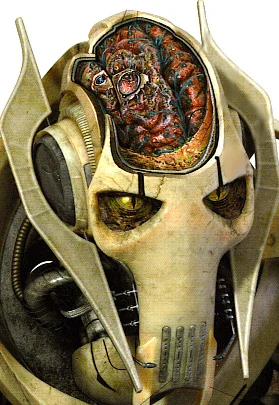
The remaining parts included portions of his brain and spinal cord, his eyes, heart, damaged lungs, liver, and enough digestive tissue to keep those organs working. They sat inside a pressurized synthskin gut-sack protected by armored ribs. His brain and eyes were also surrounded by a duranium-alloy body.
That design made Grievous more like a living pilot permanently installed inside a combat machine than a battle droid. The metal frame handled movement and protection, while the organic core still needed pressure, circulation, and life-support fluid. If an attacker struck an arm or leg, Grievous could keep fighting. A direct hit to the organ sac was a completely different problem.
Obi-Wan Did Not Shoot Through Intact Armor
The order of events on Utapau matters. Obi-Wan did not casually fire into Grievous’s normal chest plating and discover that the whole cyborg was flammable. During their hand-to-hand struggle, he grabbed the two chest plates and forced them apart. That exposed the soft organ sac underneath.
Grievous then knocked Obi-Wan away and moved in for the kill. Obi-Wan used the Force to pull Grievous’s own blaster into his hand, aimed at the opening, and fired five times at close range. The bolts passed through the gap instead of having to burn through the strongest part of the armor.
The official duel clip makes this sequence clear. The chest protection fails first, then Obi-Wan shoots the exposed center. Grievous’s death is not proof that his metal shell could catch fire from one ordinary hit. It shows what happened after his only vital biological target was uncovered.

What Actually Caught Fire?
The short answer is that Grievous’s metal body was not the first thing burning. The blaster bolts ignited the fluid that kept his exposed organs alive, and the fire consumed his remaining biological components from inside the shell.
The current Canon account describes Obi-Wan shooting Grievous five times in the exposed gut-sack, igniting the fluid around the surviving organs. The official General Grievous history gives the broader version, Obi-Wan’s shot to the chest ignited what remained of Grievous’s organic matter.
Those descriptions fit what the film shows. Fire begins in the open torso, where the organs and support system are located. It then bursts through the chest and eye openings as Grievous burns internally. His blackened mechanical shell eventually falls to the floor, but the shell is the container around the fire, not the unexplained fuel that started it.
Canon does not provide the fluid’s chemical formula, ignition temperature, or oxygen content. We therefore cannot calculate the fire like a real engineering accident. We do not need to. The stated fictional mechanism is already direct: repeated blaster hits ignited a life-support fluid and the living tissue it sustained.
Why Five Blaster Hits Were Enough
A Star Wars blaster is not firing a cool beam of light. A blaster pistol delivers a searing, concussive energy blast. One bolt can burn flesh, damage machinery, and leave scorching around the impact point. Obi-Wan put five of those bolts into the same exposed life-support compartment at very short range.
The first hit could rupture the sac, cook tissue, or damage the systems moving fluid around the organs. The following hits add more heat and destruction before anything has time to cool. That step-by-step explanation is an interpretation of the action, not a measured technical report, but it follows the scene without inventing a hidden weapon upgrade.
The pressurized design may also help explain why the result looks so violent. Once a sealed compartment is torn open and repeatedly heated, hot fluid, vapor, and damaged material have places to escape. The eye sockets and gaps in the torso are visible outlets. Still, pressure making the flames spread is a reasonable physical reading, not a specific Canon statement, so it should not replace the confirmed answer about the organ sac and its fluid.
Legends Makes The Liquid More Specific
The older Legends continuity describes the same death with one extra detail. After five bolts entered the gut-sack, oils preserving his biological components ignited and burned the cyborg from within.
That wording makes the fire easier to picture because oil is commonly associated with burning. However, it should not be silently imported into current Canon. Canon calls it fluid that kept the organs alive, while Legends specifically calls it preserving oils. The two versions agree on the larger mechanism, but they do not use exactly the same technical description.
This distinction also prevents an exaggerated answer. We can say with confidence that Obi-Wan ignited material inside Grievous’s biological support chamber. We cannot say current Canon has identified a particular petroleum-like oil or told us how that liquid behaves under real-world conditions.