
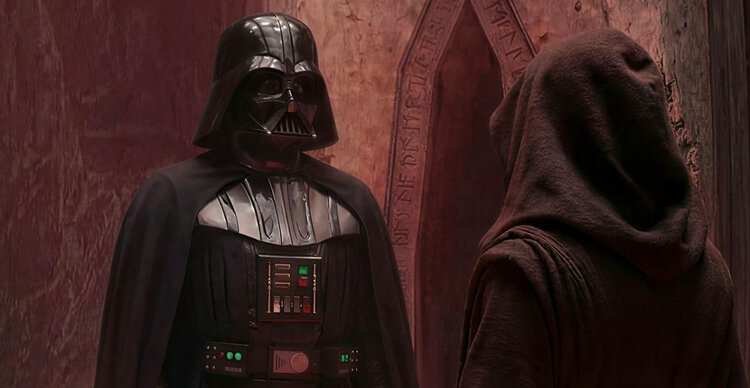
Darth Vader and Darth Traya never met in official Star Wars canon or Legends. However, the fan-made story Darth Vader Meets the Sith Who Rejects the Force imagines Vader entering the Trayus Academy on Malachor V ten years before A New Hope, where he encounters the spirit of the ancient Sith Lord.
Vader might expect an ancient Sith spirit to offer him forbidden knowledge or greater power. Traya offers him something far more dangerous: a reason to question whether he has ever truly controlled his own life.
Before becoming Darth Traya, she was Kreia, a Jedi Master who eventually abandoned the Order and embraced the dark side. However, her experiences with both the Jedi and Sith left her convinced that neither side was truly free. Both believed they controlled the Force, but Traya came to believe the Force was controlling them.

She hated its apparent will and the way it continually pushed the galaxy toward balance. Jedi would rise, Sith would destroy them, and new Jedi would eventually appear to defeat the Sith. Entire civilizations could be destroyed during that cycle, yet the Force would continue guiding events toward whatever balance it required.
That makes Darth Vader the perfect person for Traya to confront.
Vader sees himself as one of the most powerful Sith Lords in galactic history, but nearly every stage of his life was shaped by someone else. The Jedi Order decided how Anakin Skywalker should live. His visions of Padmé’s death pushed him toward Palpatine. His fear allowed Sidious to manipulate him, and after Mustafar, the Emperor placed him inside the armor that would keep him alive and under his control.
Vader escaped the Jedi, but he did not become free. He simply exchanged one Master for another.
From Traya’s perspective, Vader would not represent the triumph of the Sith. He would represent everything she despised about the Force. His fear, suffering and desire for power had all pushed him toward a destiny that seemed prepared for him long before he understood it.
Even his rebellion against the Jedi eventually helped create the balance the Force appeared to demand. Vader destroyed the Jedi Order, served the Sith for decades and would ultimately turn against his Master to save Luke Skywalker. Every attempt to escape his destiny only carried him closer to it.
The fan-made encounter therefore becomes less of a battle between two Sith Lords and more of an attack on Vader’s identity. Traya does not need to overpower him physically. She only needs to make him consider whether his strength has ever given him freedom.
Vader can command Imperial armies, destroy Jedi and kill almost anyone who stands against him. However, he cannot restore Padmé, escape his past or openly turn against the Emperor. His anger gives him power, but that anger remains connected to the same loss that Palpatine used to enslave him.
Accepting Traya’s argument would mean admitting that becoming Darth Vader did not free Anakin Skywalker. It only created a stronger prison.
That is also why Vader could never accept her philosophy. The Force is the source of his power and one of the only things he has left. Traya believes dependence on that power is another form of slavery, but Vader has built his entire identity around it. Without the Force, his suffering would have given him nothing.
Although the meeting is entirely fan-made, the two characters create a natural philosophical conflict. Darth Traya wanted to free life from the will of the Force, while Darth Vader spent most of his life believing that greater power would finally allow him to control his destiny.
Instead, he became one of the most powerful beings in the galaxy while remaining trapped by his past, his Master and the Force itself.