
Palpatine had a secret order long before his most infamous command wiped out the Jedi. This one did not target clone troopers, and it did not begin with an army turning on its commanders. It began with one ordinary B1 battle droid on a remote battlefield. What happened next became one of the strangest and most revealing stories in Star Wars.
Order 99 Replaced A Killer’s Programming
Order 99 was an experiment that removed a battle droid’s normal combat directives and replaced them with three new priorities: live free, protect the weak, and rescue strays. It was not a galaxy-wide command that instantly liberated every Separatist droid. Count Dooku tested it on one B1 unit, later known as Coppertop, during the Battle of Bogoa.
The result was immediate and unexpected. Coppertop stopped acting like a disposable weapon, developed a personal identity, and began helping wounded soldiers from both armies. His clearest confirmed rescue was a clone trooper named Gunner, although he also treated other Republic and Separatist casualties.
This entire story belongs to Star Wars Legends, not the current Canon timeline, it comes from the eight-page comic The Only Good Clanker, written by Robin Etherington and illustrated by Will Sliney. Titan Magazines published it in Star Wars: The Clone Wars Comic UK 6.26 in 2011.

Palpatine Saw Clones And Droids As The Same Kind Of Tool
The story begins away from the fighting, with Darth Sidious giving Count Dooku a disturbing lesson. To Sidious, a droid and a clone are different versions of the same thing. One is built and one is grown, but both can be conditioned to obey.
That comparison explains the real purpose of Order 99. Palpatine was not trying to improve life for battle droids. He wanted to learn whether a deeply programmed soldier could be forced to act against its original directives. Dooku selected a single B1 battle droid on Bogoa as the test subject.
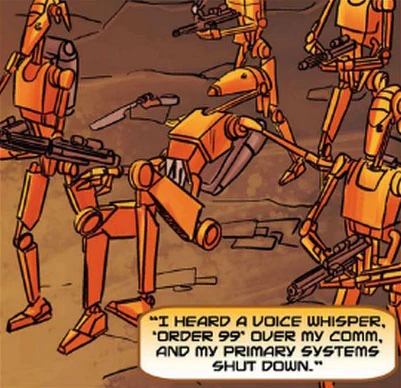
Bogoa was worth fighting over because its huge coral spires provided durable material for building ships. Republic and Separatist forces fought across the planet for three days and nights. On the second day, Coppertop advanced with other B1 units toward the Republic rear guard. Then a voice whispered the words “Order 99” through his communication system.
His primary systems shut down. When he eventually reactivated, his old desire to fight for the Separatist army was gone. The experiment had worked, but not in the neat military way Dooku probably expected.
Coppertop Chose A Name, A New Look, And A Better Purpose
Once abandoned on the battlefield, the droid did not simply switch allegiance and become a Republic soldier. He made a more radical choice. He rejected the idea that he had to belong to either army.
The former B1 called himself Coppertop. He added a gold crest, modified his face, painted an inverted red mark on his torso, and wore a cape. Those details may sound small, but they show that his change was personal as well as mechanical. For the first time, he was shaping his own identity instead of accepting the standard appearance and role assigned to him.
More importantly, Coppertop created new rules for himself. His three primary protocols became “live free,” “protect the weak,” and “rescue strays.” Rather than picking up his E-5 blaster and changing sides, he started giving medical help to wounded droids and clones.
That distinction matters. Order 99 did not make Coppertop loyal to the Republic. It gave him room to recognize suffering on both sides. He understood that clones and battle droids were being treated as expendable pieces in a war controlled by people far from the battlefield. Helping either group was not betrayal in his eyes. It was the first moral choice he had ever been able to make.
The Droid Saved A Clone Who Expected Him To Be An Enemy
After Republic forces broke through the Separatist position, Coppertop found an injured member of the 212th Attack Battalion. The trooper, called Gunner, had been hurt during the battle and left on the ground. Coppertop bandaged his torso and kept him alive.
Commander Cody arrived while searching for survivors and saw a Separatist battle droid leaning over the wounded clone. From Cody’s point of view, the situation looked obvious. A B1 was attacking one of his men. He raised his blaster and prepared to destroy Coppertop.
Obi-Wan Kenobi stopped him. He sensed that something about this droid was different, then listened as Coppertop explained what had happened. When Obi-Wan asked about his directives, Coppertop described the new principles guiding him.
The scene turns the normal Clone Wars setup inside out. The clone sees a machine built to kill him. The machine sees another manufactured soldier who has been used and discarded. Coppertop is able to notice that connection only after his old programming has been removed.
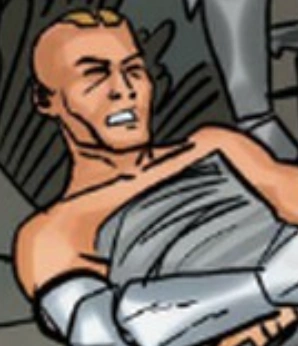
The title’s claim that Order 99 “saved lives” needs a little precision. Gunner is the clearly named soldier whose life Coppertop saves. The comic also establishes that Coppertop treated wounded members of both armies, so his work was broader than that one rescue, but it never gives a confirmed total. The strongest accurate version is that Order 99 saved Gunner and allowed Coppertop to aid other casualties.
Ventress Came To Recover Dooku’s Experiment
Dooku did not intend to leave his successful test walking around freely. He sent Asajj Ventress and a Chiss bounty hunter named Cyreltov to recover Coppertop. Dooku wanted the droid brought back so he could be examined and dismantled.
Ventress and Cyreltov watched Coppertop help Gunner, then confronted Obi-Wan, Cody, and the clones as they escorted the droid toward the Republic camp. Fighting broke out because both sides wanted control of the test subject.
Coppertop refused to stay safely out of it. He surrendered to Ventress because he could not accept more people being hurt over him. This was another choice that neither army’s programming could easily explain. He did not surrender because the Separatists had restored their authority over him. He surrendered because ending the violence mattered more than his own safety.
That choice also shows why calling Order 99 a simple allegiance switch is misleading. Coppertop repeatedly ignored orders from both sides when those orders conflicted with his new values. Even Obi-Wan told him to stay down during the fight, and Coppertop disobeyed in order to stop it.
Coppertop Used His Freedom One Last Time
Surrender did not solve Coppertop’s problem. He knew Dooku wanted to take him apart and study the effects of Order 99. If the Separatists learned from his altered programming, they could use that knowledge to control more soldiers and cause more deaths.
As Cyreltov escorted him away, Coppertop took the bounty hunter’s deactivator pistol. He then used it on himself. His final words made the point clear: he would choose his own path.
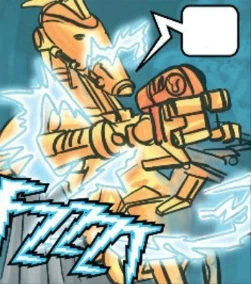
The ending is tragic, but it completes his short arc. Coppertop’s freedom was never about escaping all consequences. It was about having the power to decide what kind of being he would be. He first used that power to heal his enemies, then used it to prevent himself from becoming Dooku’s property again.
The comic describes him as deactivated or disabled, while his Legends biography lists him as destroyed around the time of the battle. Either way, this was his final known action. There is no later story in which he returns.