
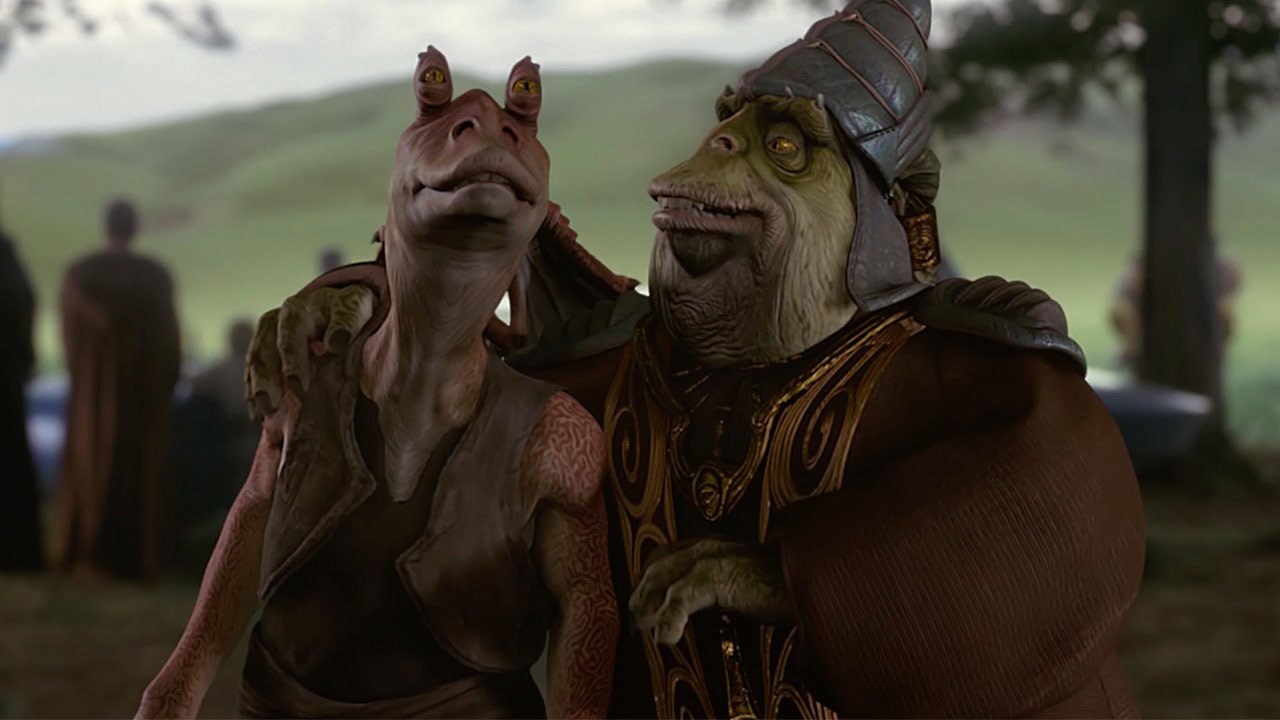
Put Boss Nass beside Jar Jar Binks and the difference is hard to ignore. Jar Jar is tall and narrow, while Nass is broad, heavy-faced, and built almost like he belongs to another species. The Phantom Menace never stops to explain the mismatch, so viewers have been filling the gap with jokes and theories for years. The real story comes from details the movie leaves off-screen.
The Short Answer: Boss Nass is an Ankura Gungan
Boss Nass looks different because he belongs to the Ankura, while Jar Jar Binks, Captain Tarpals, and most of the Gungans we notice in The Phantom Menace are Otolla.
An official StarWars.com guide to Gungans says the species can be divided into “two major races,” the Otolla and the Ankura. It names Jar Jar and Tarpals as examples of the familiar Otolla body type and Boss Nass as an example of the Ankura body type.

Ankura and Otolla Have Visibly Different Bodies
The contrast was designed into their anatomy, not created by Nass gaining weight or taking office.
Ankura traits:
- A shorter bill and shorter haillu, the long ear-like structures that hang from a Gungan’s head
- Hooded eyes rather than the raised, stalk-like eyes associated with Jar Jar
- A shorter, broader, more rotund frame
- Green skin in the examples described by current reference material
Otolla traits:
- A tall, usually lanky body
- Longer haillu
- A more prominent bill
- Eyes set on short stalks, giving faces such as Jar Jar’s their familiar open expression
Boss Nass fits the first set almost perfectly. Jar Jar fits the second. Once they are compared side by side, the mystery becomes much easier to see: the difference is consistent across the head, eyes, bill, ears, and overall build. It is not only that Nass is heavier.
The official article also says the Ankura are an older and much less common Gungan group. That helps explain why the Otolla shape feels “normal” to viewers even though it is only one of the two major forms described in the lore.
Becoming “Boss” did not transform Nass
People compared him to a queen bee, wondered whether Gungan leaders eat a kind of royal jelly, or imagined that a dominant male changes shape after taking power.
None of those ideas appears in the official material.
“Boss” is a political title, not a biological stage. The official Boss Nass Databank entry identifies Nass as the Gungan leader who governed from Otoh Gunga and later agreed to cooperate with Queen Amidala against the Trade Federation. It does not connect his office to his anatomy. Meanwhile, the official Gungan guide directly connects his anatomy to the Ankura.
So the cause and the job should not be reversed. Nass does not look like that because he is Boss. He is a Boss who happens to be Ankura.
Even “he is just fat” is incomplete. His rotund frame is part of the visual difference, but weight alone would not explain his short bill, hooded eyes, head shape, or short haillu. Those are the more useful clues.

Why Does He Seem to Be the Only Ankura Around?
The movie creates that impression by spending far more time with Otolla characters. Jar Jar is the Gungan who travels with the heroes. Captain Tarpals leads the troops we follow. The Grand Army scenes place many tall, long-eared Gungans together, which trains the audience to read that silhouette as the standard Gungan shape.
Boss Nass then appears as a single, visually dominant leader in the middle of that population. Because the film gives no spoken explanation of Ankura and Otolla, he can look like a one-off design rather than a normal member of a less common group.
Official material supplies the missing context: there are fewer Ankura, and they are described as older than the more common Otolla. That supports the idea that we would see fewer of them. It does not prove that Nass is the last Ankura, the only Ankura in Otoh Gunga, or the only one alive on Naboo. The camera mostly follows Otolla characters; it is not giving us a complete census of Gungan society.