
Strap in as we delve into a piece of lightsaber lore that might not be as famous as Luke’s sky-blue blade or Darth Vader’s menacing red, but it certainly stirs up its share of controversy.
Today, we’re talking about the flickerphase lightsaber, a weapon that, by its very nature, challenged the Jedi’s sense of fairness and honor in combat.
Flickerphase blades are detailed in Knights of Fate, a sourcebook released in 2018 by Fantasy Flight Games for their Star Wars: Force and Destiny role-playing game.
How the Flickerphase Lightsaber Worked
The flickerphase lightsaber was one of the more unusual modifications in Star Wars Legends. According to Knights of Fate, it used simple adjustments that allowed the blade to ignite and extinguish at random, making it appear to flicker on and off during combat.
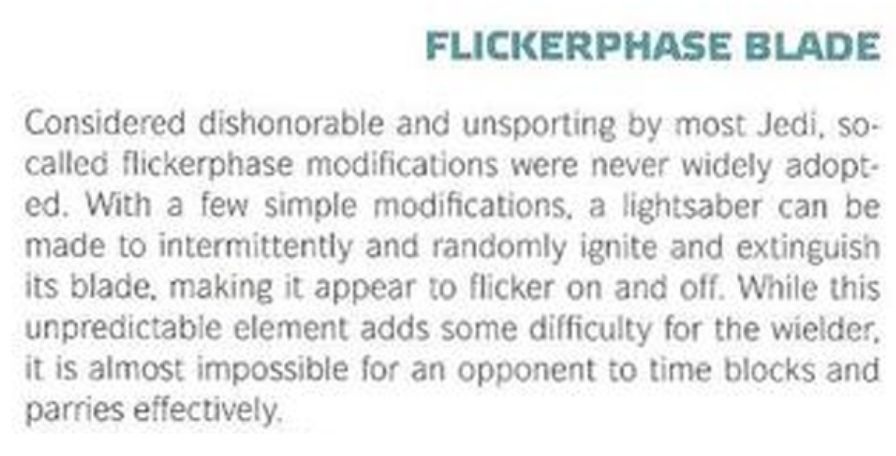
That made it extremely difficult to fight against. An opponent could try to block like normal, only for the blade to vanish for a split second and slip past their guard. The unpredictability made timing blocks and parries almost impossible.
Because of that, most Jedi viewed flickerphase blades as dishonorable and unsporting. Lightsaber combat was supposed to rely on control and precision, but this modification turned it into something far more unpredictable, and far less fair.
Why the Jedi Saw It as Dishonorable
The Jedi did not reject the flickerphase blade because it was weak. They rejected it because it went against how a lightsaber was meant to be used. According to Knights of Fate, most Jedi viewed the modification as “dishonorable and unsporting” because the blade could randomly ignite and extinguish during combat.
That unpredictability broke the foundation of a proper duel. A normal lightsaber fight depends on timing, distance, and control. Both fighters read each other, react, and adapt. But with a flickerphase blade, even a perfect block could fail for reasons that had nothing to do with skill. The blade could vanish for a split second and reappear past a guard, turning what should have been a clean exchange into something impossible to defend against.
For the Jedi, that crossed a line. Their approach to combat was never just about winning. Jedi were trained to show restraint, to avoid unnecessary harm, and to stay in control of both themselves and the situation. If an opponent surrendered, a Jedi would stop. If an enemy was disarmed or no longer able to fight, the goal was to end the conflict, not exploit the moment.
A flickerphase blade pushed in the opposite direction. It encouraged unpredictability, made defense unreliable, and created openings that did not come from skill or discipline. Instead of testing a Jedi’s mastery, it introduced an element of chaos into the duel.
That is why many Jedi saw it as dishonorable. It was not the power of the weapon that mattered, but what it represented. A lightsaber was supposed to be an extension of the user’s control and clarity. The flickerphase blade turned it into something less stable, less fair, and far less in line with Jedi principles.