
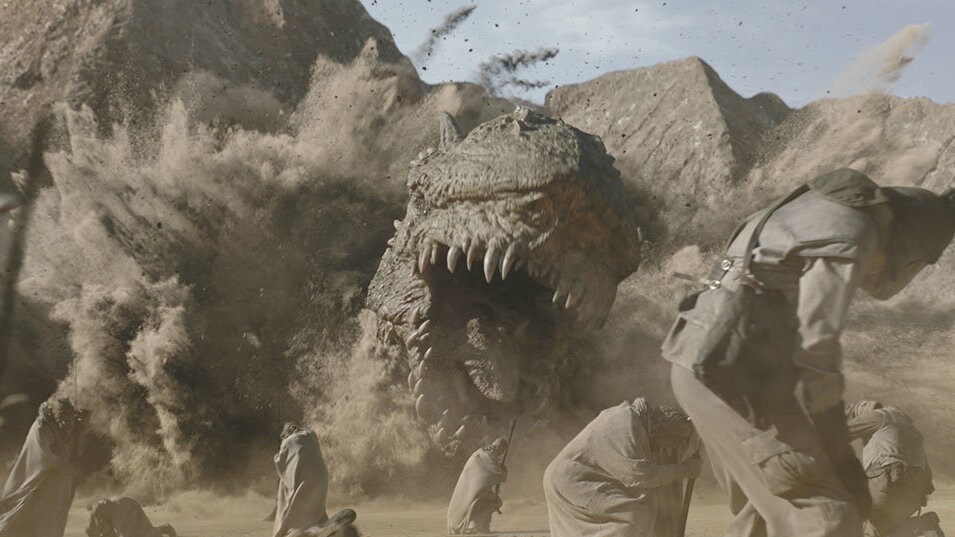
A Sarlacc is one of the nastiest ways to die in Star Wars. It waits beneath the sand, catches anything that comes close, and can keep its victim trapped for years. Yet Tatooine has another monster capable of turning that famous death pit into a hunting ground. The strangest part is not only what this animal eats, but what it does with the empty pit afterward.
The Krayt Dragon That Ate A Sarlacc Like a Snack Was Not An Ordinary Dragon
The animal is a krayt dragon, but that name covers more than one form of giant Tatooine reptile. Canon includes the smaller canyon krayt, the larger greater krayt, and an extremely rare form called the leviathan krayt dragon. The creature in The Mandalorian was one of those leviathans, a huge, heavily armored animal with sixteen limbs and the ability to spray corrosive fluid.
That distinction matters. It would be misleading to say every krayt dragon regularly hunts Sarlaccs. The smaller kinds are still dangerous predators, but the leviathan is the freakishly large form that can treat another desert monster as prey.
Canon gives us one direct example. The leviathan near Mos Pelgo had eaten the Sarlacc that once occupied the pit, then moved into the abandoned cavity and used it as a den. That is why the creature emerged from what looked so much like a familiar Sarlacc pit in “Chapter 9: The Marshal.”
This was not just a visual joke. The story placed one of Star Wars’ most feared ambush predators below something even larger on Tatooine’s food chain.
A Sarlacc Is Dangerous, But It Is Almost Trapped In Place
A Sarlacc is terrifying to anything that falls within reach of its mouth and tentacles. Most of its enormous body stays buried, however. It survives by waiting for prey instead of chasing it across the desert.

That creates a brutal weakness against a much larger burrowing predator. A leviathan krayt can move through loose sand, approach from outside the Sarlacc’s normal striking range, and tear into the buried body. Once the Sarlacc is dead, its pit is already a deep shelter in a desert where shade and protected ground are valuable.
The old Expanded Universe made the same basic point even more directly. Legends described greater krayt dragons digging Sarlaccs out as a rare treat, while banthas were much more common prey. That is the crucial word, rare. A Sarlacc was not an everyday snack. It was an unusual prize for an exceptional dragon.
The famous wildlife illustration that inspired this question is also from Legends, not a modern Canon field guide. It shows a greater krayt digging out a Sarlacc and labels the find as rare. Current Canon later gave the idea a clear on-screen example through the Mos Pelgo leviathan, but the two sources should not be treated as one uninterrupted account.
The Mos Pelgo Dragon Was A Walking Natural Disaster
The dragon’s choice of home made it a constant threat to both the Tusken tribe and the people of Mos Pelgo. It could travel beneath the sand, strike without much warning, swallow a bantha whole, and spray corrosive material over a wide area. Nearby movement could feel like a groundquake before the creature even appeared.
Din Djarin and Cobb Vanth could not simply walk into the pit and shoot it. The Mos Pelgo hunt required an alliance between people who normally distrusted each other, a large group of armed fighters, heavy weapons, explosives, and knowledge the Tuskens had built over generations.
The first plan targeted the dragon’s softer underside. The hunters buried explosives and tried to lure the beast across them with a bantha. The blast hurt it, but it did not finish the job. The dragon changed its attack, sprayed acid over the group, and killed several hunters before the survivors could regroup.

Din’s final move shows how difficult the kill really was. He let the dragon swallow him along with a bantha loaded with explosives, escaped with his jetpack, and detonated the charge from inside the animal. A normal blaster fight was never going to be enough.
Calling the dragon an apex predator does not mean it was invincible. It means almost nothing in its habitat could hunt it as normal prey. Killing this one took planning, sacrifice, technology, local knowledge, and a Mandalorian willing to enter its mouth.
The Tuskens Had Learned To Manage It, Not Defeat It
One of the smartest details in the episode is that the Tuskens understood the dragon’s digestion and sleep cycle. They sometimes fed it banthas because a well-fed dragon would remain dormant longer. That did not solve the problem, but it bought time and reduced the chance of another sudden attack on their camp.
This is more interesting than treating the creature as a giant boss fight. The Tuskens had lived close enough to study it across generations. They knew its habits, communicated with it in their own way, and understood that survival sometimes meant feeding the danger rather than challenging it.
The strategy also explains why a dragon capable of taking a Sarlacc did not eat everything around Mos Pelgo at once. Huge predators do not need to hunt every day. A massive meal can support a long period of inactivity, especially for an animal that spends much of its life hidden beneath the sand.
Once the dragon began attacking more often and threatening both communities, management was no longer enough. The only workable response was a temporary alliance and an organized hunt.
The Pearl Explains Why Anyone Would Hunt One
After the leviathan died, the Tuskens cut into the carcass and recovered an enormous pearl. Krayt dragons swallow stones that help grind food in their digestive systems, and over time some of those stones become smooth, rare krayt dragon pearls. Their scarcity and the danger involved in obtaining one make them extremely valuable.

Canon has connected these pearls to wealth and rare trophies. The huge pearl in The Mandalorian also makes the animal’s age and appetite feel real. This was not simply a monster with a treasure item inside it. The pearl was the result of a very long digestive process inside a creature that had spent years swallowing prey and stone.
Legends goes further. Krayt pearls could be cleaned, shaped, and used as focusing crystals in lightsabers. Revan could obtain one during the Tatooine section of Knights of the Old Republic. That lightsaber tradition is useful Expanded Universe history, but it should not be used to explain every pearl under current Canon.
The reward helps explain why organized hunters sometimes accepted the enormous risk. A successful hunt could provide meat, safety, status, and a treasure valuable enough to change someone’s life. The problem was surviving long enough to claim it.
Legends Let Revan Hunt One Thousands Of Years Earlier
Long before a live-action krayt dragon rose from the sand, Knights of the Old Republic gave players a memorable hunt in the Eastern Dune Sea. A dragon had nested in a cave that blocked access to an ancient Rakatan Star Map. Direct combat was not the answer there either.

Revan worked with the hunter Komad Fortuna, whose earlier attempt had cost his partner’s life. They placed mines near the cave entrance and used banthas as bait. When the dragon charged the animals, the explosives killed it. Revan then recovered the pearl from its gullet and gained access to the cave.
The story follows the same rule later used in The Mandalorian, even though the details belong to Legends. Krayt dragons are too powerful to fight on equal terms. The winning method is to understand what attracts them, prepare the ground, and place a devastating charge where their armor cannot save them.
This also gives the species a history beyond one television episode. Across two continuities, a krayt hunt is never a casual trophy trip. Someone usually dies, a settlement remains in danger, and the survivors need a plan built around the dragon’s own hunger.
So What Eats A Krayt Dragon?
In current Canon, there is no established everyday predator above an adult leviathan krayt dragon on Tatooine. Krayts are described as the planet’s apex predators, and the Mos Pelgo story supports that description. Sentient hunters are the practical threat, but only when they cooperate and bring enough firepower.
Legends did name one rare natural enemy. The sand demon was a semi-sentient insectoid feared by other Tatooine life and capable of hunting krayt dragons. It was extremely rare, lived beneath the desert, and carried so much myth around it that it never became a simple answer to the planet’s food chain.

So the hierarchy is not a neat ladder. Ordinary prey can be eaten by canyon krayts. Banthas feed larger dragons. A giant krayt can occasionally dig out and eat a Sarlacc. A sand demon can hunt a krayt in Legends. Humans, Tuskens, Jedi, and Mandalorians can kill one only with the right trap and an extraordinary amount of risk.