
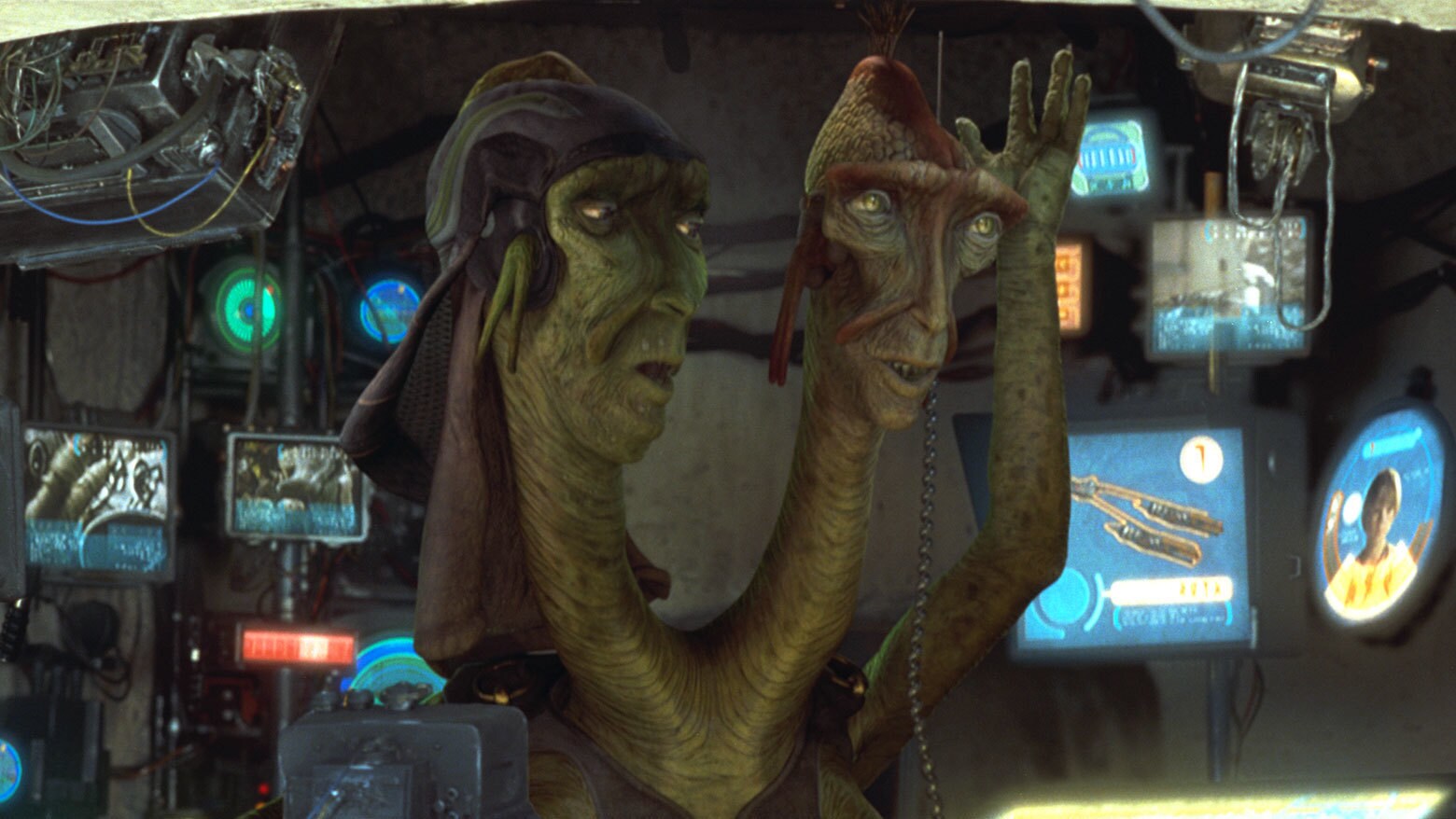
For a few seconds during the Boonta Eve Podrace, The Phantom Menace cuts to a two-headed announcer who talks over himself in two languages. He is strange enough to be memorable, yet the movie gives viewers almost no time to understand what they are looking at. That makes his apparent disappearance from later films feel even stranger. The full story is more interesting than a forgotten background alien.
That Is One Character, Not Two Random Aliens
The announcer is Fodesinbeed Annodue, better known as Fode and Beed. He is one biological being with two heads, and each head has its own name and personality. Fode is the red head who speaks Galactic Basic with the sound of a familiar sports commentator. Beed is the green head who answers in Huttese.
That setup lets one body perform both play-by-play and color commentary at the same time. During the Boonta Eve Classic, Fode gives the audience the information it needs while Beed adds speed, noise, and comic energy. It is not just a random visual gag. The character was designed around a very specific job, and the two-headed idea makes that job instantly clear.

The important detail is that Fode and Beed are not separate aliens stuck together, and they are not an unusual mutation. Their body is normal for their species.
What Exactly Is A Troig?
Fode and Beed belong to a species called the Troigs. Troigs are sentient beings from Pollillus. A typical Troig has two heads, two necks, four arms, and one shared body. Each head has its own temperament, but both remain aware of what the other experiences.
That shared awareness gives the species an obvious advantage. Four eyes can follow several things at once, and two minds can react without having to explain every detail to each other first. Canon also describes Troigs as clever, curious, observant, and good at learning languages. Those qualities make Fode and Beed’s career choice look less like a joke. A bilingual Troig is almost perfectly built to call a dangerous race filled with fast vehicles, sudden crashes, and competitors from across the galaxy.
Their full name also reflects their unusual identity. Fode and Beed are the names of the individual heads, while Fodesinbeed joins them into the name of the complete person. Current Canon does not explain every rule of Troig language and culture, but it clearly treats the two heads as distinct personalities sharing one life.
This is why it can be awkward to describe a Troig as either one person or two. Biologically, Fode and Beed share one body. Mentally, each head can speak and behave as an individual. Star Wars uses both ideas at once instead of forcing a simple answer.
The Species Did Return In Canon
Troigs have only one unmistakable live-action movie appearance, but their Canon appearance list goes well beyond The Phantom Menace. Most of those returns happened where casual movie viewers were unlikely to notice them, such as novels, comics, animation, and games.
One of the best examples is Jak Sivrak, the race announcer on the Colossus in Star Wars Resistance. The series usually presents him as a voice rather than a visible character, so it is easy to miss that he is a Troig. He was later pictured in the comic story All Aces Battle Royale. Greg Proops, who voiced Fode in The Phantom Menace, also voiced Jak, making the character a deliberate echo of the Podrace announcer without simply bringing Fode and Beed back.
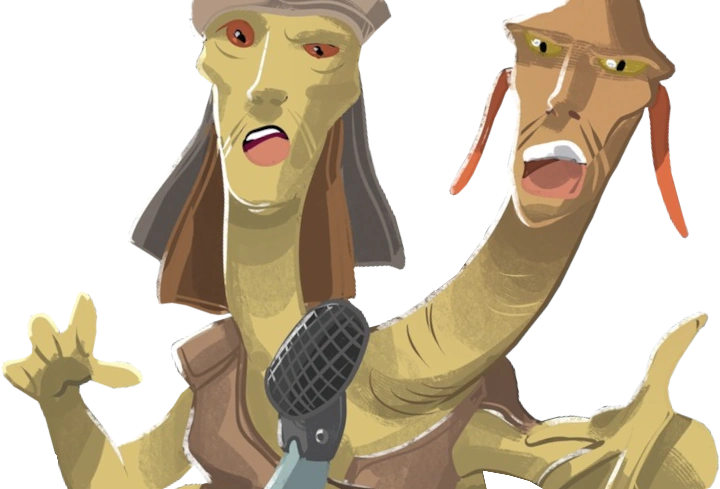
A different Troig appears in Marvel’s Star Wars (2020) #29. This unnamed auctioneer works on Spira during the Galactic Civil War and runs the sale of a Nihil strikeship. Lando Calrissian, Amilyn Holdo, and their allies are trying to obtain old Nihil technology, while an Imperial Museum curator keeps driving up the price. The role is brief, but the comic clearly draws the auctioneer as a four-armed, two-headed Troig. It is direct visual proof that the species was not discarded after Episode I.
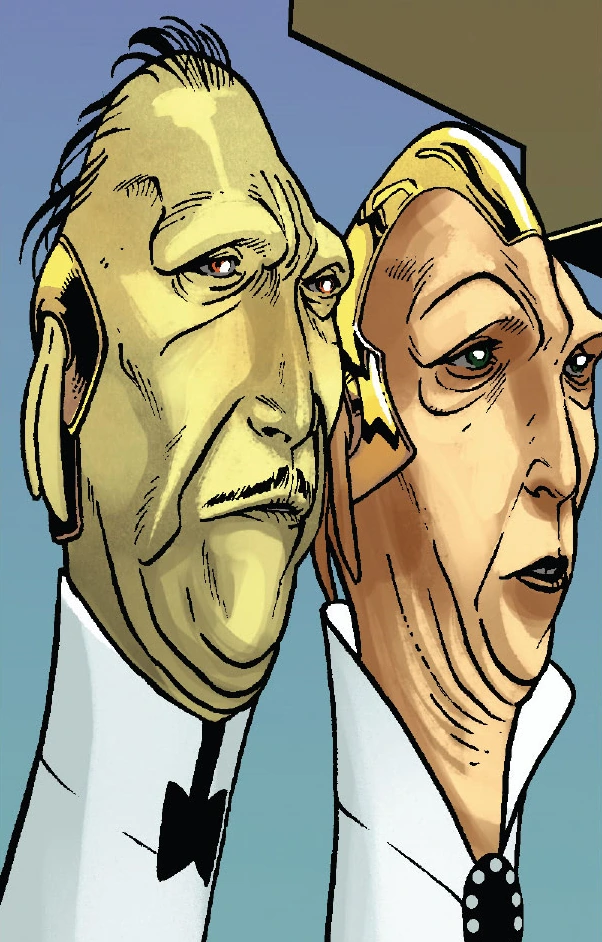
The 2024 Canon novel The Living Force offers a more character-driven use of the concept. Reezingrom Abbayav, known as Reez and Grom, hosts the holofeed program Remember Kwenn. The two heads agree on absolutely nothing, and that constant conflict makes their show both loved and hated. It is a small detail, but it uses Troig biology as a source of personality and comedy instead of treating the species as scenery.
Troigs also appear across other Canon material, including The High Republic: Convergence, War of the Bounty Hunters, and more Star Wars Resistance episodes. Listing every background appearance would not add much. The key point is simple: they returned repeatedly, just not in another major live-action close-up.
Why Does It Feel Like They Vanished?
The first reason is visibility. A voice in animation, a figure in one comic panel, or a name in a novel does not leave the same impression as a large alien filling a cinema screen. Star Wars kept using Troigs quietly, while its films stopped placing them where a broad audience could immediately recognize them.
The second reason is that Fode and Beed were purpose-built for the Podrace. Their two voices quickly explain the sport, translate some of its alien energy, and make the event feel like a galaxy-wide broadcast. Later stories had no strong reason to repeat that exact trick. When Troigs did return, writers often gave them similar public-facing jobs, such as race announcer, television host, or auctioneer, because two alert personalities sharing one body work especially well in those roles.
There is also a practical production issue, although Lucasfilm has never named it as the official reason for the species’ rarity. Fode and Beed were not made by simply putting one performer in an alien mask. Greg Proops and Scott Capurro first performed the commentary in prosthetic makeup while wearing blue material over their bodies. The planned mix of live performances and digital work did not look convincing enough, so the finished character became fully computer-generated.

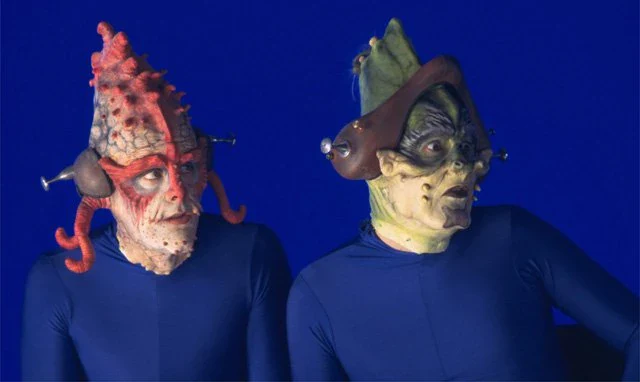
A modern live-action Troig would therefore require careful digital effects, a complicated practical setup, or both. That makes the species harder to place casually in the background than an alien that can be created with one costume and one performer. Still, this is only a sensible production explanation. There is no verified statement that Troigs were banned, retired, judged too expensive, or removed because audiences disliked them.
Legends Gave Troigs A Much Stranger Story
The following details belong to Legends, not current Canon.
The older Expanded Universe developed Troig biology and culture in far more detail. The right head was called the Saprin and was associated with qualities such as loyalty, faith, and cunning. The left head was called the Saprah and was linked with love, anger, and passion. Each head usually controlled its own pair of arms, while the species’ connected nervous system let both heads share warnings and understand each other immediately.
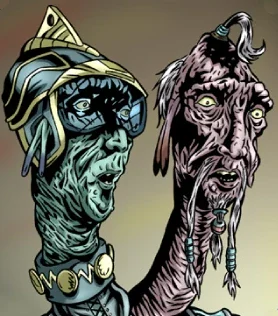
Legends also introduced rare Troigs with more than two heads, who were celebrated rather than treated as abnormal. It expanded the naming rule too: the word sin joined the names of the heads into the name of the whole being. Fode plus Beed therefore became Fodesinbeed.
The most interesting Legends story involved Dwuirsintabb, whose heads were named Dwuir and Tabb. Dwuir claimed that Tabb was mentally unstable and dangerous, then asked doctors to separate them. The problem was brutal: medical technology could save only one head, so granting Dwuir’s request would kill Tabb. The case became a public ethical debate during the Separatist Crisis, and no clear outcome was ever recorded.
That story takes the basic question behind every Troig, one body or two people, and turns it into a real moral problem. It shows that the species was capable of supporting more than a few seconds of comedy. Legends used the design to ask where one person’s rights end when two minds cannot physically live apart.