
ARF troopers are easy to recognize and surprisingly hard to explain from their screen time alone. Their low, visor-like helmets make them look important, yet The Clone Wars often gives them only a few seconds before the story moves back to the Jedi and clone captains. Even their name is close enough to ARC troopers and BARC troopers to create confusion. So what were these specialized clones actually trained to do, and did any of them accomplish something important?
ARF Troopers Were The Clone Army’s Forward Scouts
ARF means Advanced Recon Force. Their main job was to move ahead of the Grand Army of the Republic, observe the battlefield, identify enemy activity, and return useful information to commanders. In simple terms, regular clone units needed to know what waited over the next ridge, inside the next settlement, or around an enemy position. ARF troopers were among the specialists sent to find out.
That made them the Republic’s reconnaissance specialists and light cavalry. Reconnaissance was not just looking through binoculars. It could include following a target without being noticed, examining a route, finding hostile units, tracking movement, and judging whether a larger force could advance safely. If fighting started, an ARF team had to survive long enough to report what it had learned.
Their lighter armor suited that role. Clone armor changed throughout the war, and specialized variants were introduced for specialized missions. ARF armor favored stealth, speed, and freedom of movement rather than turning the wearer into a heavily protected assault trooper. The wide visor and distinctive helmet also made the class easy to identify, although unit colors and camouflage varied.
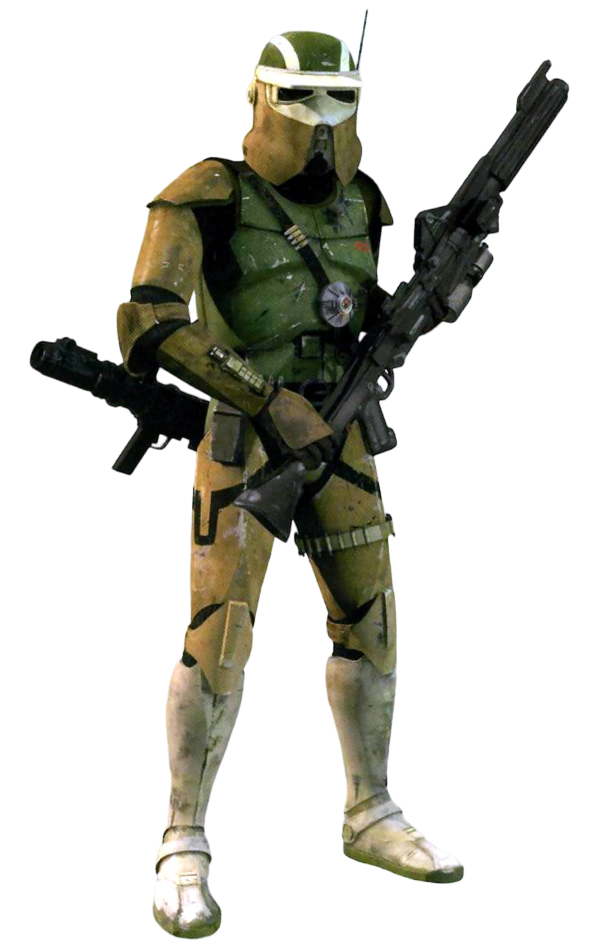
ARFs were still fully trained clone soldiers. They carried blaster rifles or carbines, and some used rocket launchers and thermal detonators. However, their weapons did not define the job. A scout who destroys one patrol but exposes the Republic’s entire approach has failed. The information, timing, and route mattered as much as the shooting.
The AT-RT Turned Them Into Light Cavalry
The vehicle most closely linked to ARF troopers was the All Terrain Recon Transport, usually shortened to AT-RT. It was a small, open-cockpit walker built mainly for reconnaissance. It could move quickly over rough ground and carried a repeating blaster powerful enough to cut through battle droids and threaten light vehicles.
That combination explains why ARFs sometimes look less like quiet scouts and more like attacking cavalry. Once an enemy had been found, an AT-RT unit could screen a larger column, chase retreating troops, attack an exposed flank, escort friendly forces, or provide fast anti-infantry fire. The same speed that helped a scout avoid a fight could help the scout exploit one.

An AT-RT was useful, but it was not safe. The rider sat high and exposed, and the walker could not trade fire like an AT-TE. ARF success depended on mobility, terrain, and surprise. Sending these light walkers straight into concentrated fire wasted their main advantages.
The connection between ARFs and AT-RT drivers is also messier than it first appears. Some official and licensed material treats AT-RT drivers as ARF troopers, while other material separates the driver role or gives it a slightly different armor configuration. The safest answer is that ARFs commonly operated AT-RTs, but not every clone seen on one should automatically be treated as the same named specialization.
Their Clearest Recon Mission Happened On Teth
Early in the war, two camouflaged ARF troopers followed the people involved in Rotta the Hutt’s kidnapping to the jungle world of Teth. They located the monastery being used by the Separatists and reported that at least two droid battalions guarded it. They also warned Anakin Skywalker that landing directly at the monastery was not possible.
It is a short scene, but it shows the whole purpose of the class. The ARFs arrived before the main rescue force, stayed out of sight, counted the defenders, identified the objective, and briefed the commander. They did not defeat the garrison themselves because that was never the point. Their work gave Anakin and Ahsoka a clearer picture before the dangerous climb and assault began.
This is the difference between reconnaissance and ordinary patrol duty. A patrol may guard an area or look for trouble. A reconnaissance team is sent to answer specific questions that affect the commander’s next decision. On Teth, the ARFs answered where the target was, how strongly it was defended, and whether the obvious approach was usable.
Ryloth Was Their Best On-Screen Achievement
The strongest example of ARF troopers shaping an entire battle came during the liberation of Ryloth. ARFs served in Lightning Squadron under Mace Windu and Clone Commander Ponds. Their AT-RTs helped clear Separatist forces from the route to Lessu and supported the heavier Republic walkers.
Two ARFs, Stak and Razor, then volunteered for a smaller and more delicate mission. They accompanied Windu while he searched for Cham Syndulla and the Twi’lek resistance. After finding the resistance, the pair joined Windu in the infiltration of Lessu.
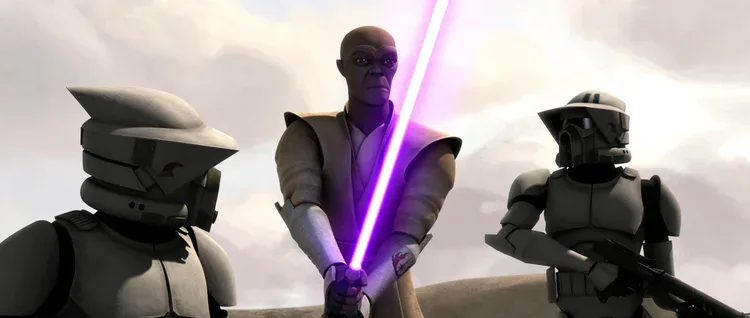
Their most important moment came at the plasma bridge protecting the capital. Stak and Razor crossed with Windu, fought their way into the control room, and restored the bridge. That allowed Lightning Squadron’s AT-RTs and the resistance’s blurrg riders to enter Lessu. They then helped defend the controls against battle droids and BX-series droid commandos while the larger attack continued.
That sequence shows why the class was more than a group of drivers. The same troopers performed route-clearing, contact with local allies, infiltration, close combat, and control of a critical access point. Razor was later given a commendation for valor for his role in the battle. If ARF troopers have one clear signature achievement, opening Lessu to the combined Republic and Twi’lek assault is it.

ARF Duties Went Beyond Open Battlefields
Not every ARF assignment involved racing across a battlefield. Sergeant Hound served with the Coruscant Guard and worked with a tracking massiff named Grizzer. During the search for Ahsoka Tano, who had been framed for murder, Grizzer followed her scent around a Republic military base while Hound handled the animal and joined the pursuit.

Hound’s assignment is a useful reminder that reconnaissance means finding people and information, not only enemy tanks. His massiff-handler training was a specialized version of the same basic function. He had to search, track, interpret signs, and direct other security forces toward a moving target.
ARFs also fought in major campaigns on Geonosis, Umbara, and Kashyyyk. On Kamino, ARF troopers supported ARC Commander Blitz during the Separatist attack on Tipoca City, and one used a rocket launcher against a Trident-class assault ship. On Umbara, ARFs riding AT-RTs joined the difficult ground campaign through terrain that made speed, visibility, and survival especially hard.
Commander Trauma and his ARF unit defended the Temple of Eedit on Devaron. They nearly stopped the droid attack, but Savage Opress arrived and killed the defenders, including Trauma and the two Jedi stationed there. The loss was not evidence that ARFs were weak. They were light reconnaissance troops forced into a fixed defense against an enemy powerful enough to wipe out the Republic outpost and Jedi temple.
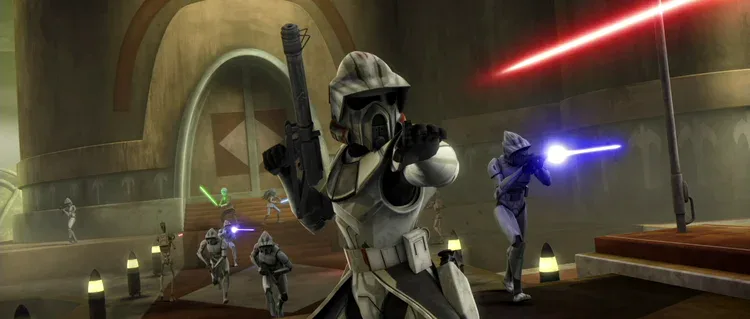
ARFs could scout, track, ride, fight, infiltrate, and support larger formations. They were not meant to replace heavy infantry, armored vehicles, or commandos in every situation.
ARF, ARC, BARC, And Republic Commando Are Different
The similar names create more confusion than the actual jobs do.
ARF troopers were forward reconnaissance specialists and light cavalry. They gathered battlefield information, operated ahead of larger units, and often used AT-RTs.
ARC troopers were Advanced Recon Commandos, elite clones selected or trained for a wider set of dangerous missions. The word “Recon” appears in both names, but an ARC trooper was not simply a higher-ranked ARF.
BARC troopers were Biker Advanced Recon Commandos associated with high-speed speeder operations. The BARC speeder was used for scouting and escort missions, but BARC and ARF are not interchangeable labels for every clone riding a fast vehicle.
Republic Commandos operated in small teams built for missions ordinary troops could not handle. They are closer to dedicated special-operations soldiers. ARFs could infiltrate or launch surprise attacks when the mission required it, but their core value remained reconnaissance and mobile battlefield support.
Real-world comparisons can help a little, but they should not be pushed too far. Calling ARFs “recon Marines,” “cavalry scouts,” or “forward observers” captures part of the idea, not a perfect one-to-one military structure. Star Wars combines several scouting and light-cavalry tasks in the same fictional unit.
Canon And Legends Do Give The Different Levels Of Detail
Current Canon establishes the important part clearly: ARFs wore lighter armor, specialized in reconnaissance, often rode AT-RTs, and served in campaigns such as Teth, Ryloth, Geonosis, Umbara, Devaron, and Kashyyyk. Their screen appearances and current reference material support the job, major deployments, and named troopers discussed above.
Legends material adds more detailed equipment lists. It describes infrared helmet systems, life-form scanners, survival supplies, specialized packs, ropes, macrobinoculars, medical gear, and training that began with riding living mounts before operating an AT-RT. Those details fit the role well, but they should not all be silently treated as current Canon.
One useful interpretation also goes beyond what either continuity states word for word. ARFs were valuable because they reduced uncertainty. A clone army could have excellent soldiers and powerful walkers, but commanders still needed to know where to send them and what waited there. The ARFs helped turn an unknown battlefield into a plan.