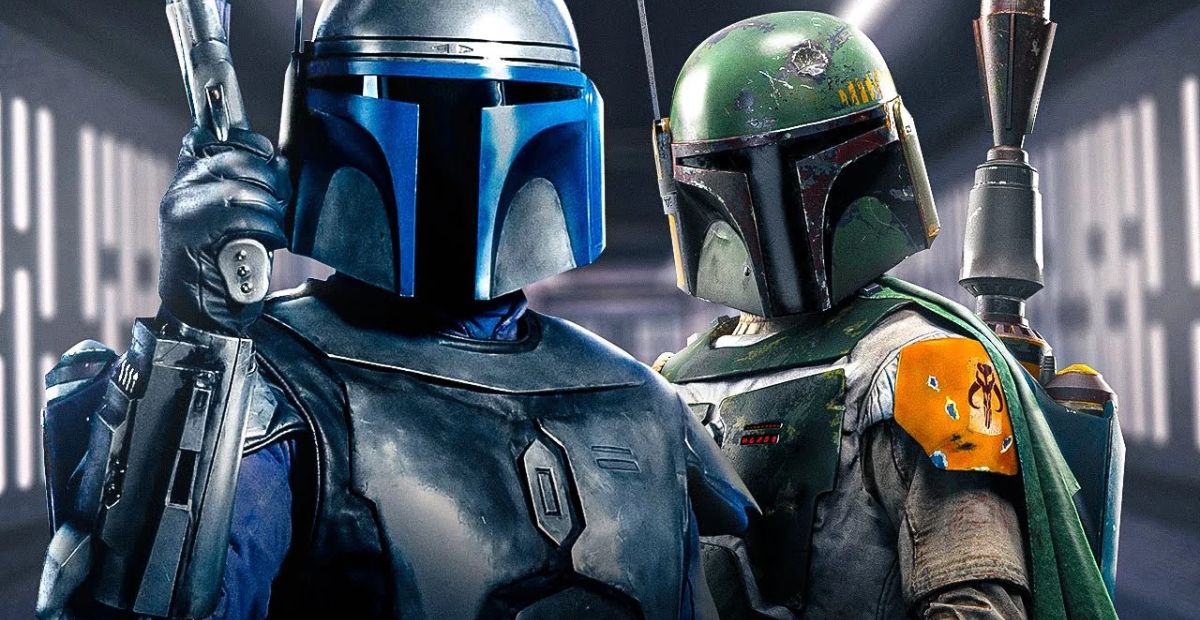
Put Jango Fett’s helmet next to Boba’s and you’d think only one of them had ever been shot at. Jango’s silver-and-blue helmet looks sleek, while Boba’s green one has chipped paint and a dent you can spot across the room. Both men made a living chasing dangerous people, so why did Boba’s helmet look so much worse? Part of the answer is in the paint, and The Mandalorian gives us a good look at what happened when Boba finally redid it.
Boba’s Helmet Already Looked Battered Before the Sarlacc
Boba’s armor took a beating over his years as a bounty hunter, and the original trilogy already shows the results. His helmet is chipped and dented when he works for Vader in The Empire Strikes Back and when he’s hanging around Jabba’s palace in Return of the Jedi. The Sarlacc came later. By then, the battered green helmet was already the face fans knew.

That big dent has a story of its own. In an unfinished Clone Wars scene shown at Star Wars Celebration in 2017, a young Boba and Cad Bane face off in a quick-draw duel. Both go down, and Boba’s helmet rolls away with smoke curling out of a fresh blast mark. That was the planned origin of the dent. The rest of the scrapes and chipped paint tell the broader story of a suit that saw years of use.
The helmet also had a job to do. It came with a targeting rangefinder, a magnifying view plate, and a built-in comlink. Those silver patches tell you the finish took a hit. They tell you very little about how well the equipment inside still worked. The same goes for the rest of the suit: Cobb Vanth wore it to defend his town, and Boba put its weapons straight back to work on Tython.
Why Jango’s Silver Helmet Looked So Much Cleaner
Jango’s paint scheme makes the difference stand out. On Boba’s helmet, bright silver patches break up dark green and red. Your eye goes right to them. Jango’s dome is already mostly silver, so a light scuff has less contrast. The shapes are similar enough that the finish does a lot of the work in making one helmet look sleeker than the other.
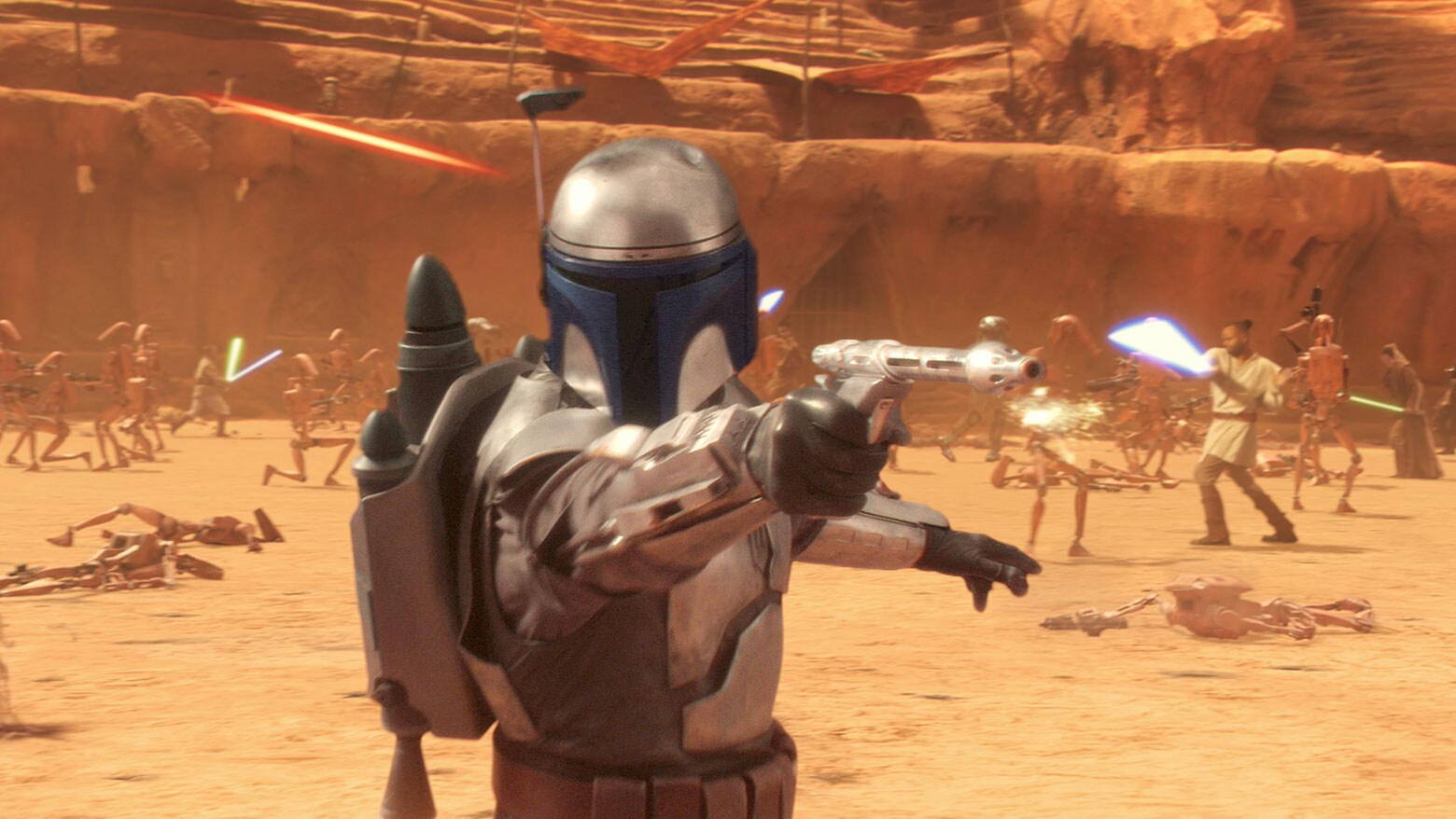
Jango was already regarded as the best bounty hunter in the galaxy when we met him. In Attack of the Clones alone, he fights Obi-Wan on a rain-soaked landing platform and later joins the battle on Geonosis. We see him during a short stretch of his career, which gives us plenty of evidence that he put his gear through real fights and very little about how often he repaired or repainted it.
There’s also a wrinkle in calling Boba’s green helmet a worn-out version of Jango’s silver one. Boba did inherit armor from his father, but in The Clone Wars, he rigged Jango’s helmet with a bomb while trying to kill Mace Windu. The green helmet we know has a history of its own.
Boba Repainted the Helmet and Left the Dent
The Mandalorian gives us the best comparison because we get to see the same armor before and after a fresh coat of paint. In Chapter 14, “The Tragedy,” Boba gets it back on Tython and immediately uses it against stormtroopers. He also shows Din Djarin the chain code in the armor, which identifies Jango as his father and backs up his claim to the suit.
By Chapter 15, “The Believer,” Boba has repainted it. The green is more even, the red trim is sharper, and the famous dent is still there. He keeps the colors he made his own, even after going out of his way to recover the armor because it belonged to his father.

That little before-and-after tells us more than guessing how either Fett looked after his gear. Boba was willing to fight in it while it looked rough, and he took the time to repaint it once he had it back. The result looks cared for and still looks unmistakably like his.
George Lucas Wanted the Helmet to Look Like It Had Been Through Repairs
The earliest version of the costume was almost entirely white. It began as a design for a “super trooper” before becoming the outfit for a single bounty hunter. Once it was Boba’s, George Lucas wanted it to look like gear that had seen battles, been repaired, and been painted over again. He also wanted the suit to look a little mismatched, as if Boba had picked up pieces from different places and put it together himself.

The 1978 prototype costume test shows the suit before it got its familiar battle-worn colors. Video: Star Wars / Lucasfilm.
Designer Joe Johnston made much of the wear with paint. He started with silver, masked off patches, painted the final colors over them, then peeled away the masking. The silver underneath looked like metal showing through chipped paint. He used the technique on both the helmet and the body armor.
Johnston thought of the helmet as Boba’s face. That helps explain why the scratches matter so much in The Empire Strikes Back, where Boba can stand still and barely speak and you already get the sense he’s been through some ugly jobs. Years later, The Mandalorian shows him doing exactly what Lucas imagined someone had done to that armor before: getting it back into shape, giving it another coat of paint, and wearing it into the next fight.