
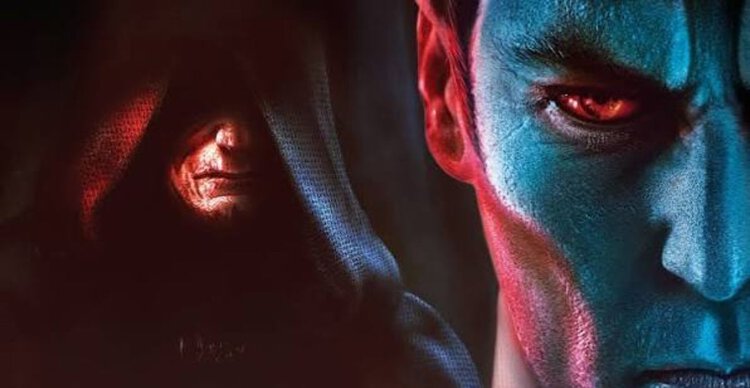
Thrawn was one of the strangest officers to rise through the Empire.
He was not human. He did not come from the Core Worlds. He did not build his career through political loyalty or fear. He came from the Chiss Ascendancy in the Unknown Regions, entered Imperial custody, and still managed to stand before Emperor Palpatine as someone worth using.
Palpatine did not promote Thrawn because he fully trusted him. He promoted him because Thrawn had two things the Empire needed: a military mind that kept winning, and knowledge of a part of the galaxy Palpatine wanted to understand.
So why did Palpatine make Thrawn a Grand Admiral?
He Was Sent By The Chiss Ascendancy
Thrawn’s story with the Empire started before he ever wore an Imperial uniform.
He was an officer of the Chiss Ascendancy, a powerful civilization in the Unknown Regions. The Chiss were facing threats beyond the borders of known space, including the Grysk Hegemony, and Thrawn was sent into the wider galaxy to judge whether the new Galactic Empire could become an ally.
If the Empire could help the Chiss, Thrawn wanted to turn it into an ally. If the Empire proved too dangerous or too weak, the Chiss needed to know that too.
That is why Thrawn arranged his path into Imperial hands. He used a fake exile on a world in Wild Space to draw Imperial attention. When Imperial forces found him, he was eventually brought before Emperor Palpatine.
Palpatine already had an interest in the Unknown Regions. Thrawn came from there, understood its dangers, and belonged to a people who knew how to survive in it. That made him more valuable than a normal prisoner or foreign officer.
Thrawn Met Palpatine In 14 BBY And Rose Through The Empire
According to Star Wars Timelines, Thrawn’s first meeting with Palpatine happened in 14 BBY, about five years after the Empire replaced the Republic.
Thrawn offered Palpatine his knowledge, his military skill, and his understanding of the Unknown Regions. His private goal was still tied to the Chiss Ascendancy. He wanted the Empire’s strength pointed toward threats that could one day reach his own people.
One detail caught Palpatine’s attention immediately: Thrawn mentioned Anakin Skywalker.
During the Clone Wars, Thrawn had worked with Anakin on a mission to Mokivj. Palpatine knew exactly what that meant, because Anakin had already become Darth Vader by the time Thrawn stood before him. Palpatine did not reveal that secret. Thrawn later had to work out Vader’s identity himself after serving alongside the Sith Lord.
Palpatine allowed Thrawn into the Imperial Navy, and Thrawn moved quickly. He learned Basic, entered the Royal Imperial Academy on Coruscant, and graduated in only three months. Eli Vanto became his aide and later his protégé.
Thrawn’s rise came from results. He studied enemy art, culture, and behavior to find weaknesses other officers missed. He did not fight like most Imperial commanders. He watched, learned, and then struck at the exact pressure point.
After the Batonn insurgency was put down, Palpatine promoted Thrawn to Grand Admiral. Thrawn eventually commanded the Seventh Fleet and became one of the Empire’s most successful commanders against rebel cells.
Palpatine Needed Thrawn’s Knowledge, But Questioned His Loyalty
Palpatine valued Thrawn for more than battlefield victories.
Thrawn knew the Unknown Regions from personal experience. He had lived there, served there, and understood why navigation through that part of space was so dangerous. Palpatine accepted him as an adviser on matters involving the Unknown Regions and spoke with him directly about that subject.
That knowledge fit Palpatine’s long-term plans. The Unknown Regions later became central to the survival of Imperial power after the Empire’s collapse. Imperial remnants fled there, and the First Order eventually emerged from that hidden space. Exegol, the Sith world where Palpatine built his cloning facilities and the Final Order fleet, was also hidden in the Unknown Regions.
Thrawn gave Palpatine access to information the Empire could not easily get from its own officers.
Palpatine still noticed the problem with Thrawn’s loyalty. Thrawn served the Empire, but his deeper loyalty remained with the Chiss Ascendancy. He kept the locations of Chiss worlds and bases hidden from Palpatine. Palpatine knew he was withholding that information.
After Batonn, Palpatine promised Thrawn that he had no plans against the Chiss. That promise did not remove the tension. Later, Palpatine tested Thrawn by sending him on a mission with Darth Vader involving a disturbance in the Force connected to young Chiss sky-walkers captured by the Grysks.
By that point, Thrawn’s divided loyalty was clear. The Empire had his service. The Chiss still had his heart and mind.
Thrawn’s Disappearance Hurt The Empire
Thrawn disappeared shortly before the events of A New Hope.
During the liberation of Lothal, Ezra Bridger surrendered to Thrawn as part of a larger plan. When the purrgil arrived, they took Thrawn, Ezra, and the Chimaera into deep space. Thrawn was removed from the known galaxy before the Rebellion’s biggest victory.
The timing hurt the Empire.
Soon after Thrawn disappeared, the Rebels destroyed the first Death Star at Yavin. Grand Moff Tarkin died with it. Palpatine lost the battle station that was supposed to secure Imperial rule and one of the Empire’s most powerful political commanders.
He had already lost Thrawn, one of his best military commanders.
Thrawn’s return in Ahsoka happens years after Palpatine’s death at Endor. By then, the Empire has broken into remnants, warlords, hidden loyalists, and scattered fleets. Thrawn returns with something most Imperial survivors do not have: the rank of Grand Admiral, the history of commanding the Seventh Fleet, and the reputation of a commander Palpatine once considered one of his most useful servants.
Palpatine made Thrawn a Grand Admiral because Thrawn was useful in a way few Imperial officers were. He could defeat rebel movements, read enemies through their culture, and give the Emperor access to the Unknown Regions. Palpatine questioned his loyalty, but he still used him until Ezra Bridger removed him from the board.