
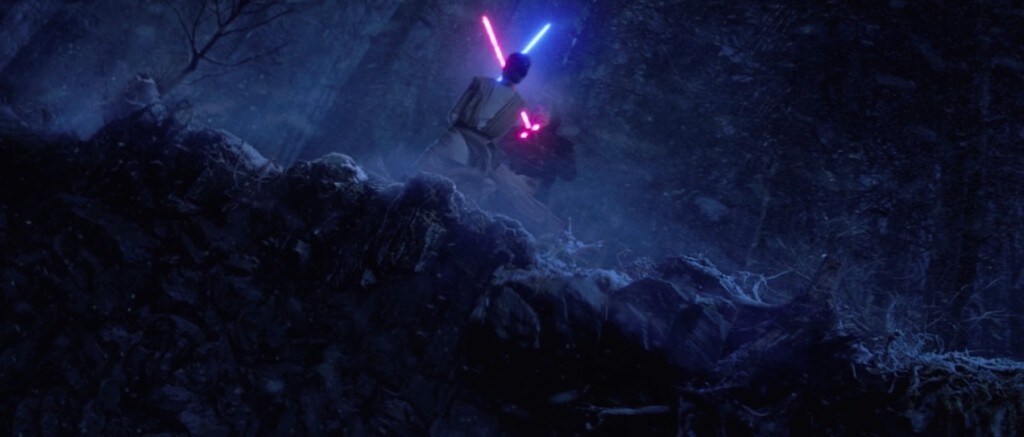
Kylo Ren has just killed Han Solo when Chewbacca’s bowcaster blast tears into his side. Minutes later, he corners Finn and Rey in the snowy forest on Starkiller Base. Then, in the middle of the fight, he repeatedly strikes the bleeding wound with his fist. It lasts only a few seconds, but it changes how the whole duel reads.
First, Kylo Was Already Badly Hurt
The simplest place to start is the injury itself. Chewbacca did not hit Kylo with an ordinary blaster. A bowcaster fires a metal quarrel wrapped in plasma energy, and the weapon is described as more powerful and accurate than a normal blaster. Earlier in The Force Awakens, the film makes a point of showing Han Solo being surprised by its force.
Kylo takes that blast directly in his side. He drops, but he still manages to follow Finn and Rey into the forest, throw Rey into a tree with the Force, and overpower Finn for most of their duel. That is impressive, but the injury never stops affecting him.
The film’s screenplay says he strains while using the Force because of the wound. It later calls him “obviously hampered” by it. This matters because punching the wound does not heal him, close it, or make the damage disappear. Whatever benefit he gets is temporary and psychological, not medical repair.
![Star Wars: Episode VII The Force Awakens - Finn & Rey Vs. Kylo Ren [4K 60fps]](https://may4bewithyou.com/wp-content/plugins/wp-youtube-lyte/lyteCache.php?origThumbUrl=https%3A%2F%2Fi.ytimg.com%2Fvi%2FFJTz-ahXyyI%2F0.jpg)
The Dark Side Rewards What Pain Creates
The dark side is driven by destructive emotion. Fear becomes anger, anger becomes hatred, and hatred can become a source of focus and aggression. A useful Canon description calls it the side of the Force that feeds on pain, hatred, and fear.
Simply being injured does not give every dark-side user a clean power upgrade. Pain matters because of the emotional response it can produce. A person can panic, collapse, or lose concentration because of it. A trained and furious dark-side user can instead turn it into rage and use that rage to keep attacking.
Kylo’s striking motion makes sense in that framework. He is forcing himself to feel the wound at the exact moment he needs aggression. Each blow is a physical reminder of Chewbacca’s attack, Han’s death, Finn’s defiance, and his own failure to feel as powerful as he expected. He is trying to remain angry enough to move through the damage.
Killing Han Made Kylo Weaker, Not Stronger
The timing is the most revealing part of the scene. Kylo has spent much of the film believing that killing Han will cut away Ben Solo and complete his fall to darkness. Instead, it has the opposite effect.
Kylo’s official biography says the act did not make him feel stronger. Somehow, he felt weaker. The screenplay is even sharper, describing him as weakened by the act and horrified by what he has done before Chewbacca shoots him.
So Kylo enters the forest carrying two wounds. One is the torn flesh in his side. The other is the emotional shock of discovering that killing his father did not give him the certainty he wanted.
That makes the wound-punch more than a combat trick. Kylo is trying to manufacture the state he thought Han’s murder would create. He wants pain to become anger, anger to become control, and control to become power. The desperation of the movement tells us it is not working cleanly.
This fits Kylo’s wider behavior. When events escape his control, he often responds by destroying objects, attacking people, or pushing himself further into violence. His power is real, but so is his instability. Striking the wound puts both qualities into one image.
Maul Shows That Suffering Can Keep A Dark-Side User Going

Maul provides the clearest Canon comparison. After Obi-Wan cut him in half on Naboo, Maul survived an injury that should have killed him. His story explains that he endured by clinging to the dark side and concentrating on his hatred of Obi-Wan. The official history of Maul’s mechanical limbs describes that survival directly.
The comparison does not prove that Kylo copied a named Sith technique. Nothing in the film, screenplay, or official character material gives the wound-punch a special name. It only shows that Star Wars already has a clear pattern: a dark-side user can turn suffering and hatred into the will to continue when the body should be giving up.
Legends takes that pattern even further. Darth Bane’s orbalisks left him in constant pain, and he learned to live and fight with that suffering as part of his dark-side existence.
Adrenaline Is Also Part Of The Answer
There is also a basic physical explanation. Hitting an injury creates another burst of pain. In a life-or-death fight, that shock can sharpen attention for a moment and provoke an aggressive response. Kylo may be using the blows to stop himself from slowing down or mentally drifting away from the fight.
But calling it only an adrenaline trick misses what the film is doing with the Force. The scene comes immediately after Kylo’s greatest act of violence leaves him spiritually weaker. He then takes a physical wound from the person who loved Han most, carries that wound into battle, and keeps striking it while fighting with increasing fury.
The physical and Force-based explanations can both be true. Pain produces a bodily shock, and Kylo uses the anger attached to that pain as dark-side focus. Star Wars makes the second layer important because the same pattern appears throughout dark-side stories: suffering becomes dangerous when someone refuses to release it and chooses to turn it into hatred.