
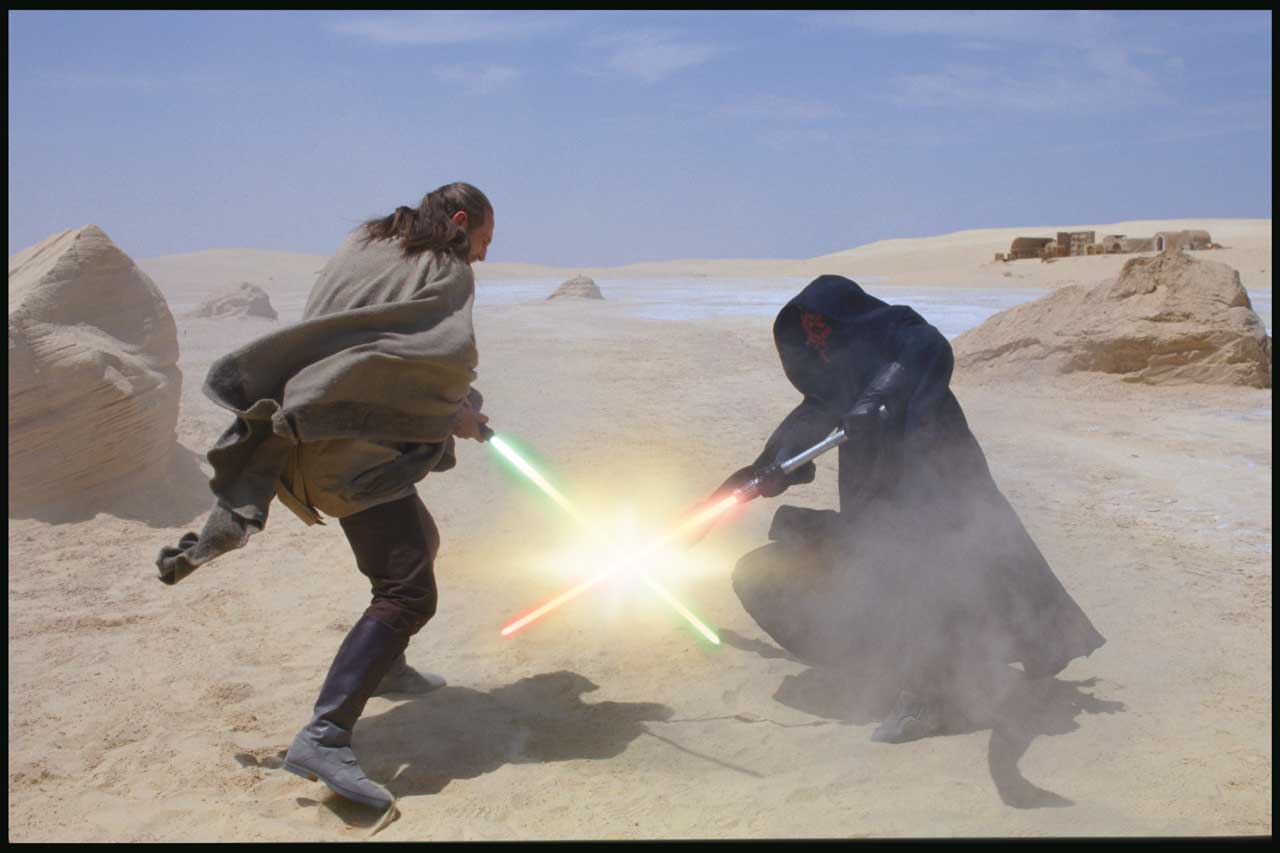
Obi-Wan didn’t always fight with the patience we associate with him. As Qui-Gon’s apprentice, he favored a faster, more aggressive approach, much like his master. In Legends, watching Qui-Gon fall to Darth Maul pushed him to rethink that approach. The change helped turn him into a Jedi who could face a relentless attack without rushing to answer it.
Qui-Gon’s Death Made Obi-Wan Rethink His Training
Obi-Wan originally specialized in Ataru, the fourth form of lightsaber combat. It emphasized Force-assisted speed, powerful attacks, and acrobatic movement, giving its users ways to overwhelm an opponent before they could regain control.
Then came Naboo. Separated from Qui-Gon by an energy barrier, Obi-Wan could only watch as Maul struck his master’s face with his lightsaber hilt, then stabbed him through the opening.
In the Legends explanation of Obi-Wan’s training, that loss prompted him to shift his focus toward Soresu, Form III. He wanted to strengthen the defensive side of his technique after seeing that even someone as skilled as Qui-Gon could be caught exposed.
That doesn’t make Ataru a bad form or mean Qui-Gon couldn’t defend himself. Maul was a dangerous opponent who successfully separated the two Jedi and exploited an opening. But for Obi-Wan, the lesson was personal: being able to launch a powerful attack wasn’t enough if he couldn’t survive the response.

Ataru’s Strengths Came With a Cost
Ataru put the opponent under pressure through speed, movement, and attacks from changing angles. Its users didn’t all fight like Yoda, but they shared an approach that demanded considerable physical effort.
That created two problems: stamina and space. An extended duel could wear down an Ataru practitioner, while a restricted battlefield could limit the movement that made the form effective.
The Legends analysis of Qui-Gon’s final duel connects those weaknesses to his fight with Maul. After moving through the hangar and generator complex, Qui-Gon ended up fighting alone in a confined area around the reactor shaft. He had less room to use his style’s mobility, while Maul kept the pressure on.
The useful distinction isn’t that Ataru offered no protection. It’s that maintaining an aggressive pace became harder when the opponent could withstand it. Obi-Wan’s new training focus addressed what happened when a fight lasted longer than he wanted.

Soresu Let Obi-Wan Control the Fight Without Leading Every Attack
Soresu emphasized close, efficient blade movements and careful defense. Rather than spend energy on a large movement when a small parry would work, its practitioner aimed to cover openings and remain composed under pressure.
For Obi-Wan, that changed what he needed from an exchange. He didn’t always have to drive an enemy backward or force an immediate breakthrough. He could defend, study their rhythm, and look for a safer chance to strike.
His defense gave him time to make better decisions. An opponent who kept attacking might become tired, impatient, or predictable. Obi-Wan could exploit that mistake without having to gamble on every counterattack.
His duel with General Grievous on Utapau shows why that approach suited him. Grievous advances with four lightsabers, using spinning blades to create an intimidating assault. Obi-Wan holds his ground, responds to the attacks, and cuts off two of the general’s hands.
The Legends account of the encounter expands on his precise parries and small evasions. Grievous brings more weapons, but Obi-Wan doesn’t need to match him swing for swing. He needs to protect himself long enough to find an opening.
That ability took years to develop. Choosing Soresu after Naboo didn’t instantly give the young Obi-Wan the composure or skill he displayed during the Clone Wars. The change gave him a foundation to build on.

He Changed His Priorities Without Forgetting Qui-Gon’s Lessons
Obi-Wan still attacked aggressively, jumped, and used acrobatics after making Soresu his specialty. In Legends, he retained elements of Ataru, giving him techniques he could draw on when the situation called for them.
A preferred form wasn’t a restriction on every movement. Obi-Wan could use a sudden offensive burst without building his entire strategy around sustaining one. His patience mattered because he still had the skill to act when an opportunity appeared.
The change also gives his relationship with Qui-Gon a meaningful final detail. He honored his master’s dying request to train Anakin, while taking his own swordsmanship in a different direction.
He carried Qui-Gon’s teaching forward, but he also learned from losing him. The apprentice who had watched helplessly behind an energy barrier spent years developing a defense that would make him far harder to catch exposed.