
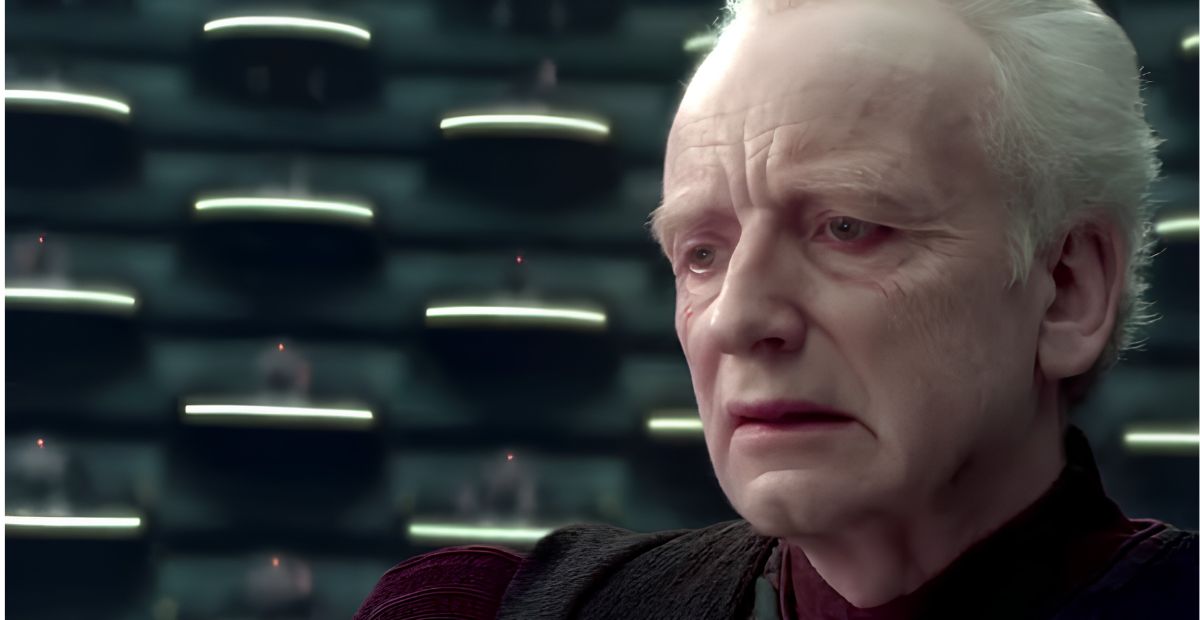
Palpatine spent decades destroying the Jedi, manipulating the Republic, and turning the Clone Wars into the path that made him Emperor. Yet once the galaxy finally belonged to him, he withdrew from public life and left the work of ruling it to others. How could the prize he had spent a lifetime chasing become something he barely wanted to touch?
After Becoming Emperor, Palpatine Nearly Vanished From Public Life
In The Rise and Fall of the Galactic Empire, Beaumont Kin points out how sharply Palpatine’s behavior changed once he finally achieved the position he had spent decades working toward. As Supreme Chancellor, Palpatine had been one of the most visible and recognizable figures in the galaxy. He worked notoriously long hours, met with numerous Senate committees, delivered public speeches, and appeared to throw all his energy into maintaining the Republic’s war effort during the Clone Wars.
Of course, much of that activity was part of his deception. Palpatine needed the Senate, the Jedi, and the wider Republic to see him as a tireless leader carrying the galaxy through a crisis. Every committee meeting and public appearance helped preserve that image while he secretly controlled the Separatists and pushed the Republic toward dictatorship.
But the performance ended almost immediately after he declared himself Emperor. Rather than becoming an even more active ruler now that the entire galaxy answered to him, Palpatine withdrew from public life and became a recluse. He appeared before the Imperial Senate far less often, made few public appearances, and increasingly remained inside the Imperial Palace while officials beneath him handled the Empire’s government.
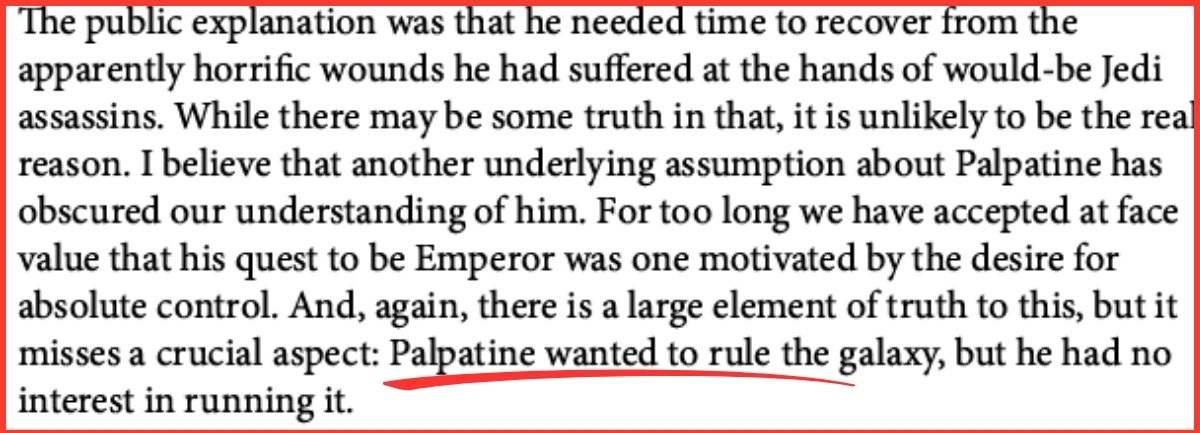
The official explanation for Palpatine’s disappearance was that he needed time to recover from the injuries he had suffered during the supposed Jedi assassination attempt. That story helped justify why the newly declared Emperor was rarely seen, but The Rise and Fall of the Galactic Empire argues that it was unlikely to be the real reason for his withdrawal.
The book challenges the common assumption that Palpatine spent decades pursuing the Imperial throne because he wanted to personally govern every part of the galaxy. What he wanted was absolute control: the authority to issue commands without opposition and the certainty that every political institution answered to him. The committee meetings, negotiations, speeches, and constant public appearances had only been necessary while he was still pretending to serve the Republic and gathering power through its government.
Once he became Emperor, that work no longer served a purpose. The Jedi had been destroyed, the Senate could no longer restrain him, and nobody could legally challenge his decisions. Palpatine had achieved the power to rule, but the ordinary work of administration held no interest for him. As the book puts it, “Palpatine wanted to rule the galaxy, but he had no interest in running it.”
Palpatine Left the Work of Running the Empire to Others
Even before the Republic officially became the Empire, Palpatine had already begun creating a system in which all political power would be concentrated under him while the actual responsibility of governing the galaxy belonged to other people. He wanted every governor, military commander, and political official to answer to him, but he had no intention of personally handling the daily administration of thousands of star systems.
As explained in The Rise and Fall of the Galactic Empire, regional control was placed in the hands of governors and later the Moffs. The most important was Grand Moff Wilhuff Tarkin, who was given enormous authority over Imperial territories and could use military force to maintain order without waiting for Palpatine to personally manage every crisis. This allowed the Emperor to remain the final source of power while officials like Tarkin carried out the work required to enforce it.

Political affairs on Coruscant were handled in much the same way. Mas Amedda, Pollux Hax, and Sate Pestage oversaw much of the Imperial government around Palpatine. They managed officials, political operations, and the systems through which the Emperor’s commands were passed down. Palpatine did not need to attend every meeting or personally supervise every decision because he had built an administration designed to operate beneath him.
The book explains that Palpatine largely allowed these figures to decide how individual sectors and institutions would be run. As long as order was maintained and Imperial authority remained unchallenged, he had little interest in the smaller details of government. He still watched the overall condition of the Empire and intervened when something threatened his control, but budgets, local administration, and routine political work were left to the people beneath him.
The Empire Was Only the Beginning of Palpatine’s Real Goal
Palpatine did not build the Empire because he wanted to spend the rest of his life managing it. The book argues that his greater concern was what would happen when that life ended. He had no interest in retirement, showed no desire to prepare a successor, and had spent too long gathering power to accept that someone else would eventually inherit it.
His rise from senator to Supreme Chancellor and then Emperor had removed nearly every obstacle around him. The Jedi were gone, his political enemies had been defeated, and the resources of the galaxy were now under his control. He finally had the time, protection, and wealth to concentrate on the problem that political power alone could not solve: his own mortality.
This also explains why Palpatine was willing to leave routine government to Moffs, governors, and advisers. Their job was to keep the galaxy obedient while he pursued a way to extend his reign beyond a normal lifetime. The Empire was not the final reward he had spent decades chasing. It created the conditions that allowed him to search for eternal life without anyone powerful enough to interrupt him.