
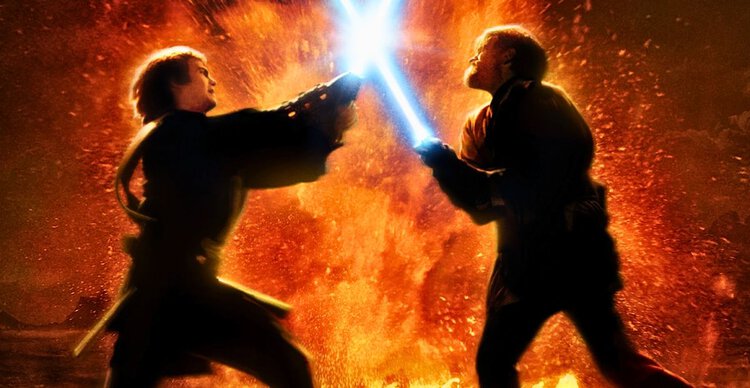
Anakin Skywalker entered the Mustafar duel believing he had become more powerful than any Jedi. Minutes later, Obi-Wan Kenobi had taken his lightsaber, three limbs, and the future he thought was waiting for him. Vader survived, but the defeat stayed with him long after the armor closed around his body. So when he finally spoke about losing, what did he blame?
What Vader Actually Said About His Defeat
The direct book answer is that Vader said he was not strong enough. He did not blame a lack of dueling opportunities, limited Clone Wars experience, or the Jedi for holding him back.
The exchange appears in Dark Lord: The Rise of Darth Vader, James Luceno’s 2005 novel set just after Revenge of the Sith. Vader asks Darth Sidious what would happen if the Emperor found somebody stronger to replace him, just as Anakin had replaced Count Dooku. Sidious insists that no one has greater potential, but Vader answers with the failure he cannot ignore:
“I wasn’t strong enough to defeat Obi-Wan.”
Sidious does not comfort him. He agrees, then gives his own explanation: “Obi-Wan triumphed because he went to Mustafar with a single intention in mind: to kill Darth Vader.”
He admits the simplest and most humiliating fact possible. On Mustafar, whatever his potential might have been, he was not strong enough to beat the man standing in front of him.

Sidious Thought Resolve Made The Difference
Sidious turns Vader’s admission into a lesson about commitment. Obi-Wan reached Mustafar after seeing security footage of Anakin killing Jedi in the Temple. He had also heard Yoda say that the boy he trained had been consumed by Darth Vader. By the time the duel began, Obi-Wan understood that he might have to kill the Sith Lord his friend had become.
Vader was in a very different state. He had betrayed the Jedi, murdered the Separatist leaders, attacked Padmé, and declared that he could overthrow the Emperor. His confidence looked absolute, but his mind was not clear. He was trying to protect Padmé, punish the Jedi, prove himself to Obi-Wan, and imagine himself as the galaxy’s next ruler at the same time.
Sidious’s point is not that Obi-Wan suddenly had more raw Force potential. It is that Obi-Wan entered the fight with a focused purpose, while Vader entered it carrying rage, fear, ambition, and personal conflict. The Legends account of the Mustafar duel records the result as a costly Jedi victory that left Vader horribly injured and dependent on his armor.
This explanation is also self-serving. Sidious is teaching his apprentice what he wants him to learn: doubt is weakness, hesitation is dangerous, and total commitment wins. He treats a deeply personal tragedy as another Sith training exercise. Even when his explanation is useful, it should not be mistaken for a neutral analysis from an honest teacher.

Vader’s Real Problem Was Not A Lack Of Power
Anakin had enormous power, but power was never the only factor in this matchup. Obi-Wan had trained him from childhood. He knew Anakin’s habits, his impatience, his aggressive pressure, and his need to force a decisive ending. Anakin knew Obi-Wan equally well, which is why most of their long duel remained so close.
The difference appeared when patience mattered most. Obi-Wan kept defending, kept moving, and waited for a mistake. Anakin treated every delay as another challenge to his superiority. When Obi-Wan reached higher ground and warned him not to attack, Anakin did not search for another route or reset the fight. He tried to prove that the warning did not apply to him.
That choice fits a pattern that current Canon later made explicit. In the Obi-Wan Kenobi Part V episode guide, a training duel ends with Obi-Wan telling Anakin that his need to prove himself is his undoing and that his need for victory blinds him. The scene takes place years before Mustafar, but it explains the same weakness. Anakin can gain the advantage and still lose because winning is not enough for him. He needs to dominate, and that need makes him predictable.


The Inexperience Explanation Does Not Match The Book
A different version of this story claims that Vader blamed his inexperience. In that telling, Obi-Wan supposedly received more chances to duel during the Clone Wars, while the Jedi held Anakin back. That sounds believable because Anakin often resented the Council and believed the Order limited him. It still does not match Vader’s dialogue in Dark Lord.
There is also a basic problem with the idea. Anakin was not short on combat experience by the end of the Clone Wars. He had fought Count Dooku several times, battled Asajj Ventress, led troops through years of war, and survived missions beside Obi-Wan across the galaxy. The official history of Anakin Skywalker describes him as a celebrated general before his fall, not a sheltered student who rarely faced real opponents.
Obi-Wan did have more years of training and a longer career as a Jedi, but that is not the same claim. More important, Vader never uses that difference as his recorded excuse in the scene. The line about being denied enough opportunities should not be attached to Dark Lord unless a separate primary source can be identified.
The confusion may come from combining several true ideas. Anakin felt restrained by the Jedi. Obi-Wan had more years of experience. Anakin also lost because he became reckless. Those points can all exist without producing a scene where Vader says, “The Jedi did not let me duel enough.” The published dialogue gives us a much shorter answer.
Vader’s Memory Shows How Deep The Denial Went
Another Legends book, The Rise and Fall of Darth Vader by Ryder Windham, retells Anakin’s life from his point of view. Its Mustafar material reinforces the emotional contradiction behind his defeat. Rage narrows his attention, he underestimates Obi-Wan, and he continues to think in terms of superior strength even after Obi-Wan has dismantled him.
That contradiction matters more than any technical excuse. Vader can say he was not strong enough, but he struggles to accept what “strength” meant in that fight. He wants strength to mean raw Force power, aggression, and the ability to overwhelm an enemy. Obi-Wan wins through judgment, control, timing, and intimate knowledge of Anakin’s behavior.
Vader’s pride can survive the first definition. If the problem was simply that he needed more power, then he could train harder, embrace more anger, and return stronger. The second definition is harder to face. It means Obi-Wan understood him, warned him, and still watched him make the fatal choice.
This also explains why “inexperience” is such a tempting answer even though the identified book dialogue does not support it. Inexperience shifts responsibility away from Vader’s character. It turns the loss into a problem of insufficient opportunities rather than arrogance. The actual story keeps responsibility on Anakin. He had choices throughout the confrontation, and he repeatedly chose anger and pride.

