
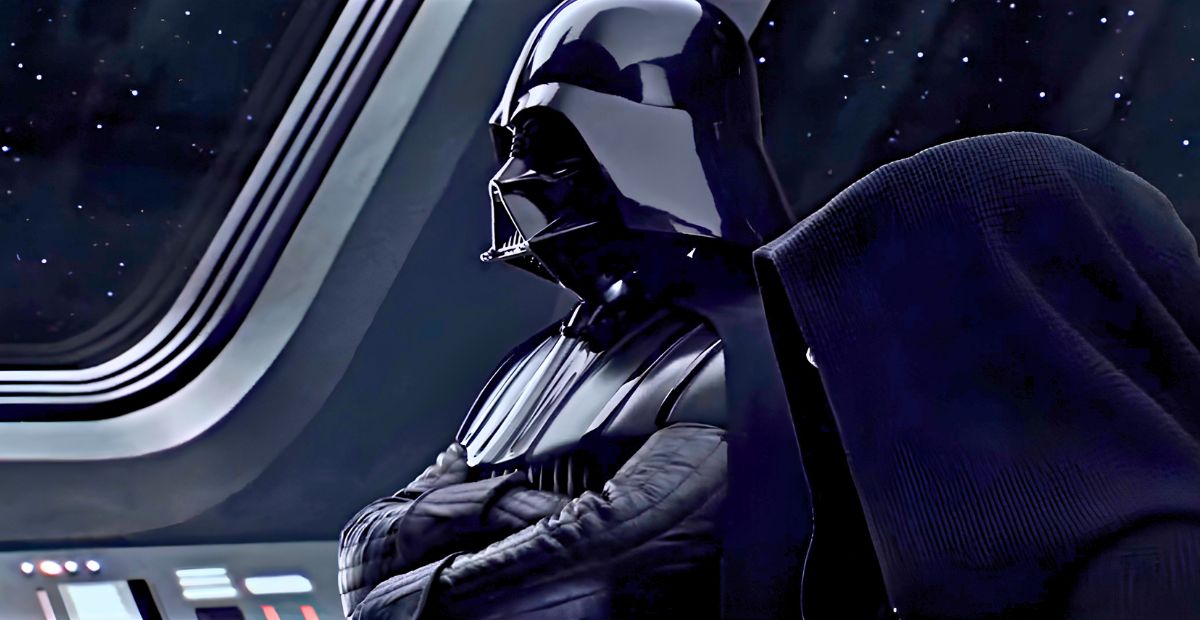
In A New Hope, the Death Star is supposed to be the Empire’s greatest weapon. But Vader never seems impressed by it. When Admiral Motti brags about its power, Vader tells him that destroying a planet is still insignificant next to the Force.
At first, it sounds like a simple Sith belief. But later stories show Vader had a deeper problem with the Death Star.
So why did Darth Vader hate it?
Vader Thought The Death Star Was Built On Arrogance
Darth Vader may be one of Emperor Palpatine’s most loyal servants, but that does not mean he agreed with everything his master built. One of the biggest examples is the Death Star. Even though the battle station became one of the Empire’s most terrifying weapons, Vader saw serious problems with it almost from the beginning.
This is explored in Darth Vader #1 from 2015, written by Kieron Gillen with art by Salvador Larroca. The issue takes place after A New Hope and before The Empire Strikes Back, when Vader is still dealing with the fallout from the Death Star’s destruction. Palpatine is angry, the Rebels have escaped, and Vader is trying to recover from one of the Empire’s biggest failures.

Throughout the issue, Vader is searching for Luke Skywalker and the Rebels, hoping to correct the disaster that happened at Yavin. But when Palpatine speaks with him, he brings up the Death Star directly. He reminds Vader that the Empire spent twenty years building it, only for the station to become “a layer of dust orbiting around Yavin.” To Palpatine, that failure belongs partly to Vader.
That is when Vader finally says what he really thought of the weapon.
He says, “The arrogance of the weapon courted disaster. Even the power of that space station is nothing compared to the Forc—”
The line echoes what Vader says in A New Hope, when he tells the Imperial officers, “The ability to destroy a planet is insignificant next to the power of the Force.” Both moments show that Vader never saw the Death Star as the Empire’s greatest source of power. From his point of view, even a station that could destroy planets was still beneath the Force.
There may have also been something personal in Vader’s reaction. If Palpatine placed too much faith in the Death Star, then Vader could have seen the weapon as something that might eventually replace him in his master’s eyes. Vader was Palpatine’s enforcer, his Sith apprentice, and one of the most feared figures in the Empire. A planet-killing superweapon threatened to make that kind of personal power seem less important.
Vader’s issue was not only spiritual either. He also saw the tactical danger. Calling the weapon arrogant was not just an insult. The Death Star’s destruction proved how costly that arrogance could be. Its loss damaged the Empire’s resources, reputation, and morale, and the second Death Star would eventually become another massive failure.
Vader Preferred A Weapon That Could Actually Fight A War
In Thrawn: Alliances, Vader even flew one of Thrawn’s TIE Defenders and came away impressed enough to support the project. To Vader, the Defender was not just another Imperial experiment. It was a practical weapon, fast, heavily armed, shielded, and useful against Rebel forces across the galaxy.
That is what makes the contrast with the Death Star so sharp. The Death Star took nearly twenty years to build, swallowed endless resources, and became the kind of project that competed directly with Thrawn’s Defender program. Thrawn: Treason makes that conflict clear: Krennic’s Project Stardust was pulling funding away from the TIE Defender, forcing Thrawn to fight just to keep his project alive.
The Defender also solved a completely different problem. The Death Star could terrify a planet, but it had to be in the right place to matter. Thrawn’s fighters could be spread across the fleet, sent after Rebel cells, and deployed wherever the Empire actually needed them. That kind of weapon fit the war the Empire was really fighting.
Vader Smiled When the Death Star Was Destroyed
In Legends, Vader’s reaction to the Death Star’s destruction goes even further.
His TIE fighter has been thrown away from the station, but he is not dead. The ship is damaged, but still spaceworthy. Vader is far enough from the blast to survive, and with a few careful hyperspace jumps, he can still reach a hidden Imperial naval base.
Then he looks back on what just happened.
The Death Star is gone. The superlaser, the troops, the weapons, the officers, the credits, the years of construction, all of it has been burned into dust in a single instant.
And Vader smiles.

Not because the Rebels won. Not because the Empire survived the disaster. But because the battle station itself was finally gone.
For years, the Death Star had pulled the Empire’s focus into one massive weapon. Vader had watched officers treat it like the center of Imperial power, even though he never believed it was greater than the Force. Now that weapon had been destroyed, and Vader was the one left drifting away from the wreckage.
The smile is painful, but it is still there.