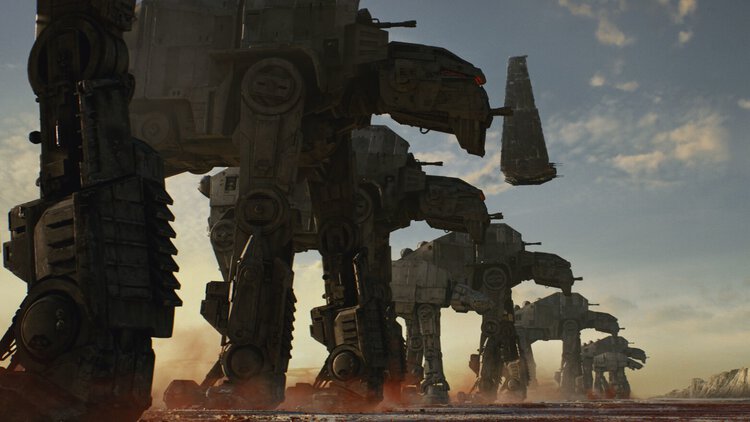
The AT-M6 is one of the strangest machines on the battlefield in The Last Jedi. Its shoulders rise above its body, its front limbs look more like arms, and it advances across Crait on what seems to be a gorilla’s knuckles. That silhouette is too specific to be an accident. Both the production design and the vehicle’s role inside the story explain why it moves this way.
The Gorilla Was The Starting Point
The behind-the-scenes reason is direct: the AT-M6 was deliberately based on a gorilla.
Design supervisor Kevin Jenkins developed the walker with director Rian Johnson. Their goal was not to draw a random new machine and call it an upgrade. They wanted the design to feel like the next stage of the Imperial walker family, in the same way that one generation of military tanks grows into another while keeping a recognizable family shape.
Jenkins viewed the original AT-AT as a tank mixed with a dog. When he and Johnson discussed how to move that idea forward, Jenkins suggested replacing the dog influence with a gorilla. Gorillas offered the stance he wanted: powerful, aggressive, high at the shoulders, and heavy through the front of the body.
He took the comparison literally. During the early design process, he molded the AT-M6’s side profile over a real photograph of a gorilla. That established the machine’s raised shoulders, low rear body, huge forelimbs, and backward-facing knuckles. The familiar animal shape was present before the details of the armor were finished.
The backward knuckles matter more than they may seem. A normal four-legged walker places four similar feet beneath its body. The AT-M6 plants its armored front limbs ahead of its shoulders like a knuckle-walking ape. Its rear legs then look shorter and lighter by comparison, which makes the whole machine lean forward.
Jenkins also built a physical model to judge the final design. He wanted it to feel as if it could have existed beside the practical vehicles of the original trilogy, not like a smooth digital object from a different universe. The result kept the hard surfaces and exposed mechanical logic of an AT-AT while changing its posture completely.

The Giant Cannon Needed A Different Body
The in-universe reason starts with the weapon on the AT-M6’s back. AT-M6 means All Terrain MegaCaliber Six, named for its MegaCaliber Six turbolaser cannon. This is not a transport with a large gun added as an extra. The vehicle is a mobile heavy-artillery platform built around that cannon.

The official reveal explains the key point in a few seconds: the AT-M6 is much larger than a standard AT-AT, and its simian gait helps stabilize the cannon. That connects the visible gorilla shape to the machine’s main battlefield job.
Canon reference details take the idea further. The walker’s frame accommodates a dedicated turbolaser power generator and auxiliary fuel cells behind the cannon compartment. Its reinforced front limbs carry the heavier forward structure and give the gun a stable base. The entire upper profile, from the tall shoulders to the long machinery on its back, belongs to one large artillery system.
This also explains why its proportions look so different from an AT-AT. An AT-AT carries troops and fights as an armored assault vehicle. The enormous AT-M6 is designed to bring a siege-breaking weapon within range of a fortified target. It needs more support at the front because the cannon and its equipment dominate the machine.
The gorilla stance therefore works like a visual shortcut. Even before the AT-M6 fires, its body tells us where its weight and strength are concentrated. The machine looks as if it is bracing itself against the ground.

Its Front Limbs Learned From Hoth
The gorilla shape also helped the designers address the most famous weakness of the old AT-AT.
At the Battle of Hoth, Rebel snowspeeders wrapped tow cables around the walkers’ narrow legs. Once the legs were tangled, an AT-AT could no longer step forward and crashed onto the snow. Jenkins and Johnson discussed that scene while developing the AT-M6. The heavy front limbs became their visual answer to the problem.
Those limbs are armored almost to the forearm. They look much harder to bind than the long, exposed legs of an Imperial AT-AT, and the wider forward posture gives the walker a different base. This was a behind-the-scenes design idea first, but the finished canon vehicle also has a direct defense: two sets of serrated cable cutters in its front legs.
The cutters do not make the AT-M6 impossible to topple. It is still a tall, top-heavy machine. They simply show that the First Order knew what had happened on Hoth and expected an enemy to try the same attack again. A cable reaching the front limbs now meets thick armor and blades meant to cut it.
This is why the AT-M6 feels like an evolution instead of a replacement. It keeps the basic four-legged walker concept, but its body reflects a lesson learned from an earlier battlefield failure. The gorilla arms are not only there to look muscular. They turn the weakest-looking part of the old design into the most heavily protected part of the new one.
The Shape Is Also A Weapon
The AT-M6 was designed to frighten an enemy before its main gun came into range. Its canon description treats it as half siege walker and half psychological weapon, and the gorilla posture is central to that effect.
A conventional AT-AT has an animal-like shape, but it stands tall and walks with a measured, almost mechanical rhythm. The AT-M6 appears to bear down on the battlefield. Its shoulders sit high, its head hangs beneath the front of the body, and its huge arms strike the ground ahead of it. Even at rest, it looks ready to charge.
Its size strengthens that impression. The AT-M6 stands about 36 meters high, while the smaller First Order walkers around it make the scale obvious. Jenkins liked the idea that older-style walkers could function almost like scouts beside this new heavy machine. On Crait, that difference makes the AT-M6 look less like another vehicle in the formation and more like the center of the entire assault.
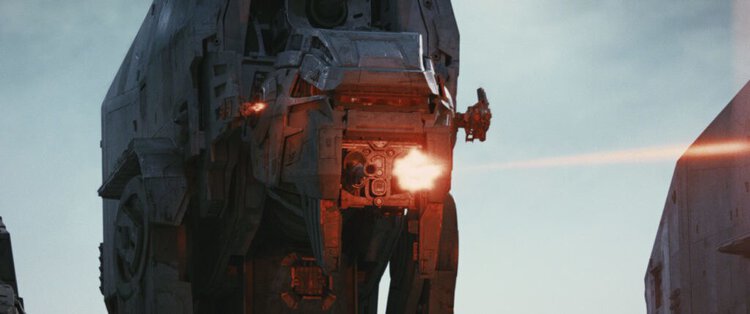
The sounds and movement complete the effect. Deep mechanical impacts accompany each step, while the red cockpit and dark armored face give the front of the walker a predatory look. The First Order does not hide the machine’s bulk. It uses that bulk to announce that a fortified position is about to be hit by something far beyond ordinary ground artillery.
The Design Works For Two Different Reasons
Behind the scenes, the gorilla gave the filmmakers a clear way to evolve the classic walker. A real gorilla photo established the profile, then high shoulders, backward knuckles, heavy forelimbs, and a forward-leaning stance turned that profile into a Star Wars machine. The physical model kept it connected to the visual language of the original trilogy.
Inside the story, those same choices suit a siege walker built around a massive cannon. The front-heavy stance stabilizes the weapon, the reinforced limbs support the machine’s forward structure, and serrated cutters discourage another tow-cable attack. The threatening posture also serves the First Order’s use of fear as a battlefield tool.
That is why the AT-M6 looks so much like a gorilla. The animal was the production team’s direct inspiration, but the shape was then given practical jobs inside the vehicle. Its silhouette, movement, weapon, armor, and purpose all point in the same direction.