
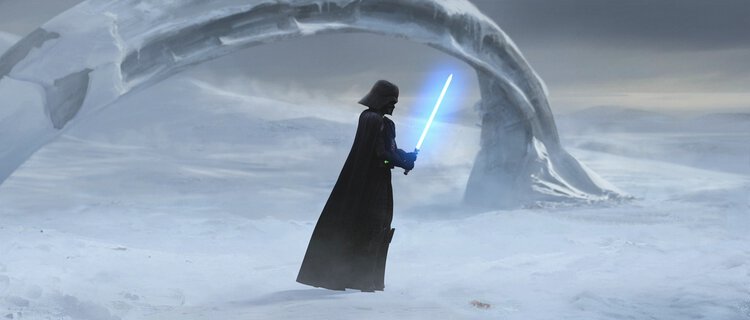
The final scene of Star Wars: The Clone Wars does something unusual with Darth Vader. He says nothing as he crosses the snow, finds Ahsoka Tano’s abandoned lightsaber, and looks up at a circling convor. The mask hides almost everything, but the camera lets us see the man trapped behind it. That brief look carries the emotional weight of Anakin and Ahsoka’s entire story.

Vader’s Eyes Turn Blue In The Finale
When Vader looks up in the final scene, his eyes turn blue again behind the red lenses of his mask. The color is only visible for a moment, and the lenses add a warm red tint around it, but the blue iris is the important detail. The shot replaces the usual image of a faceless Sith Lord with Anakin Skywalker’s human eye.
This was not an accidental glimpse through the helmet. Dave Filoni was directly asked about making Anakin and Vader’s eyes visible in “Victory and Death.” He explained that he had always been fascinated by the way a person can sometimes be seen through Vader’s red lenses in A New Hope. For the finale, he wanted viewers to see “humanity within that dark armor” and connect the black-clad figure with the young man who had given Ahsoka her lightsabers.
That gives the blue eyes a supported purpose. They are not just a cool color change or a hidden sign that Vader stopped being a Sith. They let Anakin’s humanity become visible at the exact moment his past returns to him.

Blue Eyes Do Not Mean Vader Was Redeemed
The eye change is emotional, not a secret redemption. Star Wars has never treated yellow Sith eyes as a permanent switch that proves whether somebody is good or evil in every second.
In Revenge of the Sith, Anakin’s eyes turn yellow when he is fully consumed by hatred on Mustafar. They later look normal when Padmé arrives, even though he has already accepted the name Darth Vader, attacked the Jedi Temple, and slaughtered the Separatist leaders. His natural blue eyes do not erase any of those choices.
The same rule matters in the finale. Vader is not using rage in that silent moment. He is standing in a graveyard, holding a weapon tied to the person who once trusted him most. His blue eyes show the human being under the mask, but they do not mean he has returned to the light.
Filoni made that limit clear when discussing the ending. He said the scene gives Anakin a symbolic presence but “doesn’t change anything about Vader.” He is still the Emperor’s enforcer. He still walks away with the Imperial troops. The sadness comes from seeing that Anakin is not completely absent, while also knowing he will continue choosing Vader for years.
Ahsoka’s Blue Lightsaber Pulls Anakin To The Surface
The timing of the blue eyes matters because Vader is holding Ahsoka’s blue lightsaber when they appear.
Before the Siege of Mandalore, Anakin repaired Ahsoka’s old weapons and changed their green blades to blue. He returned them during their final meeting before his fall. It was a very Anakin kind of gift, practical, personal, and slightly possessive. He had improved the sabers in his own style while waiting for her to come back.
Ahsoka later left one of those weapons beside the graves of the clones killed after Order 66. The official recap of “Victory and Death” describes her dropping the saber as the final piece of her identity as a commander in the war. Years later, Vader reaches into the snow and finds it.
This is why the weapon affects him more than a random Jedi relic would. He built part of it. He gave it to his former Padawan. It represents one of his last generous acts before he became Vader, and it now lies among the graves created by the Empire he serves.
Filoni called those lightsabers the finale’s “through line” and said there is “a symbolic arc of Anakin underneath” the story. The blue blade and blue eyes work together. Both bring the old Anakin into view, but neither one is enough to make him act like Anakin again.
![Anakin Gives Ahsoka New Sabers & Rex's 501st Division [4K HDR] - Star Wars: The Clone Wars](https://may4bewithyou.com/wp-content/plugins/wp-youtube-lyte/lyteCache.php?origThumbUrl=https%3A%2F%2Fi.ytimg.com%2Fvi%2F6PTjl_T9OqQ%2F0.jpg)
Ahsoka Represents The Life He Destroyed
Ahsoka is not only someone Vader lost. She is living proof of who Anakin used to be.
She knew him as a heroic general, an impatient teacher, and an older brother figure. She remembers the man who protected his friends and refused to leave people behind. If Vader honestly faced that history, he would also have to face his betrayal of the Jedi, the Republic, Padmé, Obi-Wan, the clones, and Ahsoka herself.
That truth is too painful for him. Vader survives by insisting that Anakin Skywalker was weak and dead. Ahsoka threatens that story because she knew Anakin before the mask and can still speak to him as that person.
The blue eyes reveal the conflict without giving Vader a speech. For one quiet second, he cannot hide from the memory in his hand. Anakin is visible, but only as a wounded part of him that Vader immediately buries again.
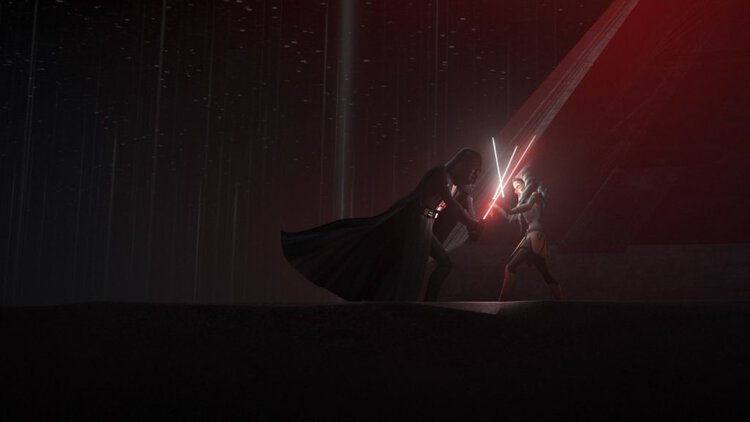
This becomes even clearer when Ahsoka meets Vader on Malachor in Star Wars Rebels. She damages his mask, sees his face, and tells him she will not leave him again. Vader answers by continuing the fight. In Filoni’s discussion of their confrontation, the damaged mask and mixed voices join Anakin and Vader in one body, but the emotional connection still cannot make him stop.
Morai Shows That Ahsoka’s Light Survived
Vader’s eyes become visible when he looks toward the bird above him. That bird is Morai, a convor with a mysterious connection to the Daughter of Mortis who has long watched over Ahsoka.
Morai brings life into a landscape of death. Below her are the ruined cruiser, clone graves, broken helmets, and Ahsoka’s discarded weapon. Vader stands among the remains of the Clone Wars while a living symbol connected to Ahsoka circles overhead.
The visual meaning is still strong. Ahsoka’s light has survived beyond Anakin’s fall, even if Vader does not know it yet. He looks toward that light with Anakin’s blue eyes, then lowers the saber and returns to the Empire.

Why Luke Could Reach Him When Ahsoka Could Not
Ahsoka pulls Anakin’s past to the surface, but that past is exactly what Vader wants to destroy. It reminds him of shame, failure, and people he believes betrayed him. He turns those feelings into pain and anger because that is easier than accepting responsibility.
Luke offers something different. He knows Vader was once Anakin, but he is not asking him to return to the Clone Wars or rebuild the life he ruined. Luke gives him a future choice. He believes there is still good in his father and is willing to risk his own life on that belief.
That is why the finale can show Anakin’s blue eyes without starting his redemption. Ahsoka’s saber exposes the man under the mask, but Vader is not ready to choose that man. Luke will later give him a reason to make one final selfless choice.