
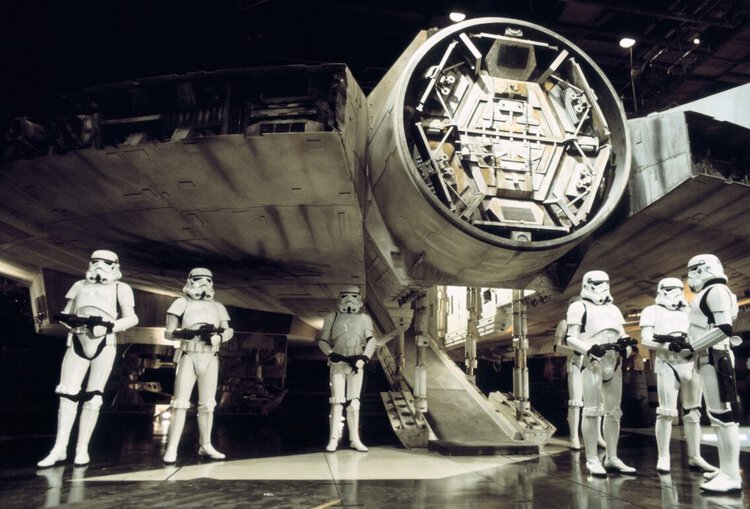
At first glance, it does look ridiculous. The Death Star has officers, technicians, gunners, pilots, droids, and enough control panels to keep half the Empire busy, yet armed stormtroopers are still pacing spotless corridors, standing beside doors, and watching intersections where nothing seems to be happening.
But that is exactly what security looks like during the ninety-nine percent of the shift when it is working.
The Death Star was not an Imperial office building. It was a mobile battle station, a prison, a naval base, a hangar complex, a command center, and a planet-killing weapon. Stormtroopers were not marching around because Darth Vader needed hall monitors. They were the station’s mobile armed garrison: guarding restricted areas, controlling movement, responding to alarms, searching ships, protecting prisoners, and being ready for the sort of infiltration that actually happens in A New Hope.
The Question Sounds Fair Until You Remember What the Death Star Is
The quiet hallways can fool us because the movies show the Death Star from the inside. Visually, it sometimes resembles a very large, very severe government building. From the outside, however, it is the Empire’s ultimate weapon: a moon-sized mobile battle station capable of destroying a planet.
That makes every hangar, detention level, tractor-beam control, communications room, power junction, weapons station, and command corridor part of a military installation. Some areas need permanent sentries. Others need walking patrols. All of them need an armed force that can move toward trouble without pulling pilots out of cockpits or technicians away from the machinery keeping the station alive.
Put another way: the people operating the Death Star cannot also be the people securing every doorway. A superlaser technician abandoning a console to investigate a suspicious noise would be a much stranger use of Imperial resources than assigning a trained trooper to patrol.

The Death Star Had Real Threats Inside Its Perimeter
The Empire had several reasons to worry about internal security, and “a random officer might get rowdy” is nowhere near the top of the list.
First, this was the most valuable military target in the galaxy. The Rebel Alliance had just proven it could penetrate a supposedly secure Imperial facility on Scarif and steal the Death Star plans. Those plans contained the station’s design history and the reactor flaw that would ultimately destroy it. Espionage and sabotage were not paranoid hypotheticals. They had already happened.
Second, the station held high-value prisoners. Princess Leia was not a drunken crew member waiting for the Imperial equivalent of military police. She was a captured senator and Rebel leader whom Vader and Tarkin were interrogating for the location of the Rebel base. A detention level holding someone that important needs guards, access control, reinforcements, and patrol routes around it.
Third, the Death Star had enormous hangars receiving ships, supplies, crews, prisoners, and equipment. Any large military facility with that much movement creates opportunities for smuggling, stolen credentials, hidden weapons, disguised infiltrators, and unauthorized access. The station’s own tractor beam could bring an unknown vessel directly inside the perimeter. That is precisely what happened to the Millennium Falcon.
Finally, a battle station can suffer boarding actions, fires, explosions, hull damage, and local system failures. A corridor that is perfectly calm at 10:00 can become a combat zone at 10:01. Security personnel have to be in position before the emergency, because “send someone after the shooting starts” is not a security plan.

A New Hope Is Basically a Demonstration of Why the Patrols Exist
The strongest evidence is not buried in a technical manual. It plays out on screen.
When the Death Star captures the Millennium Falcon, stormtroopers surround the ship and search it. The search initially fails because Han Solo has hidden everyone in smuggling compartments, not because searching a mysteriously empty ship is pointless. Han then lures two troopers aboard and overpowers them. Luke and Han steal their armor, which lets them move through the station without being immediately identified as intruders.
That disguise only works because uniforms and controlled movement matter. If nobody watched corridors, doors, or checkpoints, there would be no reason to dress as stormtroopers in the first place.
The rescue at Detention Block AA-23 makes the case even more clearly. Luke and Han cannot simply walk in, collect Leia, and leave. Personnel challenge them. The situation turns into a firefight. Alarms spread through the station. Troopers respond to the detention area, pursue the escapees through corridors, and force the group into the trash compactor. Elsewhere, troops investigate the tractor-beam disruption and chase the Rebels back toward the Falcon.
Did Imperial security fail? Absolutely. The station was overconfident, its procedures were exploitable, and the Rebels benefited from nerve, luck, stolen armor, and Obi-Wan Kenobi quietly sabotaging the tractor beam. But a security system being beaten does not prove the mission was unnecessary. It proves the threat was real and the system was not good enough.

Not Every Imperial Aboard Had the Same Job
One source of confusion is that the Death Star is full of people wearing different versions of “Imperial-looking uniform,” so it is easy to treat them as one interchangeable workforce. They were not.
Officers commanded. Technicians maintained systems. Weapons crews operated the superlaser and other armaments. Pilots flew TIE fighters. Gunners manned stations. Imperial Navy personnel handled shipboard and operational duties. The black-uniformed personnel commonly called Death Star troopers were elite Navy troopers; official material describes them as helping pilot the battle station and fire the superlaser, while Canon reference material also places them in prisoner-guard duties.
Stormtroopers, meanwhile, were the Empire’s elite shock troops. On a battle station, that made them the obvious mobile combat force when a ship needed to be searched, a prisoner had to be secured, a restricted sector had to be guarded, or an alarm needed an armed response.
There could be overlap. The Empire also used Navy troopers and specialized security troops as guards, sentries, and law-enforcement personnel. Stormtroopers could enforce Imperial rule and discipline when ordered. But “they are the police for misbehaving officers” is too narrow. A corridor patrol aboard the Death Star is better understood as garrison and shipboard security than as a squad waiting to write Grand Moff Tarkin a citation.

Why Wear Full Armor Indoors?
Because the armor was their standard duty equipment, not a costume reserved for outdoor battles.
The official Star Wars Databank describes stormtrooper armor as offering survival equipment and temperature controls. Canon reference material gives the helmet communications and filtration functions, while the plastoid plates provide protection against environmental hazards, impacts, fragments, and some lower-power or glancing fire. It does not make a trooper invincible, and it should not be treated as a guarantee against a direct blaster hit. It also should not be casually described as an unlimited vacuum suit; extended exposure can require additional equipment.
Even with those limits, the practical advantages are obvious. A patrol already wearing armor can respond immediately to blaster fire, smoke, damaged systems, sudden decompression risk, or an intruder alert. The helmet provides communications and makes every trooper instantly identifiable. Standardized equipment also means commanders know what their response force is carrying without assembling a new loadout every time an alarm sounds.
There is an intimidation benefit too. The anonymous white armor turns individual recruits into a uniform symbol of Imperial power. That is useful on occupied worlds and aboard a station packed with conscripted personnel, prisoners, visiting crews, and officers who all understand what a stormtrooper patrol represents. Still, intimidation is an added effect. The basic reason for the armor is simpler: these troops are on armed duty.
