
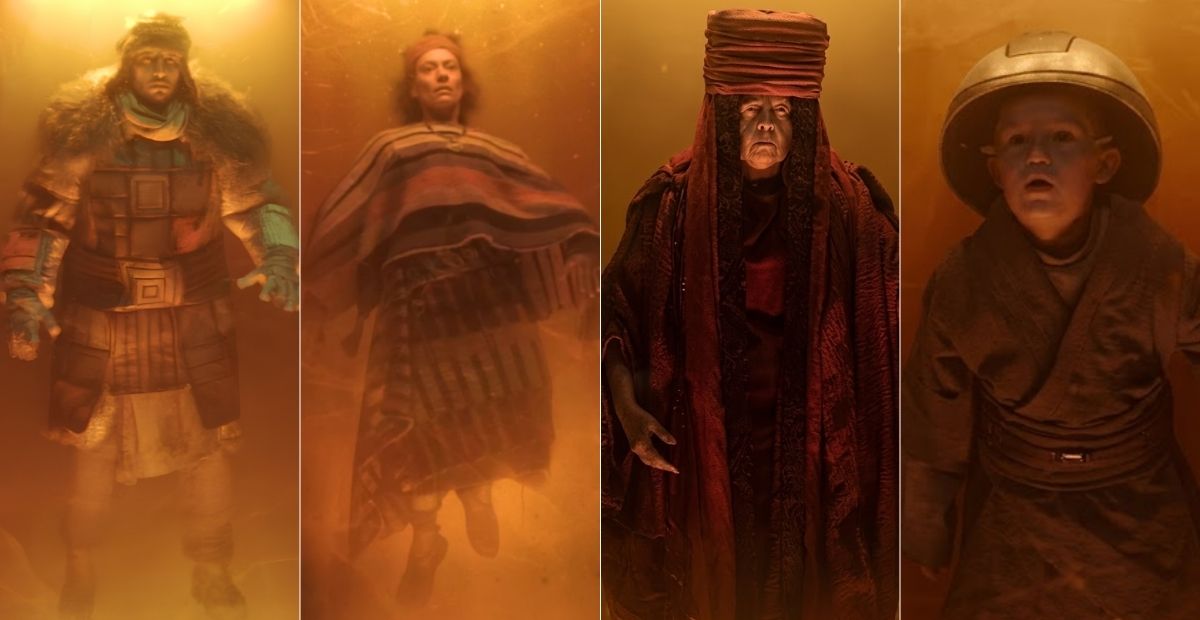
When Obi-Wan enters the lower level of Fortress Inquisitorius, the bodies do not look like normal corpses. They are sealed upright in amber-like displays, with no obvious lightsaber cuts, no blaster marks, and no visible wounds.
If the Inquisitors killed them in combat, the bodies should show damage. If stormtroopers shot them, there should be marks. And it is hard to imagine the Empire dressing them in clean clothes just to hide the wounds.
So were these Jedi already dead when the Empire preserved them, or were they kept alive in some kind of stasis?
They Were Dead, Not Frozen Alive

The bodies in Fortress Inquisitorius look confusing because they do not look like normal corpses. They are standing upright inside amber-like displays, with clean clothing and no obvious wounds. There are no visible lightsaber cuts, no blaster marks, and no clear damage showing how they died.
That is where the frozen-alive idea comes from. If these Jedi were killed in combat, the bodies should show some sign of it. If stormtroopers executed them, there should be burns or shot damage. The scene does not show that.
But when we look closer, the room does not work like a stasis chamber. There are no life-support systems attached to the bodies. No breathing tubes. No medical equipment. No monitors. No controls showing that the people inside are still alive.
Obi-Wan also gives the clearest clue when he sees what is hidden under the fortress. He says, “This place isn’t a fortress. It’s a tomb.”
That line changes how the scene should be read. The Empire was not keeping these Jedi alive for later. Their bodies were preserved after death and displayed inside Fortress Inquisitorius.
So even though they look frozen, they were not frozen alive. They were already dead.
Some Of The Bodies Have Names
Not every body in the tomb has been identified, but a few of them have names.
The most recognizable one is Tera Sinube. He was the old Jedi Master from The Clone Wars who helped Ahsoka recover her stolen lightsaber in the Coruscant underworld. Seeing him in the tomb changes the scene because he was not just a random Jedi body in the background. He was someone viewers had already met during the Clone Wars.
Another body was identified as Velerie Tide. She survived Order 66 and hid on Athio III during the Jedi Purge. The Empire eventually discovered she was Force-sensitive and captured her. That means the tomb was not only filled with Jedi killed during the first night of Order 66. Some of them were survivors hunted down later.
There was also a youngling named Faris. He is shown wearing a youngling training helmet, the same kind associated with Jedi children during training. That detail makes the tomb worse because the Inquisitorius was not only collecting fallen Jedi Knights or Masters. Children were also among the victims.
Dead Jedi Could Still Be Used To Trap Survivors
The Inquisitors kept dead Jedi inside the fortress like proof of their work. Anyone who found that chamber would see what happened to the survivors of Order 66. Masters, Knights, hidden Force-sensitives, and even children all ended up behind the same walls.
The second purpose was fear. The Empire wanted the Jedi erased, but it also wanted the survivors to know there was no safe ending. If they ran, the Inquisitors would find them. If they were captured, even death would not give them peace.
The third purpose was bait. Luminara Unduli shows how far the Empire was willing to go. She had already been executed, but the Empire used the idea that she was still alive to lure other Jedi into a trap.