
Anakin Skywalker had the highest midi-chlorian count the Jedi had ever seen. Years later, he stood beside Palpatine as Darth Vader, feared across the galaxy but still serving another Sith. Between those two moments came Mustafar and the reconstruction that kept him alive. The strange part is what that reconstruction could replace, and what it could not.
Midi-Chlorians Live In Cells, Not Mechanical Limbs
The detail starts with Qui-Gon’s explanation in The Phantom Menace: midi-chlorians reside within living cells. They are microscopic life forms that live alongside their hosts and communicate the will of the Force. They are not the Force itself, and they are not simply a substance carried around in blood.
That makes Vader’s transformation more significant than a change of costume. His replacement limbs could restore movement and let him hold a lightsaber. His respirator could keep air moving through damaged lungs. Neither was a replacement for the living tissue he had lost.
Anakin’s blood test had produced a reading over 20,000, higher than even Yoda’s. Qui-Gon later described the concentration inside Anakin’s cells as the highest he had ever seen. The boy had an extraordinary natural connection to the Force before anyone taught him how to use it.

That reading was a promise, not a finished achievement. Nine-year-old Anakin was not already a better Jedi than Yoda. He had the biological foundation for exceptional power, but still needed to develop it through training. Mustafar happened before that development could run its full course.
The missing-limb explanation concerns the loss of living tissue that hosted midi-chlorians, not proof that the concentration in every surviving cell dropped. There is no later blood reading in this explanation that lets us subtract a number from Anakin’s childhood result. The connection between bodily loss and his reduced future power comes most directly from George Lucas.
Lucas Linked Vader’s Lost Power To His Damaged Body
In a 2005 interview with Vanity Fair, Lucas described the future Anakin was supposed to have: “Anakin, as Skywalker, as a human being, was going to be extremely powerful.”
Then he connected the injuries and mechanical reconstruction to a limit on that future:
“So a lot of his ability to use the Force, a lot of his powers, are curbed at this point, because, as a living form, there’s not that much of him left.”
That is the strongest support for the headline’s idea. In Lucas’s explanation, the damage did not merely slow Anakin down or force him to change his fighting style. It restricted how powerful he could become through the Force itself.
Lucas also explained midi-chlorians in that interview as connectors between living cells and the Force. Read together, those remarks give the biological detail its importance: machinery could preserve Anakin’s life without restoring everything his original living body offered him. The films establish the cell connection; Lucas’s commentary supplies the explicit lost-power connection.
His comparison was striking. Anakin’s ability to be “twice as good as the Emperor” disappeared, leaving Vader “maybe 20 percent less than the Emperor.”
Palpatine had recruited someone with the potential to surpass him. After Mustafar, he had an apprentice Lucas described as falling short of him instead. The intimidating armor concealed the loss of the much greater Sith Anakin might have become.
Mustafar Destroyed More Than Anakin’s Remaining Limbs
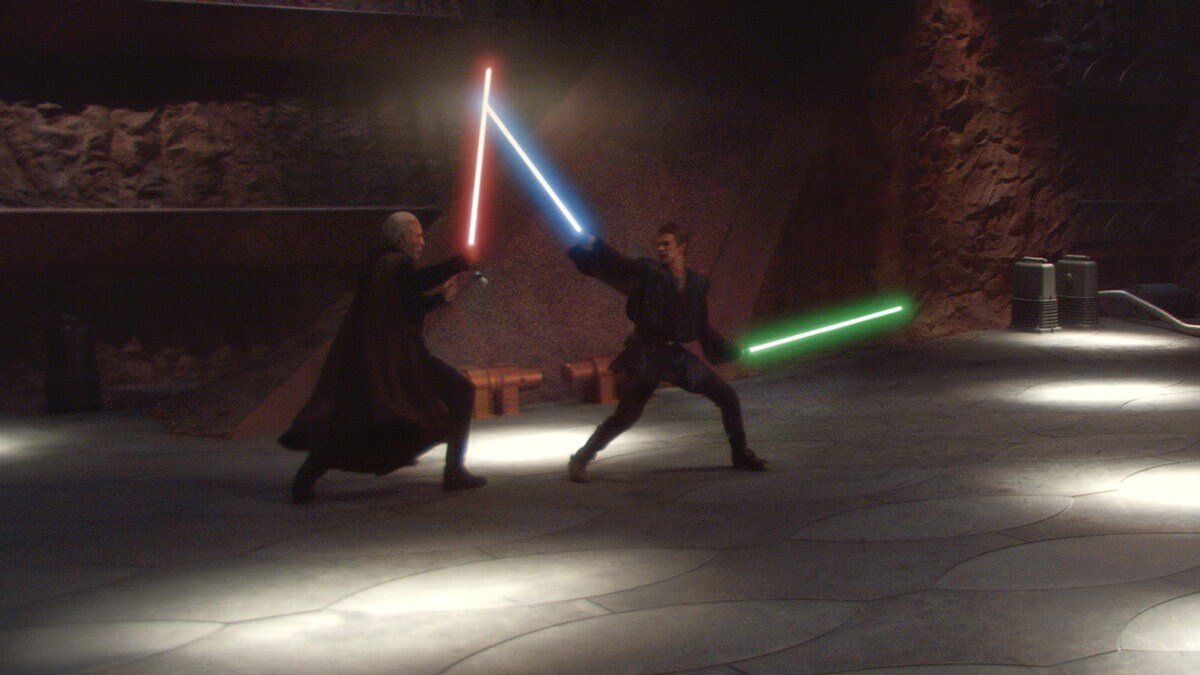
Anakin’s right forearm was already mechanical when he fought Obi-Wan. He had lost it to Count Dooku on Geonosis, then continued to grow into a formidable Jedi during the Clone Wars. One replacement arm had not ended his progress.

Mustafar was a much greater injury. Obi-Wan severed both legs and Anakin’s remaining organic arm. The fire then burned the body left behind, causing damage severe enough to reach his internal organs. Palpatine rescued a man whose injuries would otherwise have killed him.
The life-support systems in Vader’s suit show how much had changed. His mask helped his sensitive lungs take in and vent air. It also assisted his weakened vision and regulated his body temperature. Armor protected his damaged chest and abdominal organs.

The reconstruction supported a severely damaged body. That broader destruction fits Lucas’s explanation far better than treating each lost limb as a fixed deduction from a power score.
Anakin’s Full Power Was Still Ahead Of Him
The important comparison is Vader against a fully developed, uninjured Anakin, not necessarily Vader against the young man who entered the Mustafar duel. Anakin had defeated Dooku and become one of the Republic’s strongest Jedi, but Lucas still described greater power waiting ahead of him.
That also explains why Vader’s later victories do not erase the loss. Years of fighting could make him more experienced and more effective against particular opponents without restoring the future Lucas envisioned. He could improve as a Sith while remaining below the ceiling Anakin originally had.
Palpatine’s interest in Luke follows the same logic. Lucas connected Luke’s arrival to the Emperor’s opportunity to obtain the powerful apprentice Vader could no longer become. Vader remained useful, but his son offered another chance at the exceptional potential Palpatine had wanted.