
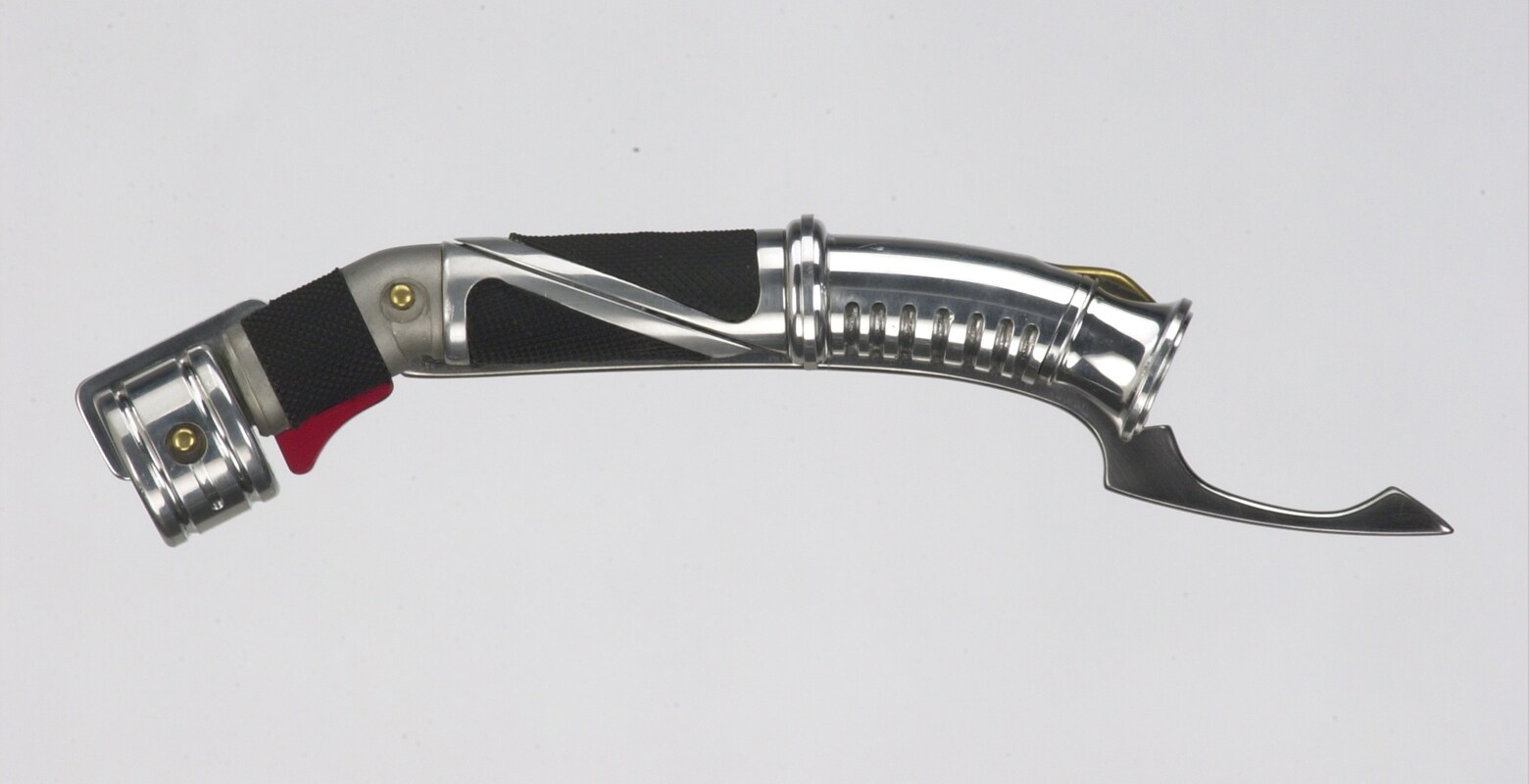
Count Dooku’s lightsaber looks like someone bent a normal hilt and decided to keep it. Next to Obi-Wan’s or Anakin’s weapon, that curved silver handle stands out almost as much as its red blade. It even has the silhouette of a long utility lighter. But where did Dooku get it, and why would one of the galaxy’s best swordsmen choose something so unusual?
The Curve Gives Him More Precise Control
Dooku’s curved hilt helps him slash and lunge with greater precision. The bend is deliberate, not battle damage, and it serves the person holding the weapon rather than changing the shape of the blade.
His greater precision matters because a lightsaber duel is not just about swinging hard. A small adjustment can move a blade around an opponent’s guard or put its tip exactly where the attacker wants it. Dooku favors that kind of controlled movement.
Think of the difference between holding a straight handle and one shaped around a particular grip. The angle changes how your hand sits relative to the tool. In Dooku’s case, the lightsaber is tailored to the way he directs his attacks, especially when he fights with one hand.
That does not mean the curve makes the blade hotter, stronger, or impossible to block. Nor does it prove that every Jedi would fight better with one. The useful advantage is finesse and blade control, paired with a swordsman who knows how to use it.
The red blade still extends straight from the emitter. The unusual part is the handle beneath it, where the weapon meets Dooku’s hand.

Dooku Made It While He Was Still A Jedi
Dooku did not receive the curved lightsaber as a welcome gift from Palpatine. He constructed it himself, replacing the earlier lightsaber he had carried as a Padawan with a more personal design during his Jedi career.
Its original blade was blue. That makes the shape especially interesting: what looks like a sinister Sith weapon in the films began as a Jedi’s custom equipment. The curve belonged to Dooku’s approach to swordsmanship before it became associated with Darth Tyranus.
In Tales of the Jedi, the younger Dooku already carries a curved-hilt, blue-bladed saber. He does not suddenly discover the design after leaving the Order. It is part of the identity he takes with him.

When he becomes Sidious’s apprentice, Dooku reassembles and modifies his personal weapon, eventually giving it the red blade seen in Attack of the Clones. He changes its appearance and allegiance without abandoning the grip that suits him.
There is also a useful wrinkle in the timeline. His blade is still blue when he fights Yaddle in Tales of the Jedi, despite his dark-side involvement. Blade color is not an instant status indicator that changes the moment a Jedi betrays the Order.
His Fighting Style Makes The Shape Make Sense
Dooku specializes in Form II, also called Makashi. It is a lightsaber-dueling style built around careful, controlled strikes rather than simply overpowering an opponent with heavy swings.
That explains why his battles feel closer to fencing than to a brawl. He often keeps his movements compact, fights one-handed, and waits for an opening instead of throwing his whole body into every strike. A hilt designed for precision fits that approach.
His duel with Obi-Wan on Geonosis is a clear example. Dooku does not need to batter him endlessly. He finds openings and wounds Obi-Wan’s arm and leg, putting him out of the fight. Against Anakin, he eventually severs the younger Jedi’s arm. These are targeted attacks, not proof of a special cutting-power boost hidden in the handle.
The same battle also shows the limit of the design. Dooku defeats Obi-Wan and Anakin, but cannot overcome Yoda. His curved saber gives him a weapon that suits his skill, not a guarantee of victory.

Legends Gives The Design A More Specific Historical Link
In Legends, Dooku deliberately studies older curved-hilt designs from Form II’s heyday in the Jedi Archives. He chooses a shape that fits his hand and improves precise blade control rather than following the style fashionable among other Jedi.
That older account adds a nice detail: he is not just being eccentric, he is looking back at equipment associated with the discipline he values. It also describes a dual-phase feature that can shorten the blade for close combat. Those specific mechanics belong to the Legends version and should not automatically be attached to the current-canon weapon.
The basic pairing of Dooku, Makashi, and a precision-focused curved hilt is present in current canon. The detailed old-design explanation is a separate layer of the weapon’s history.
The Movie Prop Was Inspired By A Filipino Sword
Outside the story, Dooku’s lightsaber has a surprisingly concrete origin: a traditional Filipino barong.
During work on Attack of the Clones, art department assistant Roel Robles brought his collection of Filipino and other Asian fighting swords into the studio. Robles practiced Filipino martial arts, and the collection gave the designers real weapons to examine while developing something different for Dooku.
George Lucas reviewed the swords and chose the barong, a weapon with a curved wooden handle and a short, hefty blade. That handle helped inspire the lightsaber’s distinctive shape.
Concept artist Dermot Power had already been exploring a curved lightsaber hilt independently. Robles and Power worked together to refine the design into the version Lucas wanted. So the finished prop came from both a real-world weapon reference and the art department’s own development work.

Christopher Lee’s performance makes the fencing connection feel natural. Dooku carries himself like an experienced, formal swordsman, and the curved weapon looks right in his hand.
Curved Hilts Are Unusual, Not Exclusive To Dooku
Asajj Ventress is the clearest comparison. During the Clone Wars, she wields two red-bladed, curved-hilt lightsabers similar in style to her master’s. She can use them separately or join them into an S-shaped double-bladed weapon.
That alone shows the curve is not a one-off piece of technology only Dooku can operate. Ventress uses the same broad design idea in a much more aggressive two-weapon approach.

Curved hilts are not a Sith-only feature, either. Dooku carried one as a Jedi, and Ahsoka’s later white-bladed lightsabers also have curved handles, though their profiles look different from his.
What makes Dooku’s version memorable is how closely it matches him. He is controlled, proud, and particular about how he fights. His weapon looks custom because it is custom, not because every other lightsaber builder forgot that handles could bend. The utility-lighter resemblance is funny, but the design belongs to a serious duelist.